Dagestan: History, Mysteries, and Legends

For Browsing

The role of Dagestan at all stages of history has been largely determined by its geographical location. The Transcaucasian Caspian route, as part of the Silk Road, facilitated connections at various times between Eastern Europe and the countries of Transcaucasia and the Near East, the Far East, and even India. It is a melting pot of civilizations and cultures that have left their marks not only in the form of monuments but also through the dozens of peoples who continue to inhabit this unique region.

Ekranoplan "Lun" - Caspian Monster

W9RH+8F Arablar, Republic of Dagestan, Russia

One of the projects of new and promising weaponry created in the 1980s was the ekranoplan "Lun." Abroad, these aircraft were admired for their interesting appearance and feared for their capabilities. Due to changes in the country, there was an attempt to convert the ekranoplan "Lun" from a ship destroyer into a rescue vehicle, but later it was completely abandoned and left to fate at one of the factories.

Caspian Fort Boyard - Workshop 8 of the Dagdiesel Plant

VP85+RM Turali 4th, Republic of Dagestan, Russia

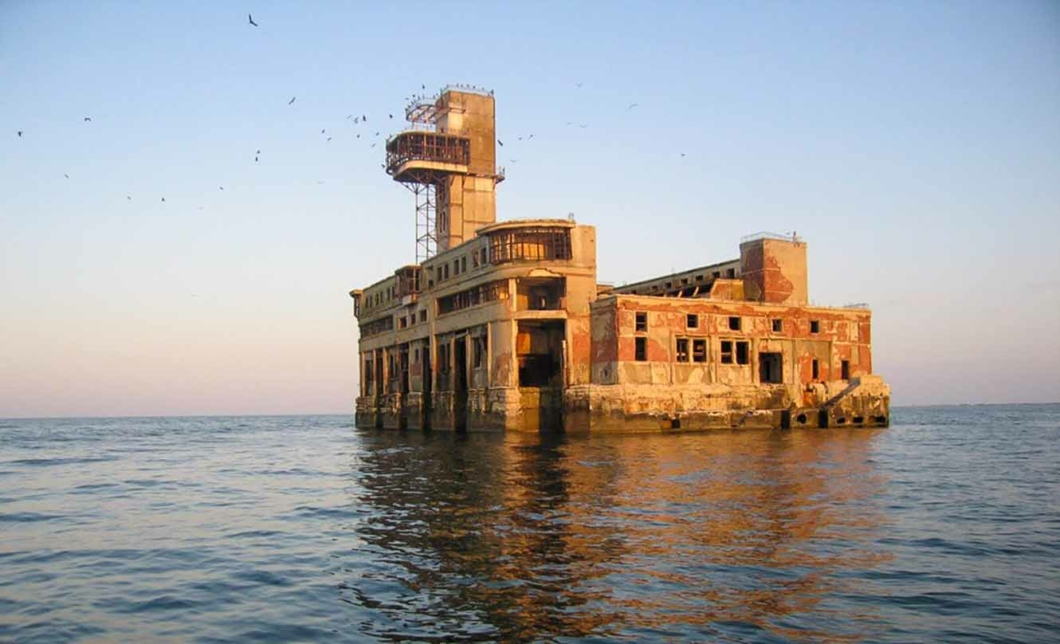
The most incredible building of the Soviet avant-garde is located in the Caspian Sea, 2.7 kilometers from the shore. This artificial island has become a kind of calling card for the Russian part of the Caspian Sea. Initially shrouded in secrecy, it now patiently awaits the decision of its fate.

Caucasian War, Gimrinskaya Tower - the leap of Imam Shamil

PVWF+XP Gimry, Republic of Dagestan, Russia

Not far from the village of Gimry stands a stern defensive tower known as the Gimry Tower. It was built for the defense of the aul by Ghazi Muhammad and his murids, among whom was Shamil, after the defeat at Khunzakh in 1830. The Gimry Tower is believed to be a witness to the death of Ghazi Muhammad – the first Imam of Dagestan.

Caucasian War, Storming of Akhulgo

FC7V+H9 Takunzakkuli, Republic of Dagestan, Russia

The mountaineers, despite the inevitable death, refused to surrender at all costs and defended themselves with frenzy: women and children, with stones or daggers in their hands, threw themselves onto bayonets or, in despair, threw themselves into the abyss to certain death. It is difficult to depict all the scenes of this terrible fanatical battle: mothers killed their own children with their own hands, just so they would not fall into Russian hands; entire families perished under the ruins of their huts. Some of the murids, exhausted from wounds, still wanted to sell their lives dearly: even while surrendering their weapons, they treacherously dealt death to those who tried to take them.

Caucasian War, Assault on Akhulgo - Surkhaev Tower

QPCW+Q2 Ashilta, Republic of Dagestan, Russia

Having studied the area, General Grabbe decided that, first and foremost, it was necessary to capture the Surkha Tower. On June 12, siege operations began. Batteries were set up in five locations. Due to the lack of soil, the gun platforms were filled with stones. Moreover, transporting the cannons to various locations was an incredible challenge. In some places, the road had to be carved directly into the rocks.

Gunibsky (Tsarsky) Tunnel

CW7G+86 Gunib, Republic of Dagestan, Russia

Gunib Tunnel, or the Tsar's Tunnel, as it is called by the locals. Year of construction: 1866-1867. Length: 103 meters, height: 6 meters, width: 4 meters. The tunnel was built (carved out by hand) for strategic and communication purposes by Russian soldiers and local residents.

Sarykum Dune - nature, Dumas, White Sun of the Desert, and more

265J+43 Khumtop, Republic of Dagestan, Russia

The first mention of the Sarykum dune is found in the book by the famous French novelist Dumas, published in Paris in 1861, titled "The Caucasus from Prometheus to Shamil."

Kum-Torkale Station

263Q+73 Burlavai, Republic of Dagestan, Russia

The remains of the abandoned Kum-Torkale railway station are located at the foot of the Sarykum sand dune in the Kumtorkalinsky district of Dagestan. It once belonged to the now-vanished village of Kum-Torkale. The village was completely destroyed in 1970 by a strong earthquake.

Pushkin-Tau (Izbergtau)

R. Zorge, 40a/1, Building 1, Entrance 1, 4th floor Izberbash, Republic of Dagestan, Russia, 368500

Pushkin-Tau (Izbergtau) is a mountain located in the vicinity of the city of Izberbash. It stands at an altitude of 220 meters above sea level. Pushkin-Tau is a combination of many rocks that overlap each other, and only from one specific spot can the profile of the great poet A. S. Pushkin be clearly seen.

Cavalier Battery Rock or Tamerlane Rock

32 Zulpukarova St., Buynaksk, Republic of Dagestan, Russia, 368220

The Cavalier-Battery Rock, formerly known as Tamerlane Rock, is one of the landmarks of Buynaksk (Temir-Khan-Shura). The conqueror's tent stood on it, and Tamerlane could see the entire surrounding area, while his guards could see all threats. From here, he sent punitive expeditions to the mountains of Dagestan.

Saltinsky Underground Waterfall

93Q8+QR Silta, Republic of Dagestan, Russia

The Saltinsky Underground Waterfall is the highlight of Dagestan, a true wonder of nature hidden from prying eyes deep within the planet's interior. Located in the canyon of the Saltinka River, it is recognized as a natural monument of regional significance.

Shamil's Gazebo or Baryatinsky's Rotunda

9WWP+8X Gunib, Republic of Dagestan, Russia

Monument to the people's feat in the Caucasian War, the place where the final point was set in the Caucasian War in 1859. At this site, negotiations took place between Imam Shamil and Prince Baryatinsky.

The Gimry Road Tunnel is the longest road tunnel.

Gimrinsky Road Tunnel, Republic of Dagestan, Russia

The Gimrinsky Road Tunnel is the longest road tunnel in Russia. Located in Dagestan, it connects Buynaksk and the village of Gimry, providing the shortest and weather-independent transportation link for the construction of the Irganayskaya Hydroelectric Power Station, as well as for nine districts of mountainous Dagestan to the railway and the republic's center. The length is 4,303 meters.

A wooden bridge without a single nail

WRVM+JC Shile, Republic of Dagestan, Russia

In the Dagestani village of Gulli, there is a mysterious wooden bridge that bears the weight of centuries. Less than a hundred kilometers from the tourist city of Derbent, on the road leading to the Khanag Waterfall, lies the equally charming village of Gulli, where people come to see the wooden bridge that carries the burden of centuries. It is thrown over a small and shallow tributary of the Khanag-Chay River. The bridge is reliably constructed: once oxen with carts passed over it, and today it can support a passenger car.

The Fortress of Seven Brothers and One Sister or Khuchnin Fortress

village, Khuchni, Republic of Dagestan, Russia, 368650

The fortress of seven brothers and one sister, also known as Khuchninskaya, Yagdygskaya fortress, is part of the defensive system (the Caucasian Wall) that protected the local inhabitants of Dagestan from nomadic invasions. It was built in the 7th–8th centuries. It is a continuation of the Derbent fortress, whose construction took place from the 6th to the 16th centuries.

Kubachi - a famous village of jewelers and gunsmiths

3JM3+PM Kubachi, Republic of Dagestan, Russia

One of the largest traditional centers of metalworking in the Caucasus, as well as stone and wood carving. Known since the early Middle Ages for the production of chainmail and weapons.

Akhtyn Fortress

FP9Q+CW, Akhty, Republic of Dagestan, Russia, 368730

Akhtynskaya Fortress (Lezgian Akhtsegh-Kyele) is a Russian fortress in Dagestan, located in the village of Akhty in the Akhtynsky District, built in 1839 by General Golovin. It is a historical and architectural monument of federal significance. The southernmost fortress on the territory of Russia.