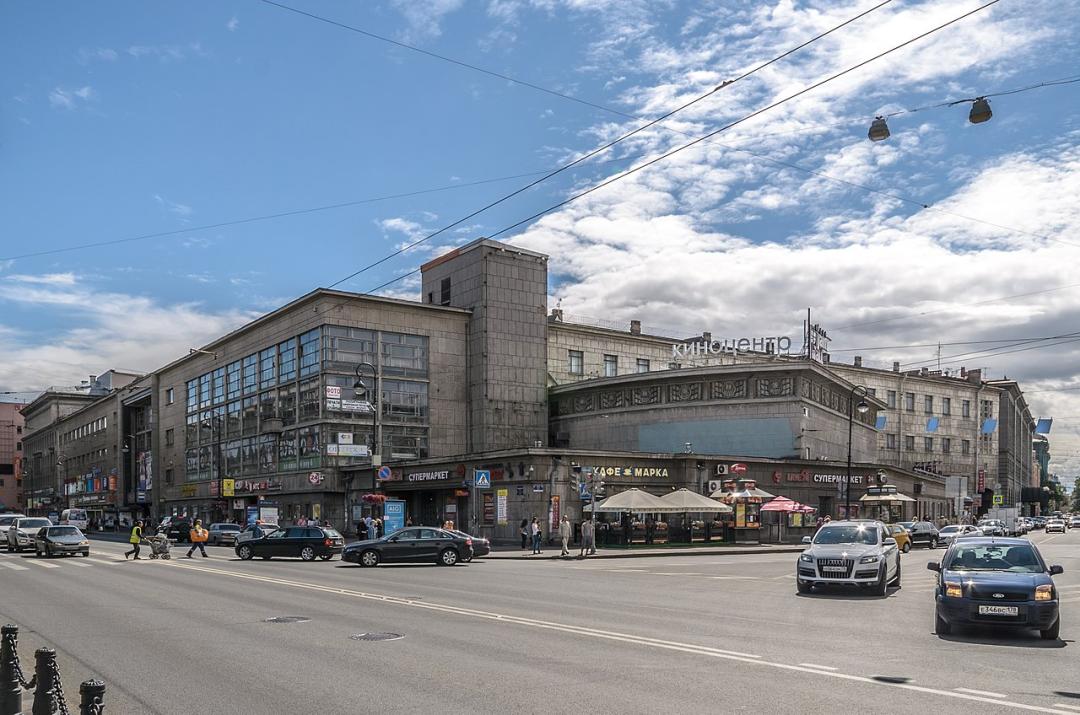

Previously, on this site in 1910, architects Belogrud and Ginger, with the participation of Sysoev, built the "Sporting Palace" of the Bashkirov brothers—Alexander and Nikolai—who were millers (the part facing the street has not survived, the rest was incorporated into the existing building during reconstruction). It housed the city's largest cinema, a restaurant, and a concert hall, but the main feature was the roller-skating rink—the "skating ring."
The current building was constructed between 1931 and 1938 based on a design by Levinson and Munz. A reinforced concrete shell of the former Sporting Palace was integrated with a theater hall seating 2,200, featuring an orchestra amphitheater and two balconies, surrounded by a circular foyer. To improve acoustics, the ceiling of the hall was shaped like a horn. On either side of the theater hall along the avenue were planned club and sports zones. The sports zone with a swimming pool was designed to be located at house No. 40, but this wing was never realized. Above the entrance to the Palace of Culture is a bas-relief strip symbolizing theatrical art, music, and labor. To the right of the giant glazed portal were library rooms, distinguished by suspended glass panels spanning three floors and wrapping around the building’s corner. Behind this volume, a tower cuts into the 200-meter horizontal block on the north side, intended to serve as the vertical axis of the composition and the dominant feature of the avenue, similar to Trotsky’s Kirov District Council. According to the original design, it was supposed to rise 46 meters, but its actual height is 30 meters. Levinson tried to have the tower completed but without success. At the base of the tower, at the corner of the avenue and the adjacent square, there is a group of volumes of varying sizes, dominated by the small sector-shaped hall (cinema hall). The stucco decorations of the cinema stage portal were created by sculptor Gromov.

The original name was the House of Culture of Industrial Cooperation (colloquially called "Promka"). The current name, in honor of the Lensovet (then the Leningrad Council of Workers' Deputies), and the status of a palace of culture were assigned in 1960.
In April 1935, at the initiative of Marshak, the first Children's Book Festival was held in this building, which became a tradition. The building housed numerous clubs, studios, lecture halls, a library, a theater hall, a cinema, and a winter garden. The palace remained open even during the blockade.
Currently, part of the building is occupied by various shops and offices, while another part is still used by clubs and studios. Concerts, theatrical performances, and lectures are held here from time to time. In the part of the building facing Shevchenko Square (Malyy Prospekt of the Petrograd Side, 89), until 2014, there was the "Gem-Hall" cinema.
The building belongs to the Federation of Trade Unions of St. Petersburg and the Leningrad Region and was managed by the cultural institution "Palace of Culture named after Lensovet." At the end of February 2007, LLC "Palace of Culture named after Lensovet" was established, with 51% of shares owned by the Federation of Trade Unions and 49% by CJSC "Petrovsky Builder," part of the "KONRAD" group of companies. The new owners intended to complete the fifty-meter tower designed by Levinson but never realized; however, this project faced public criticism and was not approved by KGIOP (Committee for State Control, Use and Protection of Historical and Cultural Monuments).
Construction of the House of Culture of Industrial Cooperation (now the Palace of Culture named after Lensovet) began in 1931. The project was created by architects Levinson and Munz. A large and very important site at the corner of Kirov Avenue and Shchors Avenue was allocated for construction. Before the revolution, a large building of the Skating Ring—a roller-skating rink—stood here. It was in a neglected state. It was decided to convert the Skating Ring, originally made entirely of concrete and reinforced concrete, into the auditorium of the House of Culture, while the front part of the old building, directly facing Kirov Avenue, was demolished and replaced with a new multi-story building spanning the entire width of the site.
The House of Culture, one of the largest in Leningrad and comparable to the previously built Moscow-Narva and Vyborg districts, included: a theater hall for 2,200 spectators, a large cinema, two lecture halls, large exhibition and dance halls, a foyer, a library, and numerous club rooms.
The cinema hall was designed as an additional volume adjoining the corner part of the building. The corner location of the site also determined the asymmetry of the composition. A tall tower, introduced into the corner part of the building and built to roughly half its planned height, enhanced the asymmetry. The fact that the tower, which was supposed to contrast with the elongated blocks, was not fully built negatively affected the overall appearance of the building.
During construction, the project was partially modified, mainly to "enrich" the facades—a rustication was added, and a sculptural frieze was introduced above the main entrance. All this was due to the changing direction of Soviet architecture at the time, as mentioned above. In fact, the modern interpretation of the composition, sharp and expressive in its own way, did not need any decorative additions.
Unfortunately, the quality of finishing work in the House of Culture named after Lensovet left much to be desired. Poor plastering, wooden window frames, and substandard glass all worsened the building’s exterior appearance.
The architects successfully utilized the old concrete shell of the Skating Ring. They divided it transversely into three parts: the main middle part housed the auditorium, while the other two, semicircular in shape, contained the foyer and the stage. The predetermined width of the hall with a large number of seats resulted in an excessively elongated shape. However, its architectural decoration was successful. A large amount of wood of various species was used in the interior finish.

The long, horizontally articulated four-story building under one roof had a dull, monotonous appearance. It was proposed to change the design to give the building a more interesting exterior. Because of this, construction was extended until 1938. During the project revision, to avoid monotony, the architects cut the facade through its entire height with two large, deeply recessed stained-glass windows framed in black granite, and the northern corner of the building was decorated with continuous glazing. Above the northern corner of the large building, a 50-meter rectangular tower was to be constructed (according to the project), but this idea remained unrealized. Among the interior spaces, the theater is of greatest interest, for which the architects used the old walls of the huge sports hall, where the theater foyer, the auditorium for two thousand seats (including orchestra, amphitheater, and two balconies), and a large technically equipped stage were comfortably accommodated. Construction was completed at the end of 1938. The northern facade of the Palace of Culture named after Lensovet (until 1960—the House of Culture of Industrial Cooperation) faces Malyy Prospekt (formerly Shchors Avenue), on its odd-numbered side.
Sources:
https://ru.wikipedia.org/wiki/Palace_of_Culture_named_after_Lensovet




Written by Jermaine
Discuss this with the author and others
No comments yet. Be the first to start the conversation.