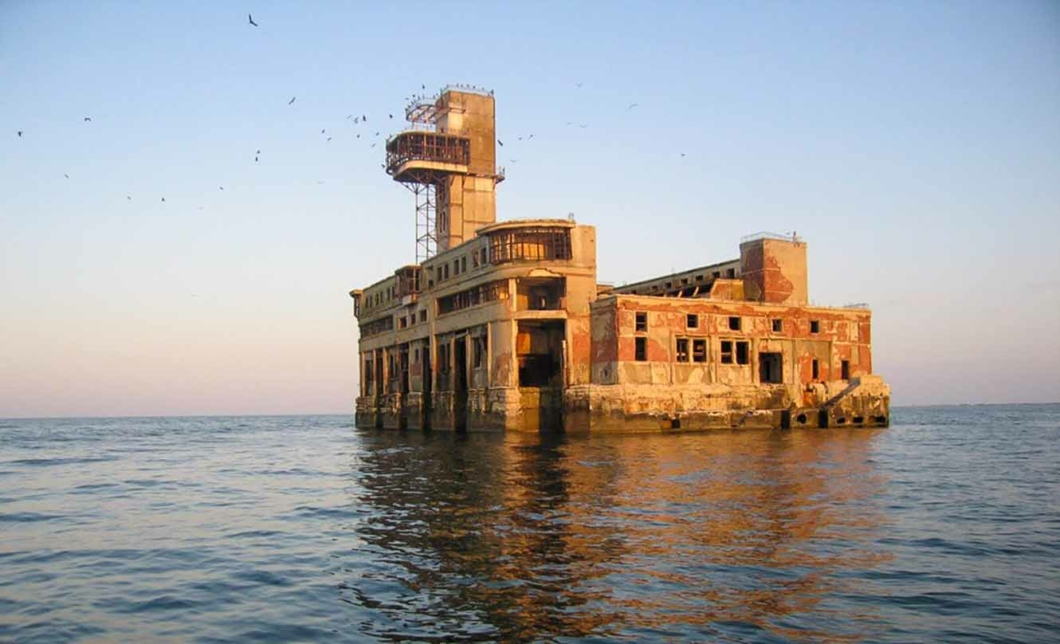

The most incredible building of the Soviet avant-garde is located in the Caspian Sea, 2.7 kilometers from the shore.
A bit of background. Torpedoes are expensive weapons. After assembly at the factory, a torpedo requires testing, called zeroing. On the finished torpedo, rudders responsible for depth and course are set at specific angles. Then it is fired from a torpedo tube. It must travel a set distance at a certain speed, at a specified depth, along the required course. Afterwards, special boats called torpedo catchers retrieve it. Torpedoes that pass the zeroing tests are handed over to the customer – the Navy. The Navy has special ships where all new types of naval weapons undergo initial testing. Some of these ships are equipped for torpedo testing. However, once torpedoes are produced in mass quantities, a special shore-based zeroing station becomes necessary.
In the 1930s, the Soviet Union did not have a stationary zeroing station. Considering the increasing production of torpedoes, it was simply essential. A meeting was even held with Stalin on this issue. Options for placing the station in the Caspian Sea were considered – near Baku or in Kaspiysk. The People's Commissar of Heavy Industry, Sergo Ordzhonikidze, proposed to build such a station in Kaspiysk. On one hand, Baku was close to the state border with Turkey and Iran. On the other hand, Kaspiysk – then the settlement Dvigatelstroy – was located in the ice-free part of the Caspian Sea, which was very important. The depths and hydrology were ideal for creating a torpedo zeroing station.
In the 1930s, near Kaspiysk, construction began on secret machine-building plant No. 182, which was to produce underwater weapons and diesel engines for ships and equipment. There were no suitable islands in the area, so it was decided to place the gigantic zeroing (testing) workshop directly in the sea for the first time in domestic history.
The project was led by engineer Alexander Dezortsev, who was educated in Europe and by that time had built the largest hydraulic structures, dams, and power plants in the USSR.
The technical solution of the building was unprecedented. On the shore, in an excavated pit on a wooden pavement within formwork, the massive workshop foundation, a "pontoon," a huge reinforced concrete "box" 14 meters high, was poured. Simultaneously with concreting the foundation, a 6-meter-high "cushion" of stones was piled up at the future island site 2.7 kilometers from the shore using special barges. Then the artificial dam separating the pit from the sea was destroyed, and the floating "box" was towed to the station construction site in February 1935. There, the "box" was filled with water and "set" on a pre-prepared platform of rubble stone. Construction of the station then proceeded in the usual way, with people and materials delivered by sea vessels. A construction report dated October 10, 1936, noted: "The giant reinforced concrete mass on the sea, on the prepared foundation, on which the main building will be constructed, has been installed. Construction work and equipment installation will be completed in 1937."
The construction faced incredible difficulties and delays – starting with the fact that only 35 people with two horses and a tractor began digging the huge pit, and ending with the impossibility of working blindly in murky water.
In January 1937, the under-construction workshop "A" was renamed workshop No. 8. The layout drawings of the above-water part of the eighth workshop were developed by chief engineer A. Dezortsev, project manager Akhtenshtein, senior engineer Matevosyan, and designer Parfenov. This workshop was commissioned in 1939. The inventory card listed: a building with an area of 5,189 sq. m, total volume of 26,000 cubic meters, installed on a reinforced concrete foundation, brick walls, reinforced concrete ceilings, parquet floors. Ultimately, the artificial island took on the appearance of a fantastic castle with a tower. Considering the harsh nature of the Caspian winter, the glass thickness was seven millimeters. In official secret documents, it was called the "pavilion" object.
There was an elevator that lifted to the observation tower located on the ninth floor. Since the Caspian weather was often rough and testers could be delayed for a long time due to storms, the right wing of the workshop on the upper floors housed a canteen, a hotel, and even a library. In the middle of the basement, in a large sports hall, workers played basketball and volleyball. To provide communication with workshop No. 8 and its servicing, northern and southern piers of the port, a pier, and a ship repair workshop were built on the shore.
The authors of the above-water part paid special attention to the architecture of the project. The striking silhouette of the workshop with a tall tower and a powerful observation platform overhang became a symbol of the city and was placed on the coat of arms of Kaspiysk. The carefully designed facades with rounded projections, "captain's bridges," and vertical ribbon windows suggest that the authors were well acquainted with European Art Deco and the new Soviet style – Constructivism. Until 1966, tests were conducted from time to time – old-type torpedoes were still being produced. In 1966, the workshop was closed but remained guarded. The zeroing station was moved to the settlement of Ordzhonikidze in Crimea. Workshop No. 8 was abandoned. Ten years later, in 1976, the guard was withdrawn. Upon withdrawal, all documentation was destroyed. Between 1978 and 1995, the Caspian Sea level rose, and waves began to destroy the reinforced concrete foundation of the artificial island. Kaspiysk housed the testing base of TsKB-19 – today the Central Design Bureau for Hydrofoil Ships named after Alekseev. They conducted tests of combat ekranoplans. Since the workshop formally remained on the balance sheet of "Dagdizel," testers used it to practice firing guns from ekranoplans. The tower was hit on one side and slightly tilted. Additionally, shells hit the torpedo ports – the gates from which torpedoes were fired. First, a fire broke out inside the workshop from the shots, then the incoming water began actively destroying the interior of the workshop.
At the end of the USSR era, a private individual offered to buy the workshop and organize a restaurant, hotel, and casino with its own pier. The plant, which owns the artificial island, agreed. But the still powerful KGB of the USSR was categorically against it.
The workshop No. 8 attracted the interest of maritime border guards – they needed an external observation post. But an insurmountable contradiction arose in this matter. Divers inspected the island's foundation. Their conclusion – the foundation is fully suitable for further operation. An expert commission that examined the buildings on the island concluded that their use was impossible. The border guards refused workshop No. 8.
Workshop No. 8 is a symbol of Kaspiysk, a symbol of "Dagdizel," and in a certain sense – a symbol of the Russian part of the Caspian Sea. Some call it the most mysterious object of the Caspian.
Sources:
https://welcomedagestan.ru/placepost/8-j-tseh-zavoda-dagdizel/
https://www.bankgorodov.ru/sight/ceh--8-zavoda-dagdizel
https://versia.ru/na-ostrove-poxozhem-na-srednevekovyj-zamok-ispytyvali-novye-torpedy
https://etokavkaz.ru/istoriya/kaspiiskii-fort-boyard-taina-kotoroi-ne-bylo
Written by Jermaine
Discuss this with the author and others
No comments yet. Be the first to start the conversation.