
On the facades facing the courtyard, the Miroir pour les infants de Challant is a series of frescoed heraldic arms. This cycle shows the diverse branches of the Challant family and their principal matrimonial alliances. It was created in order to preserve a record of the family history and to transmit it to future generations.
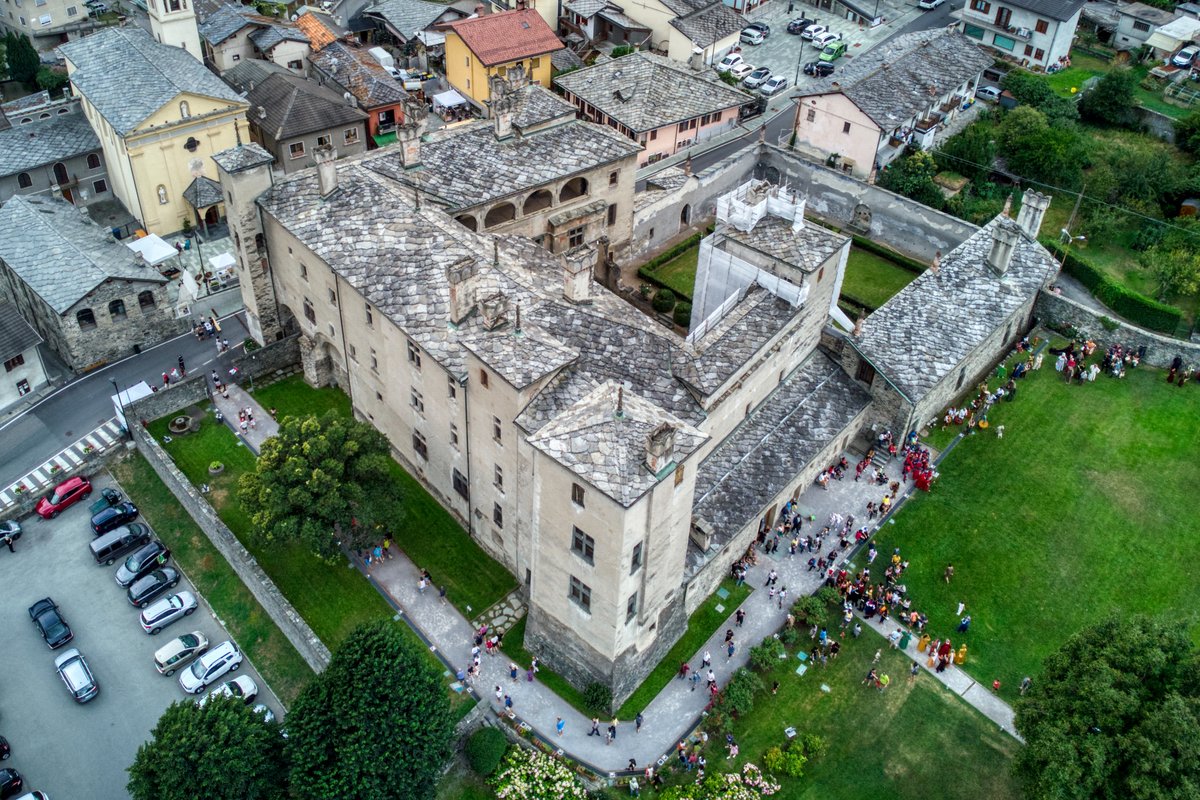
The castle has a long history, starting as a fortified building for the Bishop of Aosta. Tensions between the Bishop and the De Verrecio family reached a boiling point around 1333, when the castle was attacked and damaged by fire. By 1379, the bishop submitted to Yblet of Challant, who transformed the episcopal stronghold into an elegant princely residence in Gothic style. The castle eventually hosted illustrious guests, including the future emperor Sigismund of Luxemburg and King Charles VIII of France.
During the Renaissance, George of Challant-Varey erected new wings to connect existing buildings, unifying the complex into a single horseshoe shape surrounding a central courtyard. This period saw the addition of the decorations on the portico and the celebrated fountain in the form of a pomegranate tree. The portico, located on the east side of the courtyard, features a rare example of medieval Alpine painting with a frescoed cycle of scenes of daily life from the late Middle Ages. Under Philibert of Challant and his son René, the castle reached its greatest splendour and hosted a rich and refined court.
Today, the castle is no longer a private residence but belongs to the Aosta Valley region. Visitors can still see the old frescoes and the pomegranate fountain. The castle may be visited by guided tour.
Sources: Wikipedia, OpenStreetMap, Wikidata, Wikimedia Commons

Written by Nicolo Ciampini
Discuss this with the author and others
No comments yet. Be the first to start the conversation.