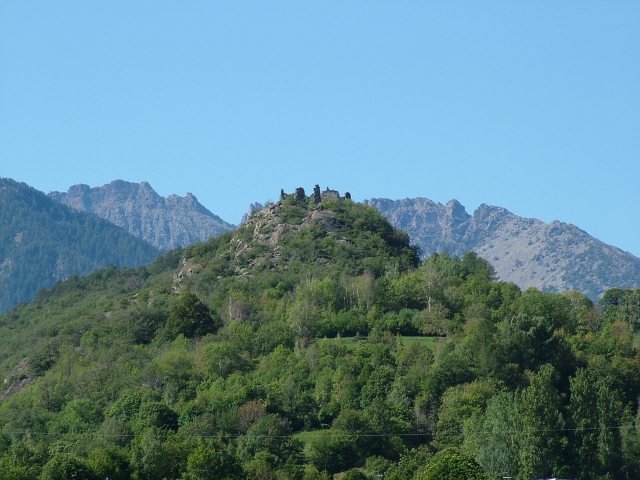

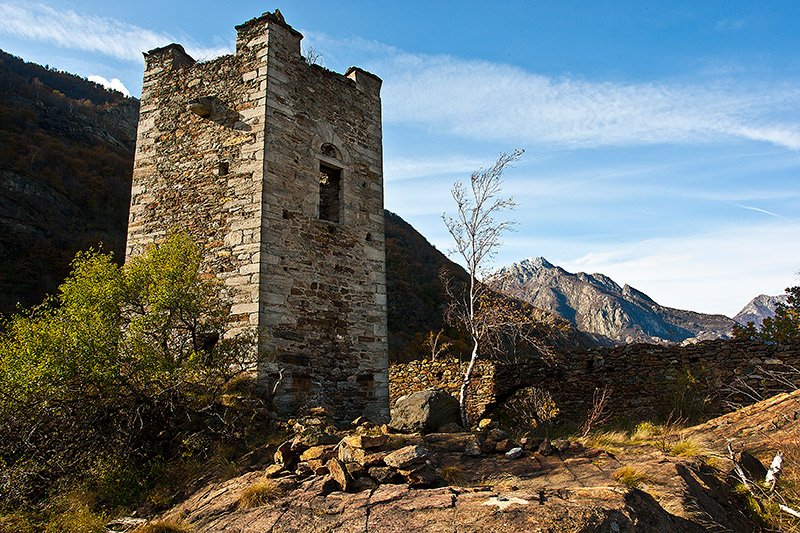
The Castello di Villa-Challand sits on a hill overlooking the village of Challand-Saint-Victor in Val d'Ayas. Located a short distance from Verrès, the castle occupied a strategic position that allowed for the control of the road rising along the valley. It is one of the oldest castles in the Aosta Valley and played an important role in the history of the Challant family.
The history of the castle began in the early 13th century when Conte Tommaso I gave the fief of Villa-Challand to Bosone II, the Viscount of Aosta, giving him the possibility of building a castle there. From that moment, Bosone and his descendants began to use the appellation "di Challant" to indicate their lordship. The castle later belonged to Gotofredo I di Challant and Aimone III di Challant, before passing to Gotofredo's son, Ebalo I di Challant.
Ebalo I di Challant, also remembered as Ebalo Magno, remodeled and enlarged the castle to make it his favorite residence. While the manor initially had the structure typical of primitive castles with a rectangular tower measuring 5 by 7 meters surrounded by a curtain wall, Ebalo extended the walls to the north and south by 30 meters. This enlarged the courtyard and allowed for the insertion of a chapel and another rectangular building measuring 11 by 6 meters. In 1885, Alfredo d'Andrade described that the chapel contained remains of frescoes, some painted with accuracy and others as decorative fragments, of which only a few remain today.
By the mid-14th century, the castle was protected by a garrison of at least fifteen infantrymen. It was further restructured and fortified by Caterina di Challant around 1430 during an inheritance dispute with her cousin Giacomo di Challant Aymavilles. In 1453, commissioners commissioned by Ludovico di Savoia visited the castle to demand its return to Margherita di Challant, but they were targeted with stones and arrows and forced to flee. At that time, it is believed that seventy armed men were hidden inside the castle.
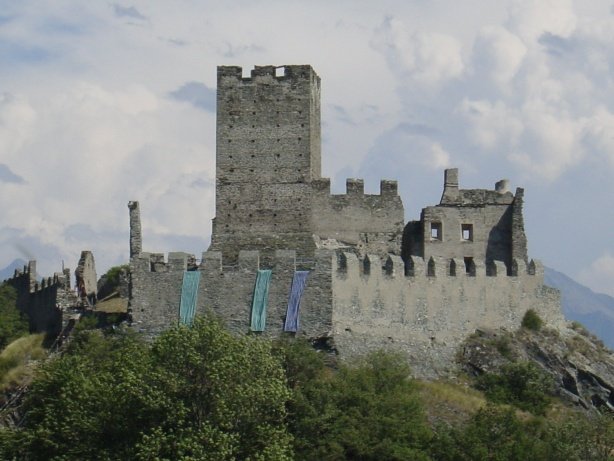
After Caterina's defeat and the loss of her lands, the castle entered a period of decline. It was no longer used and was probably used as a source of building material, as Ibleto di Challant may have done during the construction of the Castle of Verrès. Today, only ruins remain of the site, which are inaccessible due to the danger of collapse. Among the ruins, one can still recognize parts of the two-story perimeter walls, some windows and arrow slits, the remains of the water cistern, and traces of some frescoes.
Sources: Wikipedia, OpenStreetMap, Wikidata, Wikimedia Commons
Written by Nicolo Ciampini
Discuss this with the author and others
No comments yet. Be the first to start the conversation.