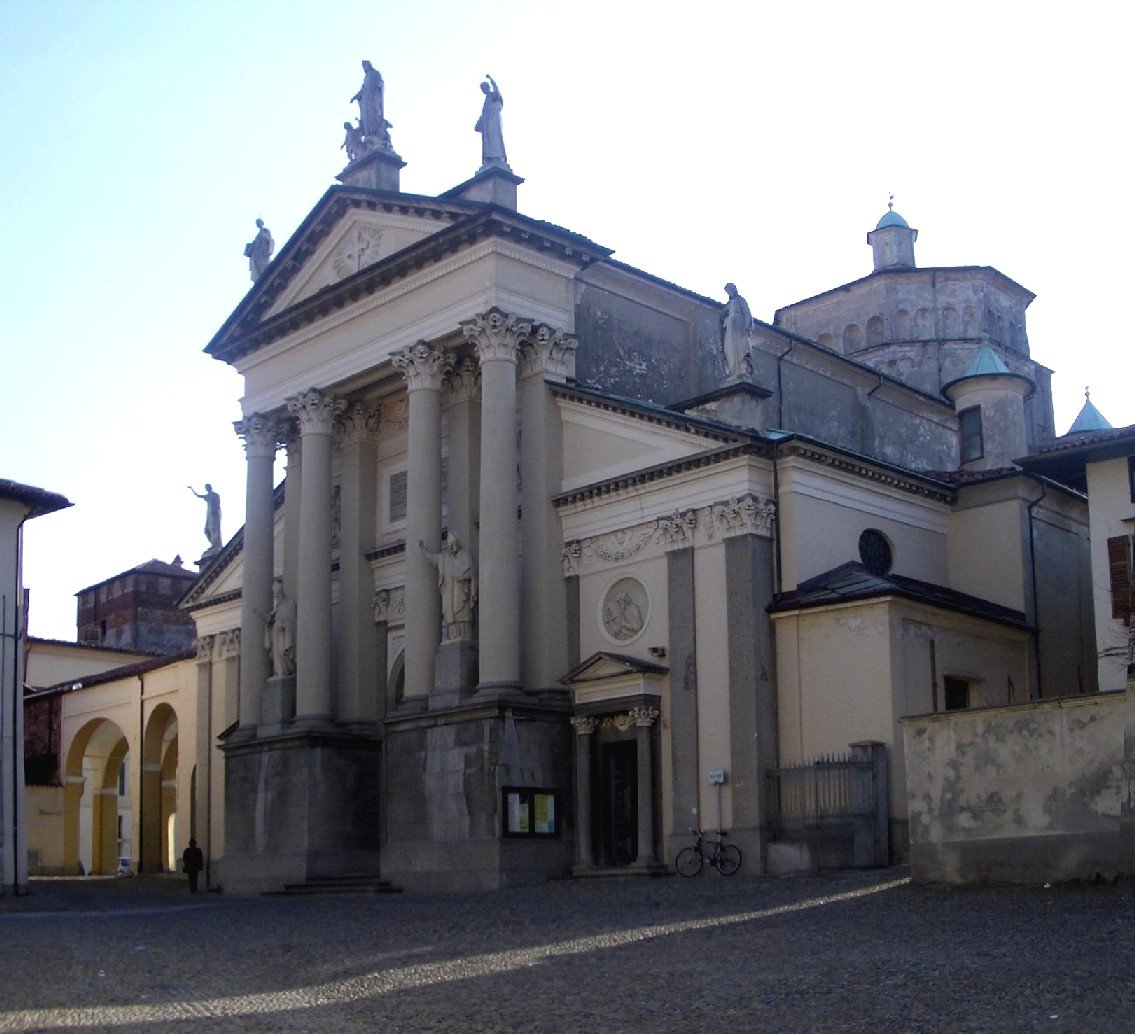

Ivrea Cathedral is a Roman Catholic church located in the highest area of Ivrea, Italy. Built on the site of a first-century Roman temple, a Christian church was constructed in the design of a Roman basilica between the fourth and fifth centuries. In the eleventh century, Bishop Warmondo enlarged the structure in the Romanesque style, establishing a scriptorium. As the apse and other portions of Warmondo's work remain, the cathedral serves as an important example of Romanesque architecture in the Canavese.
The cathedral features a Neoclassical façade and is connected to the Ivrea Episcopal Palace through a covered walkway. Its bell towers are attributed to the early 11th century, though the upper portions housing the bells were not completed until two hundred years later. These upper portions began to be rebuilt in the 12th century following the 1117 Verona earthquake. In 1516, Bishop Bonafacio Ferrero replaced the Romanesque façade with a Bramante-style portico, which was later reworked into a Palladian style in 1854. Bishop Ottavio Pocchettini later commissioned architect Giuseppe Martinez to remodel the building in Late Baroque style.
The cathedral houses a variety of significant art and historical artifacts. The crypt contains frescoes from the thirteenth to the fifteenth century, some of which are damaged by time. A carved walnut reredos depicting motifs of plants and human and animal figures, attributed to Baldino of Surso, is now held in the Civic Museum of Ancient Art in Turin. On the foundation pillar of the southern bell tower, a holy warrior is depicted, possibly representing a member of the Theban Legion.
Sources: Wikipedia, OpenStreetMap, Wikidata, Wikimedia Commons

Written by Nicolo Ciampini
Discuss this with the author and others
No comments yet. Be the first to start the conversation.