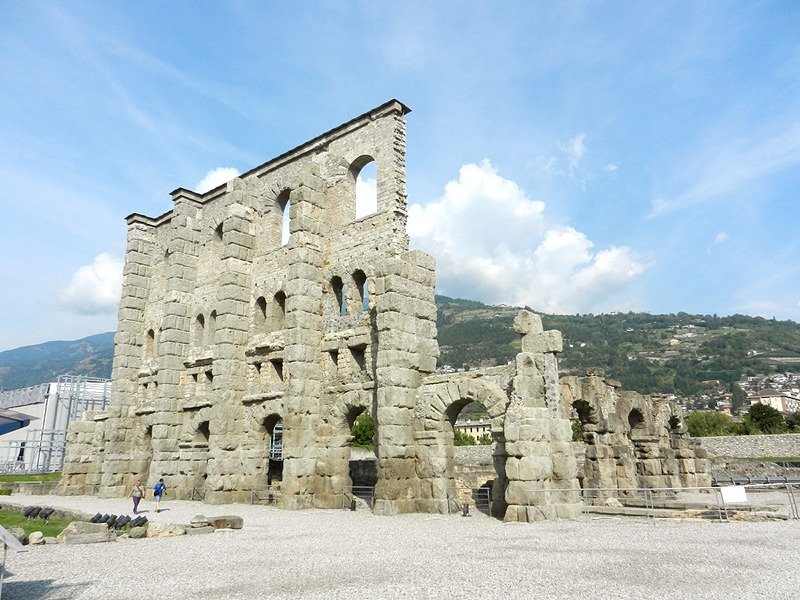

Located in Aosta, northwestern Italy, the Roman Theatre was built some decades after the foundation of the city (25 BC). Although an amphitheatre was built nearby during the reign of Claudius, this grand theatre occupied an area of 81 by 64 metres, which could contain up to 3,500 – 4,000 spectators. What remains today includes the southern façade, standing at 22 metres. The cavea was enclosed in a rectangular-shaped wall, reinforced by buttresses every 5.5 metres, and included four orders of arcades which lightened its structure.
It has been proposed that the theatre once had an upper cover, in the same way of the Theatre of Pompey in Rome. The orchestra had a diameter of 10 metres, and the scene, though only the foundations remain, was adorned with Corinthian columns and statues, covered with marble slabs. A marketplace surrounded by storehouses on three sides with a temple in the centre and two thermae on the open side have also been discovered. Today, the theatre is used for music shows and theatrical performances. It was shuttered in 2022 for further restorations, costing nearly 5 million euros, and reopened in July 2026.
Sources: Wikipedia, OpenStreetMap, Wikidata, Wikimedia Commons
Written by Nicolo Ciampini
Discuss this with the author and others
No comments yet. Be the first to start the conversation.