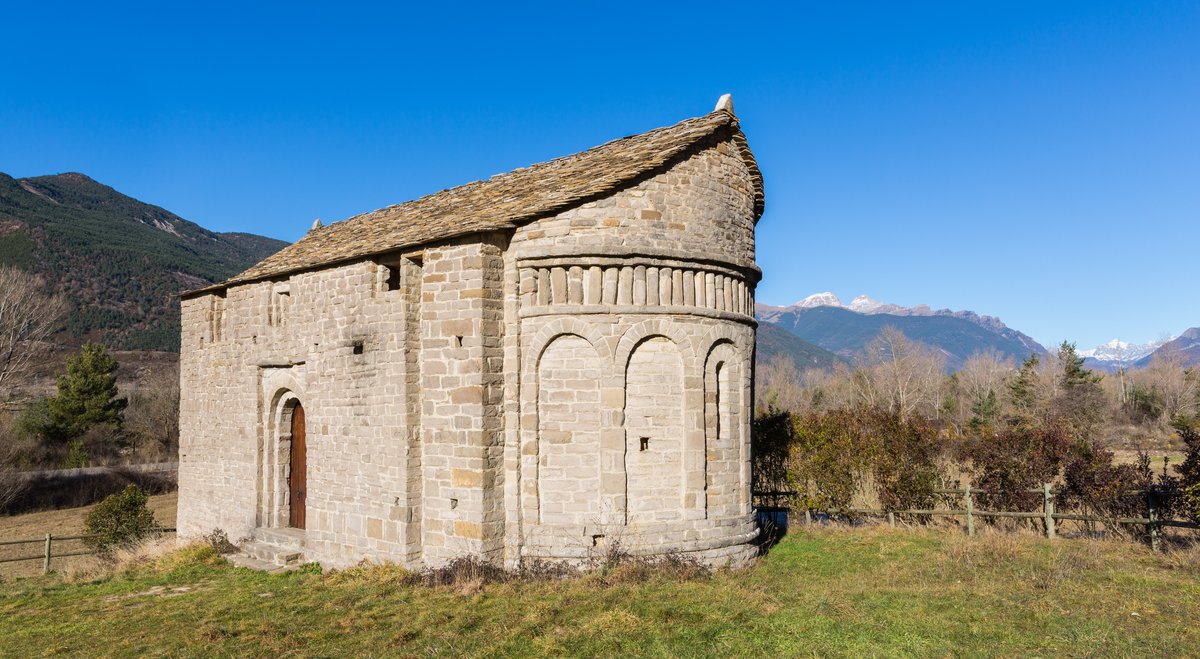

Deep in the hills of the Serrablo comarca in northeast Spain, the tiny village of Biescas seems to have stood still in time. The buildings here are made of stone and look as if they were built centuries ago, and that's because they were. In one such building is the Church of San Juan de Busa, built between 1058 and 1071. It is said to have been constructed by Fortun Guillen, a local lord. The church is a fascinating blend of styles, primarily Romanesque, but it also displays Arabic influences, which makes it stand out among the other churches in the region.
The Church of San Juan de Busa is an example of the local tradition that is still alive in parts of Spain - the Mozárabic or Lombardic Romanesque style. It is characterized by decorative elements like a frieze of baquettes, blind arches, and lesenas. The church has a rectangular single nave covered by a two-pitched wooden roof. The most distinctive feature of this church is the inscription on the arch of its main entrance. The inscription in cufic characters reads, 'La ilaha illa Allah', which means 'No other god but Allah' in Arabic.
It is believed that the church was built by Muslim craftsmen, and the inscription is a testament to their skill and their faith, or it may be a testament to the church's denomination as Catholic. Today, the church is a historical-artistic ensemble since 1982. It is a testament to the past and a source of pride for the local community. For tourists, it offers a glimpse into a different time and a culture that is seldom seen.
Sources: Wikipedia, OpenStreetMap, Wikidata, Wikimedia Commons
Written by Nik Frost
Discuss this with the author and others
No comments yet. Be the first to start the conversation.