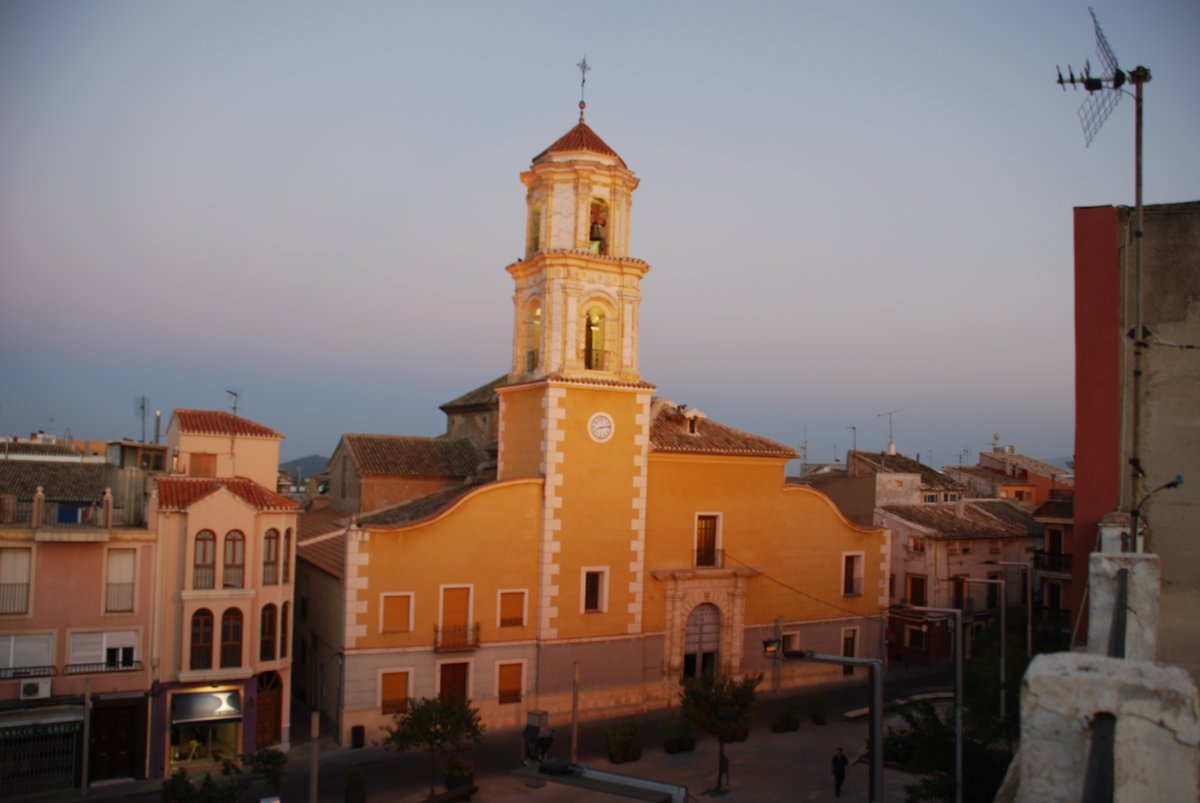

Iglesia de Nuestra Señora del Rosario, a shining testament of faith in Bullas, Spain, boasts a striking red-roofed southern facade that captivates the eye. Previously, the religious temple of the town was the ermita de San Antón, under the ownership of the Casa de Fajardo. The church, consecrated in 1723 and originally reliant on the parroquia of Santa María Magdalena in Cehegín until 1804, underwent a restoration and expansion in 1803, led by the architect Jerónimo Martínez de Lara.
The church, dedicated to Nuestra Señora del Rosario, is home to religious sculptures of great artistic significance, such as San Juan Evangelista (created by Gregorio Molera Torá in 1929), the Virgen del Rosario (Jenaro Lázaro Gumiel, 1939), Nuestro Padre Jesús Nazareno (Juan González Moreno, 1944), and San Francisco de Asís (Nicolás Prados López, 1945). This intriguing collection includes the Virgen de la Soledad (José Sánchez Lozano, 1951), believed to be a relic from the original 19th-century statue, the Virgen de las Angustias (Tomás Noguera Belenguer, 1952), the Sagrado Corazón de Jesús (Juan González Moreno), and Santiago Apóstol (Antonio Labaña Serrano, 2000), among others.
Sources: Wikipedia, OpenStreetMap, Wikidata, Wikimedia Commons
Written by Nicolo Ciampini
Discuss this with the author and others
No comments yet. Be the first to start the conversation.