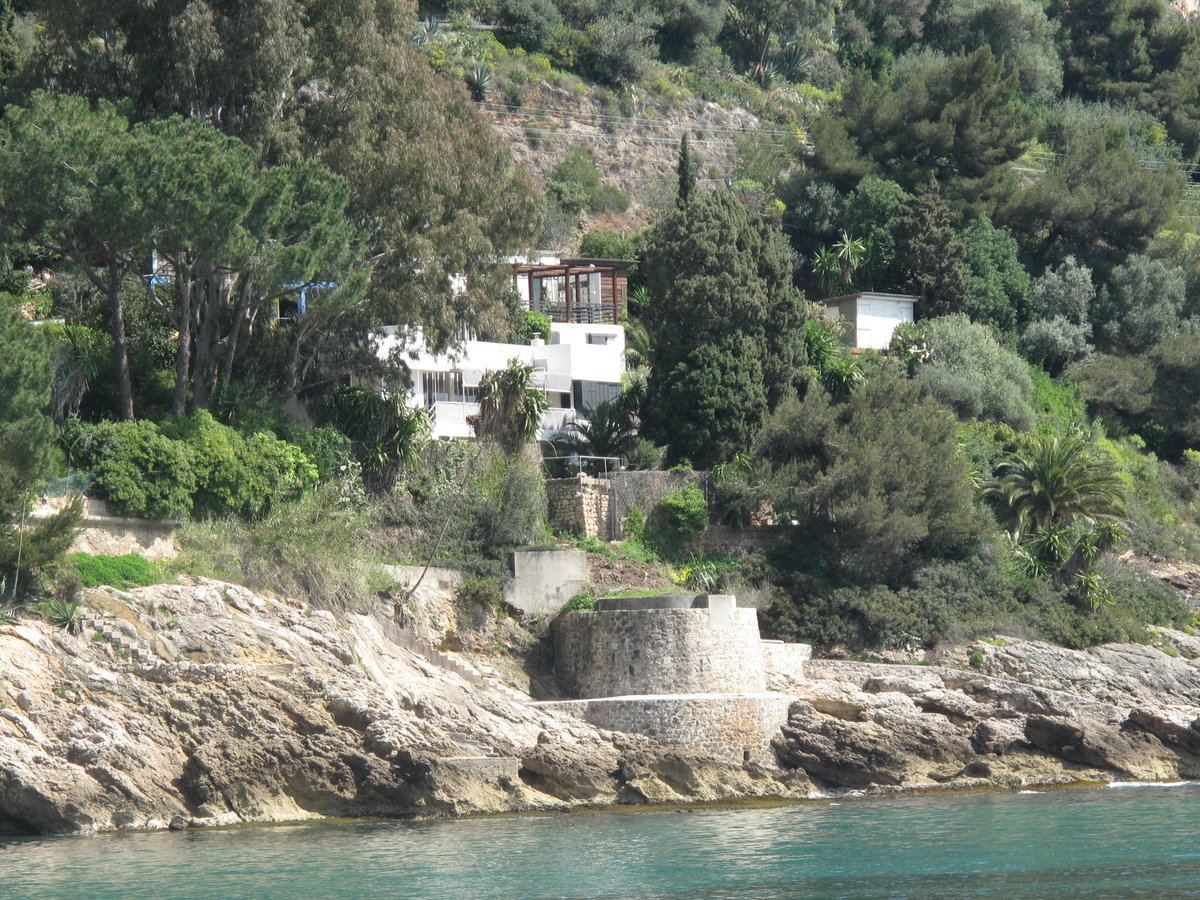

Why is the house named E-1027? The numbers are a code for Eileen Gray and her lover Jean Badovici. E stands for Eileen. 10 stands for Jean. 2 stands for Badovici. 7 stands for Gray. The name reflects their relationship as lovers during the building's construction from 1926 to 1929.
This L-shaped, flat-roofed villa features floor-to-ceiling windows and a spiral stairway to the guest room. It was Gray's first major work, making the border between architecture and decoration indistinct and personalizing the space to the lifestyle of its intended occupants. Gray also designed furniture for the house, including a tubular steel table with an adjustable top that caught crumbs, allowing her sister to eat breakfast in bed without ruining her sheets.
But the romance soured. Badovici inherited the place in 1932. Le Corbusier, a friend of Badovici, visited the house several times after the couple had parted. In 1938 and 1939, while staying as a guest of Badovici, Le Corbusier painted bright murals on the plain white walls with his permission. Gray felt these murals were an act of vandalism, a change to her ex-lover's house that infuriated her.
Today, the villa is a French National Cultural Monument managed by the local commune of Roquebrune-Cap-Martin. It survived a lengthy restoration that faced criticism for departing from Gray's intent by replacing original glazing and light switches with standard 21st-century products. Visitors can see the house by guided tour only for groups of no more than 12 people. It remains a quiet, curated way to see a house that was once at the center of a loud architectural argument.
Sources: Wikipedia, OpenStreetMap, Wikidata, Wikimedia Commons

Written by Nicolo Ciampini
Discuss this with the author and others
No comments yet. Be the first to start the conversation.