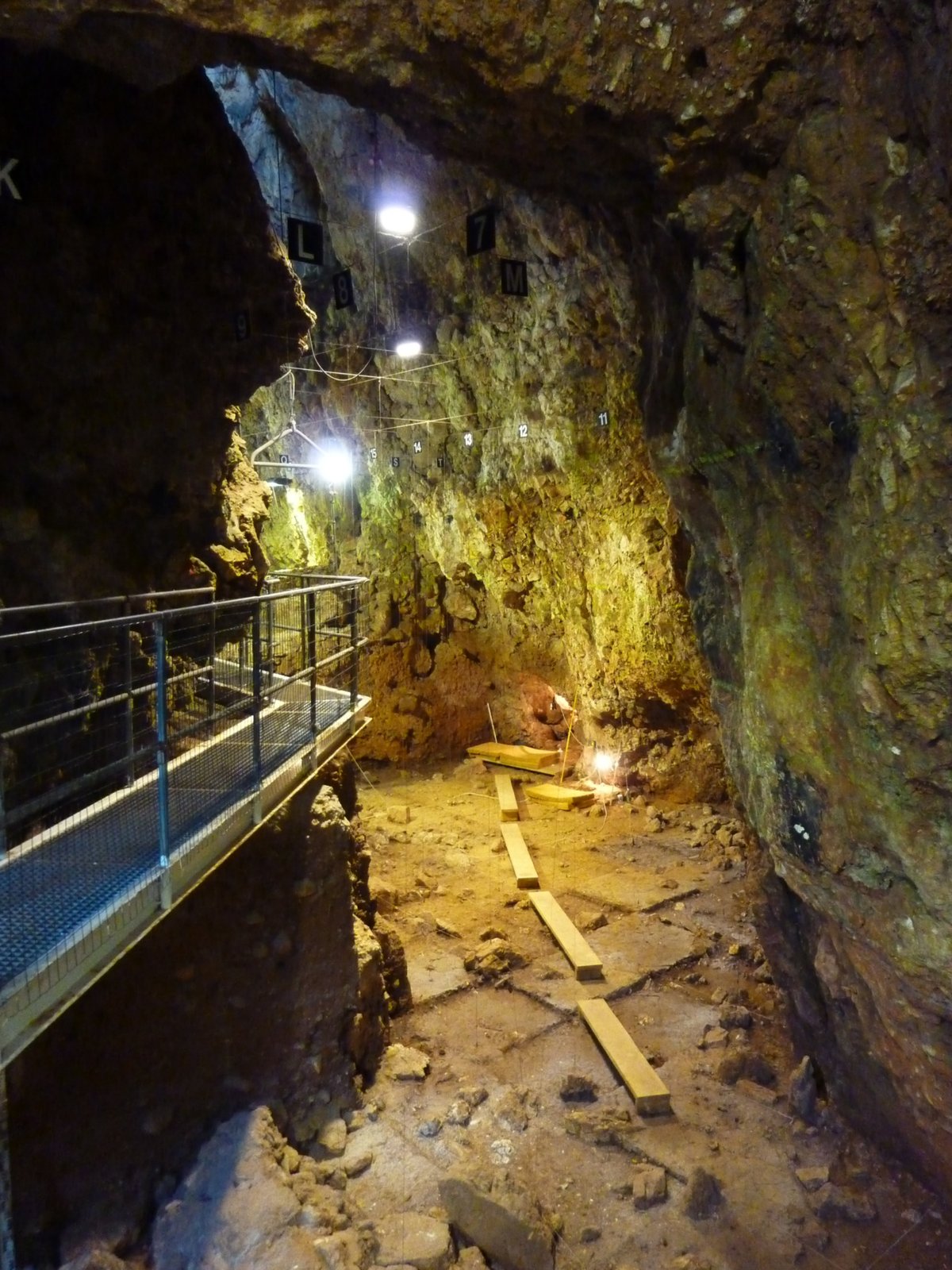

Was someone actually living here during the Lower Paleolithic period? Or did some prehistoric creature just have a very specific hobby of moving rocks around? In a cave on the outskirts of Nice, archaeologists found a row of large stones lined up against a wall. They have been interpreted as packing stones that could have been used to support the poles of an animal skin tent pitched against the cave wall. While no evidence of the organic poles or the tent itself would have survived, stone tool flakes and animal bone appear to spill outwards from between the stones at two points, which may represent entrances to the conjectured shelter.
Does a domestic life actually exist in these theories? If you buy into it, we are looking at a remarkably organized household. There are two circular charcoal concentrations that likely served as hearths, surrounded by fragments of animal bone and tiny sea shells. The shells may represent seaweed brought into the cave to serve as bedding. This may indicate specialised activity areas within the settlement with an inner domestic area and an outer one which would have been covered by the tent but presumably used for another purpose. Some skeptics might say natural processes or a reason for their placement not involving a structure may explain their presence, but the layout at Le Lazaret is more compelling than at similar sites.
Were the inhabitants highly organized? Excavators unearthed more than 20,000 fossilized faunal bone fragments, and they found the cranial fragments of a nine-year-old juvenile from roughly 200,000 years ago. Whether they were Homo heidelbergensis or proto-Neanderthals, they left behind significant archaeological traces. Occupation layers from marine isotopic stage 6, between 186,000 and 127,000 years ago, may demonstrate construction abilities and other organisational skills by the inhabitants at the time.
Sources: Wikipedia, OpenStreetMap, Wikidata, Wikimedia Commons




Written by Nicolo Ciampini
Discuss this with the author and others
No comments yet. Be the first to start the conversation.