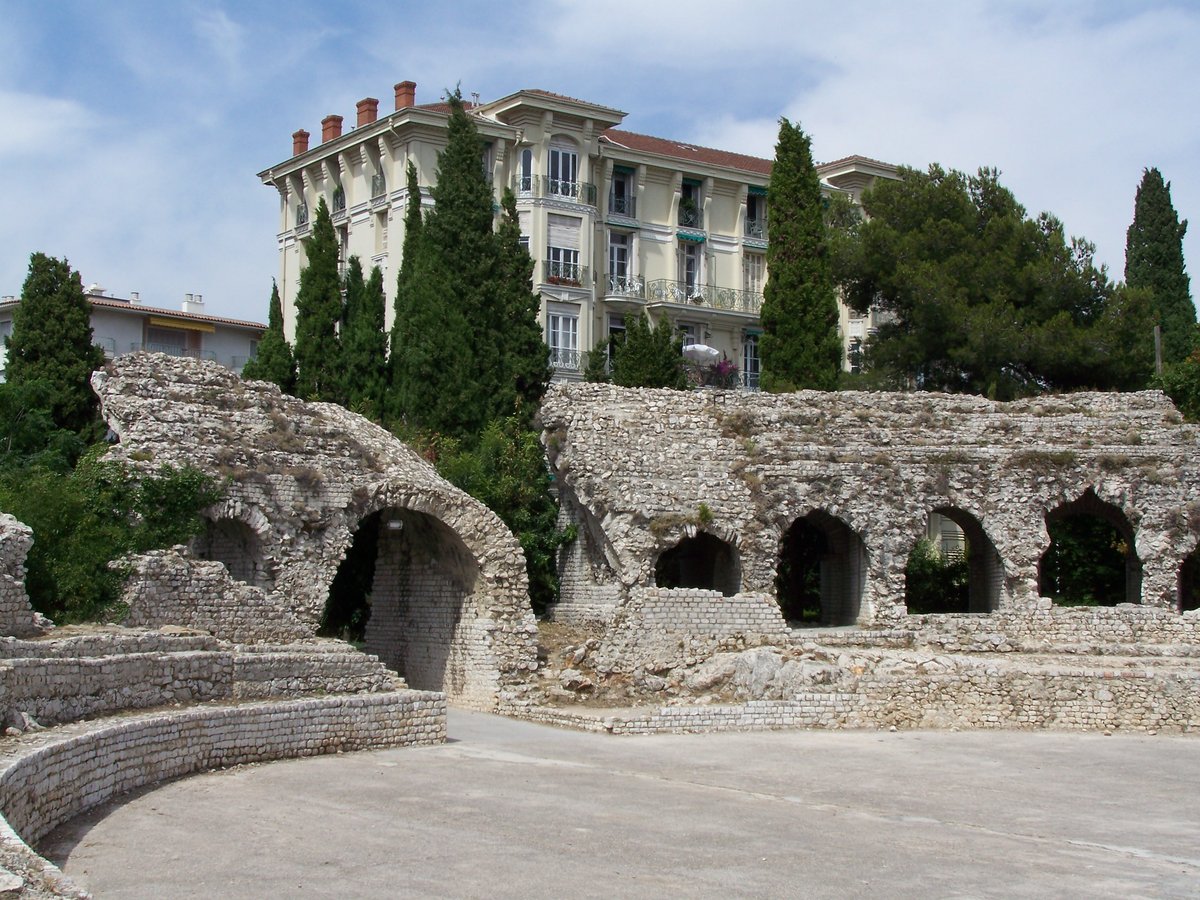

The Arènes de Cimiez is a Roman amphitheater located in the Cimiez district of Nice. It served the ancient city of Cemenelum and is one of the smallest amphitheaters recorded in Gaul. The monument was constructed in two successive campaigns between 70 and 80 AD and was eventually abandoned around the 4th century. It was excavated in the 1930s, 1940s, and 2007, and it remains open to the public today.
The first phase of construction focused on the arena and a reduced cavea with only three rows of seats. The masonry was built using small blocks of stone (opus vittatum). In a second phase, the amphitheater was expanded to form an ellipse measuring 67.20 by 56 meters. During this expansion, the masonry began to include layers of architectural terracotta (opus mixtum). This second stage also involved cutting through an aqueduct that had lined the monument in its original state. The structure also includes a velum, with some of its anchor points still visible.
Researchers have debated the original role of the small amphitheater. Due to its size, some early theories suggested it was a military training ground for cohorts stationed in Cemenelum, though this view has been questioned. The absence of pits and cages rules out animal fights, and the small scale makes it difficult to imagine large-scale gladiator combat. It is more likely that the venue hosted games intended to entertain the population of Cemenelum.
Following its abandonment, which likely occurred at the end of the 3rd century, the site was occupied by gardens and vines. A coin of Probus was found among the demolition materials of that period. Today, the monument is protected as a historical site, and visitors can explore the podium walls and the north and south vomitoria in the Jardin des arènes de Cimiez. Excavated objects from the site are preserved and displayed at the Musée Archéologique de Nice-Cimiez.
Sources: Wikipedia, OpenStreetMap, Wikidata, Wikimedia Commons



Written by Nicolo Ciampini
Discuss this with the author and others
No comments yet. Be the first to start the conversation.