

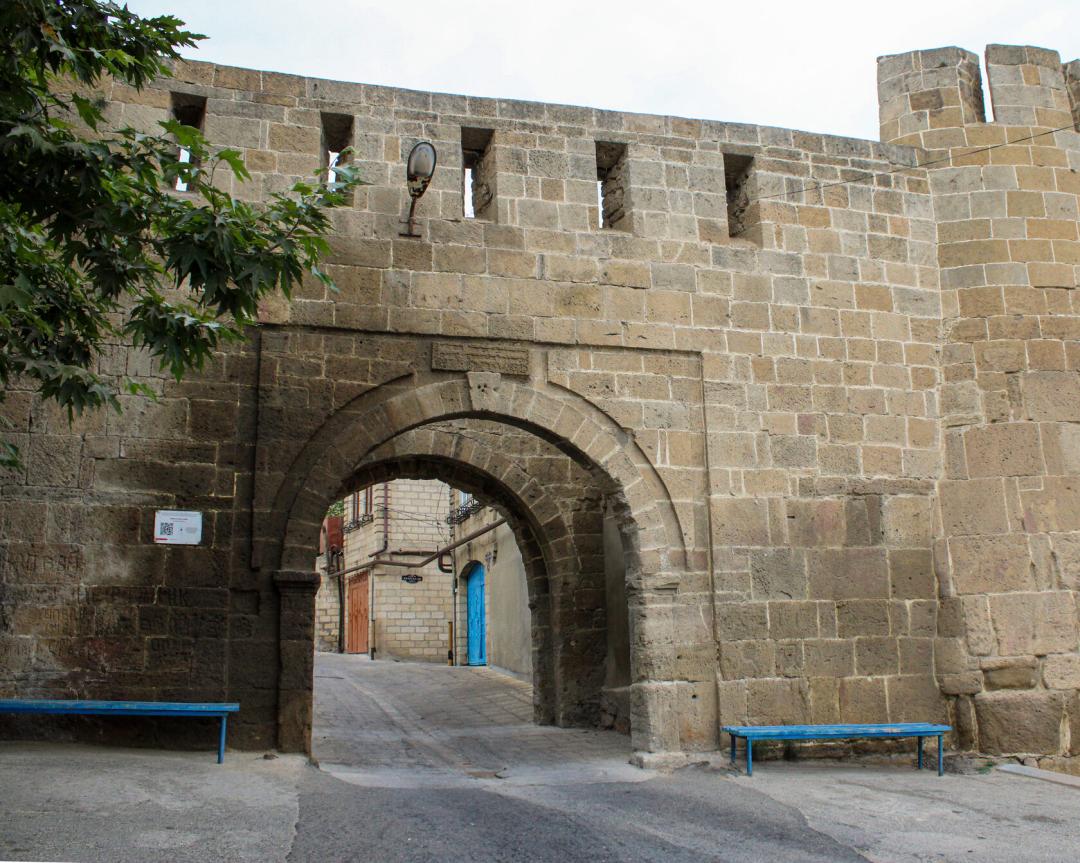
Naryn-Kala is a Persian citadel, part of the Derbent fortress, connected to the Caspian Sea by double walls designed to block the so-called Caspian Gates to the Persian Empire. In the early Middle Ages, the Persian Empire was regularly attacked by barbarian nomads. For this reason, over time, a decision was made to close the Caspian Gates between the sea itself and the spurs belonging to the Jalgansky Ridge. This could only be done by building a huge and powerful wall, which was absolutely impossible to breach with the weapons of that time. The Sasanian masonry is well traced both in the city walls and in the citadel. It consists of facing rows laid out of large stones dry, and rubble masonry on lime mortar. For a stronger connection with the rubble, the facing stones are alternately laid lengthwise and crosswise (sometimes the crosswise stones are doubled), creating a characteristic pattern. The outer surface of the stones is well hewn, while the inner planes are left untreated, which contributed to better adhesion with the rubble. The oldest masonry consists of uniform but not strictly standard stones in shape and size: individual slabs were trimmed to each other during construction. Such a wall construction, besides exceptional strength, imparted monumental immovability and grandeur.

The citadel was built near Derbent and for a long time was inhabited only by guards who protected the entrance around the clock. Later, it turned into an important trade, administrative, and cultural center.
In Middle Persian, the name means "sun fortress." Since the Middle Ages, the Derbent fortress wall was also called Alexander the Great’s wall due to the legend that the great conqueror built it. In reality, Alexander the Great never visited these places.
Naryn-Kala occupies the top of the hill closest to the sea. The path along the shore was blocked by two parallel fortress walls (the Derbent wall), which adjoined the citadel on the west and extended into the sea on the east, preventing the fortress from being bypassed by shallow waters and forming a harbor for ships. Between the walls, spaced 350–450 meters apart, lay the medieval city of Derbent. To the west of the citadel, the Mountain Wall (Dag-bary) stretched for 40 km, designed to prevent bypassing the fortress through mountain valleys and passes. Despite its age, the fortress played a crucial defensive role for centuries. New rulers rebuilt and renovated it, so today, like tree rings, the structure reflects the entire history of Derbent. The irregularly shaped citadel covers an area of 4.5 hectares. Its dimensions are approximately 180 meters wide and 255 meters long; the walls are reinforced with small towers spaced 20–30 meters apart and an artillery tower in the southwest. Additional protection on three sides is provided by the steep slopes of the mountain.
The complex was designed to withstand prolonged sieges. To ensure water supply, underground channels were dug to fill internal reservoirs directly from mountain springs. One such reservoir was a local Christian church, built in the fourth or fifth century but later abandoned, causing it to gradually sink almost entirely underground. Remarkably, this church has survived to this day. It is considered the oldest Christian temple in Russia.
On the vast territory of the fortress operates the Juma Mosque, also considered one of the oldest in Russia, built here in the eighth century. Starting from the fifteenth century, a madrasa was built next to the mosque.
Inside the citadel, baths, a fortress water supply system made of ceramic pipes, and the ruins of the Shah’s palace remain — a large entrance portal and parts of the walls. Opinions about the existence of an early Christian temple from the 4th–5th centuries (the oldest in Russia) here vary. Some experts believe the cross-domed room was a reservoir; others note the absence of a water conduit below and the above-ground (not semi-underground or underground) structure, consider the building’s shape inconvenient for a reservoir, which in Derbent is usually rectangular or square, and also point out the building’s orientation according to the cardinal points. Each wall has three gates, the oldest of which are the Orta-Kany (Middle Gates).
The outer walls, 2.5–3.5 meters thick and reaching heights of 20–25 meters in some sections, make it an impregnable fortress capable of withstanding heavy and prolonged sieges.
Derbent is located at the most strategically vulnerable point of the Caspian passage, where the Greater Caucasus mountains come closest to the sea, leaving only a narrow 3-km strip of plain. The Derbent fortress is part of a grand defensive system that protected the peoples of Transcaucasia and Western Asia from nomadic invasions from the north. The system included city walls, the citadel, sea walls, and the Mountain Wall Dag-bary.
To the west, the Derbent walls adjoin the Naryn-Kala citadel, which was built after the 10th century, since before that, a signal fire was lit here when the enemy approached. The fortress known today was built in the 6th century on the Jalgansky Ridge by order of the Persian ruler Khosrow I Anushirvan ("Immortal Soul") of the Sasanian dynasty. Since 735, Derbent and Naryn-Kala became the military-administrative center of the Arab Caliphate in Dagestan, as well as the largest trading port and a center for the spread of Islam in this land.
The Middle Ages are remembered in the history of Naryn-Kala as the time when the Derbent khans settled here, making the citadel their main residence for some time. In the eighteenth century, khan’s chambers were built here, and a little later — the divan-khan (chancellery), dungeons (prison basements), and several other administrative buildings. Among Russian constructions is the guardhouse, built in the nineteenth century.
As a result of the Caspian campaign, the city of Derbent became part of the Russian Empire. Emperor Peter I moved from a dugout, now a local landmark, to the khan’s palace, to whom the Derbent beys presented the city keys on a silver tray covered with Persian brocade (kept in the Kunstkamera in St. Petersburg) with the words: "Derbent was founded by Alexander the Great, and therefore there is nothing more fitting and just than to hand over a city founded by a great monarch to another monarch no less great than him." During the Russo-Persian War of 1796, the fortress was retaken by Russian troops under the command of General-in-Chief Valerian Zubov, who established his headquarters in the citadel. After the arrival of the Russians, the khan’s palace was significantly rebuilt for military needs and then completely dismantled. In 1827–1828, a guardhouse building in the neoclassical style was constructed and has been preserved. Bestuzhev-Marlinsky, serving then in the Caucasian army, lamented: "The corner room where the great Peter lived in the khan’s house in the Derbent fortress was preserved as it was during his time. The Russians changed everything: they did not spare even the window from which he admired the sea."
After studying the historical and cultural heritage of Derbent, the World Heritage Committee included in July 2003 the "Citadel, Ancient City, and Fortress Structures" in the World Heritage List. These sites still impress with their scale and monumentality.
Sources:
https://derbentmuseum.ru/arhitekturno-arheologicheskij-kompleks-citadel-naryn-kala/



Written by Jermaine
Discuss this with the author and others
No comments yet. Be the first to start the conversation.