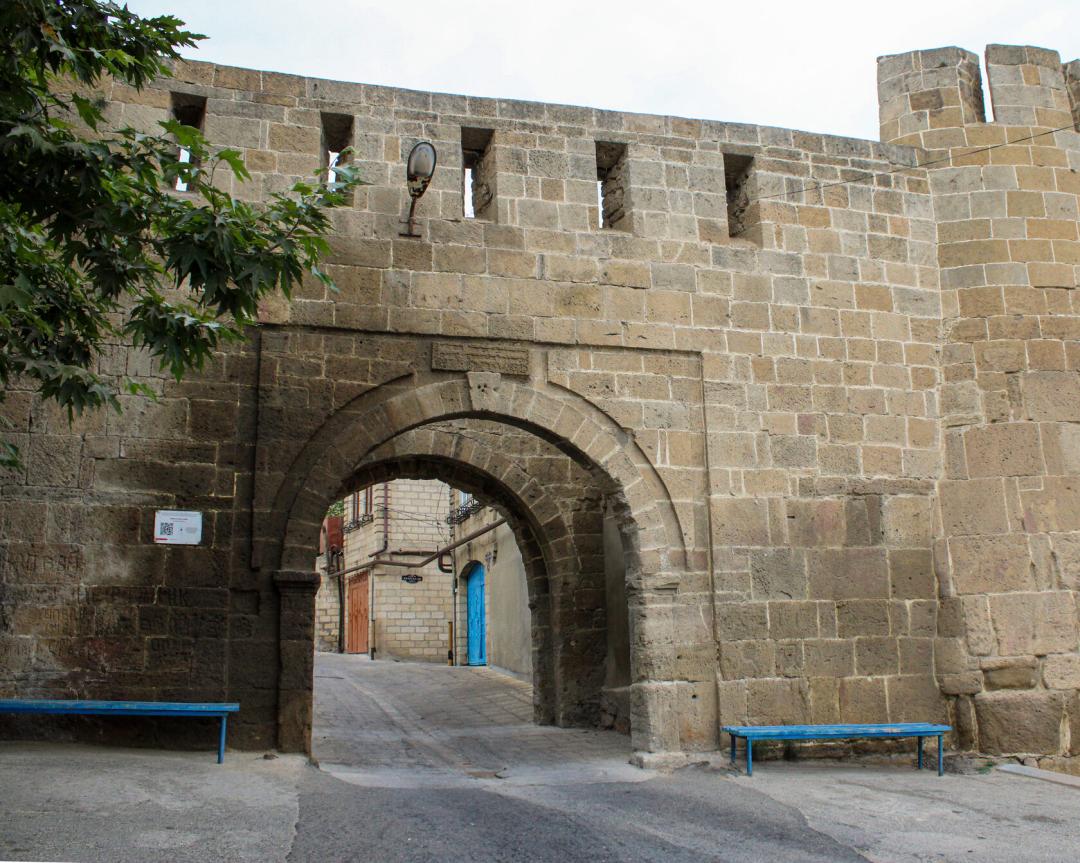
Gates of the South Wall of Derbent — Kala-kapy (Fortress Gates)

5th Nagorny Lane, 7, Derbent, Republic of Dagestan, Russia, 368600

The Gates of the South Wall — Kala-kapy (Fortress Gates) (from the Arabic "kala" — fortress, citadel) are the uppermost first gates from the citadel on the southern city wall. Unlike other gates, they do not lead into the city but directly to the entrance of the citadel. Therefore, there is another name for these gates — Khan-kapy (Turkic Khan's Gates, Gates of the Khan). The gate opening probably appeared when the city was under Turkish control, during the period of intensified conflict between Derbent and Shirvan.

The South Wall Gates — Kala-kapy (Fortress Gates) (from the Arabic "kala" — fortress, citadel) are the uppermost first gates from the citadel on the southern city wall. Unlike other gates, they do not lead into the city but directly to the entrance of the citadel. Therefore, there is another name for these gates — Khan-kapy (Turkic Khan’s gates, Khan’s gates). The gate opening probably appeared when the city was under Turkish control, during the period of intensified conflict between Derbent and Shirvan. Despite some similarity to other city gates, they are clearly of later origin. Specialists date the construction of the gates to the 18th century, the period when Derbent became part of the Quba Khanate, and attribute them to Fatali Khan of Quba.

From the outside, the gate opening has a flat lintel, while from the city side it has a pointed arch shape, making them similar to the ancient city gates, which are characterized by this very design. On the eastern side of the gates stands a semicircular watchtower made of rusticated (roughly hewn, with a convex surface) stone.

The technique of constructing a bastion with a rounded projection housing a guardhouse is undoubtedly closer to the Turks, who were well acquainted with European fortification, rather than to the Persians, whose fortifications were much more primitive. This technique also suggests that next to this bastion and under its protection, between it and the citadel wall, there must have been an opening in the wall for secret sorties under the fortress wall. Later, in the second half of the 18th century, the Kala-kapy gates were built in place of this opening. Worth noting is the reconstructed and heightened section of the wall near the guardhouse — it was meant to serve as a kind of protruding bastion at the fortress and during prolonged sieges to protect against flanking fire. This entire reconstructed defensive complex is laid with careful yet decorative masonry of rusticated blocks, used for the first time in Derbent, indicating that a visiting engineering and construction team worked here, possessing skills in both civil or even palace architecture and Western Russian fortification and engineering arts.

In 1920, the gates collapsed, and for a long time a breach existed in the wall at their place. In 1960, they were restored. The outer facade of Kala-kapy is extremely simple — a rectangular opening with a wedge-shaped lintel in the fortress wall; such gates are also shown in one of the early 19th-century drawings. The inner facade of the gates is more interesting; during restoration, by analogy with earlier gates, the vaulted passage ceiling was given a pointed arch shape.

Sources:

https://welcomedagestan.ru/placepost/kala-kapy/

https://pro-derbent.ru/kala-kapy-xvi-xviii-veka-vorota-yuzhnoj-steny


Follow us on social media

More stories from Derbent: One of the oldest "living" cities in the world

The southern wall of the Derbent fortress

5th Nagorny Lane, 7, Derbent, Republic of Dagestan, Russia, 368600

The construction of the existing stone walls of the Derbent Fortress is dated to the 6th century AD. This dating is based on Arabic written sources from the 9th-10th centuries. Arabic authors associate the construction of the city of Derbent with the name of the king of Sasanian Persia, Khosrow I Anushirvan (531–579 AD). Furthermore, the reports of the Arabic authors are supported by Pahlavi construction inscriptions located on the northern wall.

Bayat-Kapy — the second gate from the Naryn-Kala citadel on the southern wall of Derbent

Orta-Kapy Street, Derbent, Republic of Dagestan, Russia, 368600

Bayat-Kapy are the second gates from the Naryn-Kala citadel on the southern city wall. According to Arab authors of the 9th-10th centuries, the Kala-Kapy gates did not exist before, and the Bayat-Kapy gates were the first of the three gates on the southern wall from the Naryn-Kala citadel.

The Kiyamat-Kapy Gate (Gate of Judgment Day) of the Derbent Fortress

3 Internatsionala St., Building 4A, Derbent, Republic of Dagestan, Russia, 368600

The "Kiyamat-Kapy" Gate (the Gate of Judgment Day) was discovered and excavated by archaeologists in 2002-2004. It is an arch in the northern fortress wall of Derbent, located within Nizami Park. The excavations revealed a complex presumably of ritual significance. During the studies, it was established that ritual ceremonies involving hammering nails into the wall and offering copper coins to make wishes were performed here.

Guardhouse in Naryn Kala

Makhachkala-Derbent road, 360600, Republic of Dagestan, Russia, 368600

The guardhouse, along with the infirmary and warehouses, was built in 1827 to accommodate and serve the needs of the Russian garrison soldiers. The construction inevitably reflected the characteristic features of the Empire style, which was dominant in Russian architecture at the time.

The main gates of the Naryn-Kala fortress

Makhachkala-Derbent road, 360600, Republic of Dagestan, Russia, 368600

The eastern gates of the Naryn-Kala citadel (called Bab-el-Alkama by the Arabs) are its main gates, actually built into the retaining wall and covered with pointed arches and slabs forming the base of the rooms of Fatali Khan's khan's office (18th century).

Dag-gates - the gates of shame of the fortress Naryn Kala

Makhachkala-Derbent road, 360600, Republic of Dagestan, Russia, 368600

Among the people, they were called the mountain gates, secret gates, spare gates, and even the gates of fugitives or shame. The fact is that one of the rulers of Derbent retreated through these gates during a battle, surrendering the city to the enemy. Because of this, these gates were not used even in peacetime, as exiting through them was considered disgraceful. When Peter I inspected the fortress in 1722 and was told the story of these gates, the emperor decided to go out through them no matter what. He was once again told that it was inappropriate. However, Peter I, saying, "What do I, the Russian tsar, care about Muslim shame," still went out through them, thereby lessening the degree of disgrace.

Dash-gates (Stone Gates or Gates of Stone) — the third gates from the Naryn-Kala citadel on the northern wall of Derbent

Gagarin St., 2, Derbent, Republic of Dagestan, Russia, 368600

Dash-gates (from Turkic. Stone gates or Gates of stone) are the third gates from the citadel Naryn-Kala on the northern wall. They led to the quarries, from where the inhabitants took building material. Hence the name of the gates.

Maiden's Bath in the old part of Derbent

22 Agasieva Ave, Derbent, Republic of Dagestan, Russia, 368608

The museum complex "Maiden's Bath" is located in the old part of Derbent, near the oldest mosque in Russia, the Juma Mosque. The vaulted baths are one of the attractions of Derbent. This is a traditional type of structure for the East. Such baths played a significant role in a Muslim city, being an integral part of its social life, just like mosques and bazaars. The bathhouse in the Caucasus, as in the East, served not only for cleansing but also for strengthening the body, uplifting the spirit, for rest, friendly, and business conversations.

Derbent Lighthouse

Derbent Lighthouse, Derbent, Republic of Dagestan, Russia, 368600

The Derbent Lighthouse is the southernmost lighthouse in Russia, located in the Dagestani city of Derbent. It is the same age as the Makhachkala lighthouse: both are over 1.5 centuries old. The lighthouse is included in the list of protected monuments of Russia and is part of the UNESCO World Heritage list.

Juma Mosque in Derbent is the oldest mosque on the territory of the former USSR.

7, Magal St., 10, Derbent, Republic of Dagestan, Russia, 368600

According to historical data, in the spring of 732, a huge Arab army led by Maslama ibn Abd al-Malik, whom the local historical chronicle "Derbent-name" and folk legends call Abu Muslim, appeared at the walls of Derbent, which at that time was controlled by the Khazars. As a result of a prolonged siege, Maslama managed to conquer Derbent. He converted the city's population to Islam and began the construction of mosques. Numerous written sources report the construction of the "great congregational mosque" in the 115th year of the Hijri calendar (733/4 AD) by the Arab commander Maslama ibn Abd al-Malik, who conquered Derbent and is called Abu Muslim in the local historical chronicle "Derbend-name" and folk legends. The Juma Mosque is one of the oldest mosques in the world and the oldest mosque in Russia.

Dungeon in the Naryn-Kala Fortress

Makhachkala-Derbent road, 360600, Republic of Dagestan, Russia, 368600

The underground prison-dungeon, located in the northeastern part of the Naryn-Kala citadel, is a unique monument of medieval architecture. Its depth is 11 meters, and the internal area is 25 square meters. Light and air penetrated the dungeon through a hole in the stone.

The grave of Esfandiar near the Derbent citadel

Makhachkala-Derbent road, 360600, Republic of Dagestan, Russia, 368600

The burial site of the rulers of Derbent — Esfendiyarov is located 35 meters south of the Kala-Kapa gate by the stairs leading to the observation deck.

Naryn-Kala — the citadel of Derbent

Makhachkala-Derbent road, 360600, Republic of Dagestan, Russia, 368600

Naryn-Kala is a Persian citadel, part of the Derbent fortress, connected to the Caspian Sea by double walls designed to block the so-called Caspian Gates to the Persian state. In the early Middle Ages, the Persian state was regularly attacked by barbarian nomads.

Orta-kapy (Middle Gates) — the third gates from the citadel Naryn-Kala on the southern wall of Derbent

16 Urta-Kapy St., Derbent, Republic of Dagestan, Russia, 368600

Orta-Kapy (from Turkic, Middle Gates) are the third gates from the citadel Naryn-Kala on the southern wall. The gates got their name from the district of the ancient city — "Orta-tepe" (Middle Hill), adjacent to these gates.

Khan's Bath in the northwestern part of the Naryn-Kala fortress

Makhachkala-Derbent Road, 360600, Republic of Dagestan, Russia, 368600

The Khan’s Bathhouse is an architectural monument, presumably built in the 16th–17th centuries, located in the northwestern part of the Naryn-Kala fortress in Derbent. “The bathhouse in the Caucasus, as throughout the entire East, is a matter of special care… Because the bathhouse serves not only for washing but also for strengthening the body, lifting a fallen mood, for rest, for meetings and conversations about buying and selling, and for displaying skill in chess and backgammon.”

Khan's Palace - the palace complex of the Naryn Kala fortress

Makhachkala-Derbent road, 360600, Republic of Dagestan, Russia, 368600

The most interesting and richly ornamented carved stone palace complex in Derbent is the Khan's Palace in the Naryn-Kala citadel, built in 1768 by Fatali Khan, the most powerful feudal ruler of the Eastern Caucasus. It reached its greatest power in the years 1770–1780, during which the entire citadel was transformed into the Khan's residence.

Ancient Eastern Bathhouse (Women’s)

12 Urta-Kapy St., Derbent, Republic of Dagestan, Russia, 368600

The women's bathhouse was built in the 15th-17th centuries and is located in the upper part of the city near the "Juma Mosque." The Arabic name is Mesjid Hammam, meaning a bathhouse located by the mosque. It is constructed from rubble masonry, with walls and floors inside made of hewn stone. The structure is partially buried in the ground to reduce heat loss by more than half. It has a classic layout of an Eastern bathhouse with cold and hot sections, covered by domes with a skylight lantern, and numerous auxiliary rooms.

Rectangular underground reservoir of the Naryn Kala fortress

Makhachkala-Derbent road, 360600, Republic of Dagestan, Russia, 368600

A large rectangular underground reservoir served as the main water storage for the defenders of the citadel. Water was supplied through stone underground channels from mountain springs. The rectangular cistern was adjacent to the service yard of the khan's palace.

Dzharchi-kapy (Herald's Gate) — the first gate from the Naryn-Kala citadel in the northern wall

373F+WW Derbent, Republic of Dagestan, Russia

Dzharchi-Kapy (Herald’s Gate) — the first gate from the Naryn-Kala citadel in the northern wall. At these gates, the khan’s herald (from Turkic *Dzharchi*) proclaimed the orders and decrees of the city’s rulers. Arabic written sources from the 9th–10th centuries call these gates Bab al-Muhajir (Gate of the Refugees). According to legend, the Khazars who controlled the city, unable to withstand the siege by the Arab army led by Maslama in 734, secretly left the city through these gates.

Retail space of Derbent

2nd Nagorny Lane, 12, Derbent, Republic of Dagestan, Russia, 368600

Derbent has long been known for its trade relations. Almost everywhere in the city, trade was conducted with imported goods as well as products made by local craftsmen and producers. Many of the active markets have been preserved near the fortress walls of the city to this day. One of the historical trading places was the square in the upper part of the city. The residents of the densely populated magals deliberately did not use this area so that trading places would be located directly in the historic part of the city for their convenience.

Northern wall of the Derbent fortress

6 Mamedbekova St., Derbent, Republic of Dagestan, Russia, 368600

The construction of the existing northern city wall of the Derbent fortress is dated to the 6th century. Its construction is associated with the name of the ruler of Sasanian Persia, Khosrow I Anushirvan (531–579). The northern wall stretches for 3.5 km from the Naryn-Kala citadel along the northeastern slope of the Jalgan Ridge spur eastward to the sea.

The mosque with a minaret is the only ancient minaret in Derbent.

373G+WC Derbent, Republic of Dagestan, Russia

Currently, in Derbent, only one mosque with a minaret has been preserved, which is called the "Mosque with a Minaret" (Minarya-mesdjidi) or the "Minaret Mosque." It is located in the upper (western) part of the city near the Jarchi-Kapa gate and is the oldest mosque in the city.

House of the Decembrist Bestuzhev-Marlinsky

Magal St., 23, Apt. 147, Derbent, Republic of Dagestan, Russia, 368600

The house where the Decembrist Alexander Alexandrovich Bestuzhev-Marlinsky lived from 1830 to 1834

Kilisa Mosque (Mosque Church)

pr. Agasieva, 22, Derbent, Republic of Dagestan, Russia, 368608

Kilisa Mosque — one of the neighborhood mosques located near the ancient trading center of the city, received its name (kilisa means church) because for some time (in the 19th century) it was used as a garrison church.

Bala Mosque in the upper part of the city of Derbent

18 Urta-Kapy St., Derbent, Republic of Dagestan, Russia, 368600

The Bala Mosque is located in the upper part of the city of Derbent, near the "Orta-kapy" gate. The mosque dates from the 11th to the 19th centuries. It is a neighborhood mosque.

The Kirhlyar Mosque is located south of the Kyrhlyar-Kapa gate.

N. Krupskaya St., 2, Derbent, Republic of Dagestan, Russia, 368600

The mosque is located to the south of the Kyrkhlyar-Kapa gate, and apparently, the mosque's name originated from its location. The one-story building is rectangular in plan (18 x 10 meters), stretched from west to east. The central part of the building is covered by a pointed stone dome with a diameter of 7 meters.

Ancient Eastern Bathhouse (Men's)

2nd Nagorny Lane, 12, Derbent, Republic of Dagestan, Russia, 368600

The ancient men's Eastern bathhouse is located near the Kilis Mosque on the territory of the old market square and is one of the oldest in Derbent. The bathhouse is constructed from well-hewn stone blocks. It has the classic layout of an Eastern hammam – with cold and hot rooms, niches for resting, domed ceilings, and auxiliary rooms.

Dubary-kapy – the fourth from the citadel Naryn-Kala

4 V. Lenin St., Derbent, Republic of Dagestan, Russia, 368600

Dubary-Kapy are the fourth gates from the citadel Naryn-Kala among the preserved gates on the southern city wall.

Kyrkhlyar Gate (Gate of the Forty) — the second gate from the Naryn-Kala citadel on the northern city wall

N. Krupskaya St., 2, Derbent, Republic of Dagestan, Russia, 368600

Kyrkhlyar Gate (from Turkic, Gate of the Magpie) — the second gate from the citadel Naryn-Kala on the northern city wall. The name of the gate comes from the nearby burial site "Kyrkhlyar." Arabic sources call the gate Bab al-Kabir (Great Gate) or Bab al-Jihad (Gate of the Holy War), which is apparently related to the numerous wars in which Muslim troops passed through these gates on military campaigns against the Khazars who had not accepted Islam.