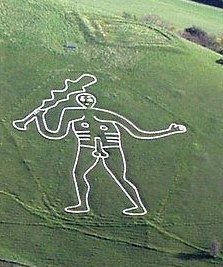
In a quiet corner of Dorset, England, the Cerne Abbas Giant stands tall, an enigmatic figure etched into the chalk hills of a region rich in history. It is an archaeological site, measuring 55 metres (180 feet) in length. Also known as the Cerne Giant or the Giant, it is one of two major extant human hill figures in England, along with the Long Man of Wilmington. However, documentation of the Cerne Abbas Giant stretches no further back than the late 17th century, adding an air of mystery to its origins and purpose.
The shallow trenches that form its shape suggest an age-old practice, yet archaeological evidence hints at some parts having been lost or altered over time, a mystery that leaves scientists uncertain about its original form. Scholars have proposed theories, such as its representation of Hercules, a Greek mythological hero who was also considered a Roman god, due to its position on the hill, its size, and its weapon. Another theory suggests a peculiar representation of an early Saxon deity, a notion partially supported by its similarity to other known Saxon hill figures.
Yet, no concrete evidence has been found to support any of these hypotheses. The Cerne Abbas Giant remains a mystery, a puzzle that continues to captivate scholars and visitors alike. The giant's position in local culture and folklore, especially its association with fertility, only adds to its allure. It is one of England's best-known hill figures and a visitor attraction in the region.
Sources: Wikipedia, OpenStreetMap, Wikidata, Wikimedia Commons
Written by Nicolo Ciampini
Discuss this with the author and others
No comments yet. Be the first to start the conversation.