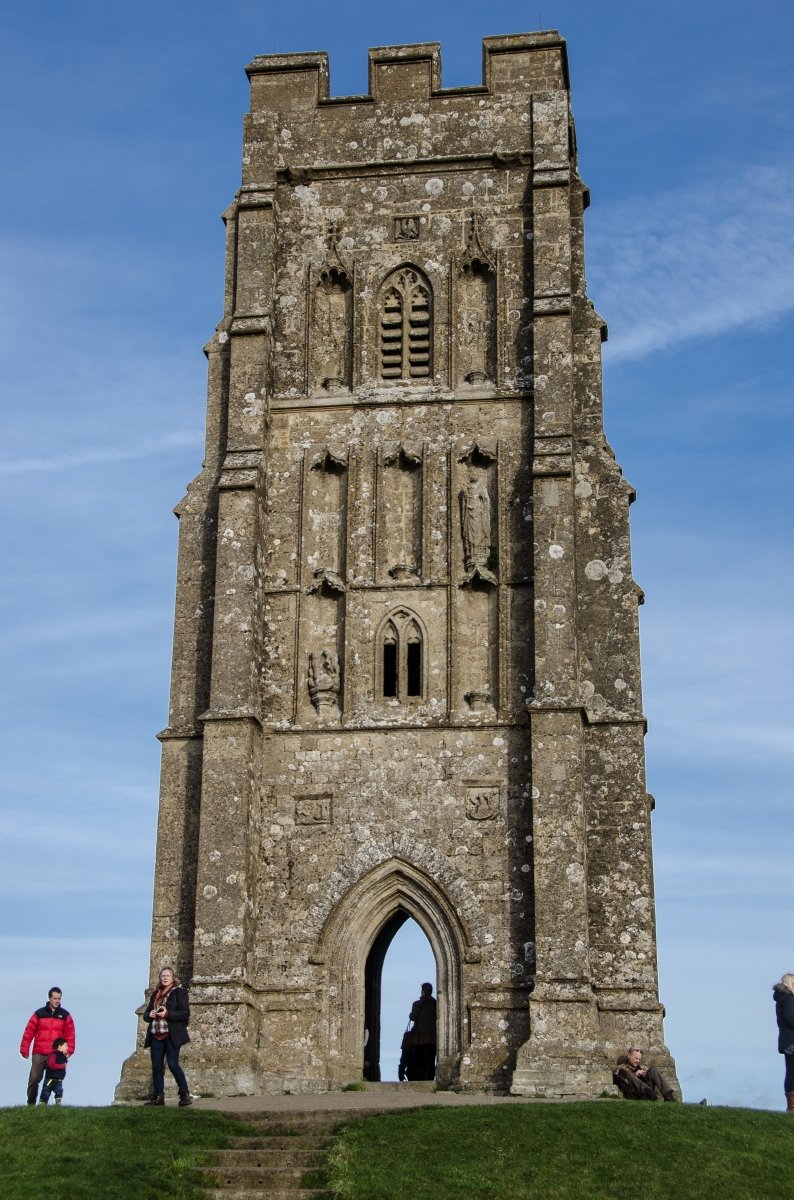
Glastonbury Tor, a hill near Glastonbury in Somerset, England, rises from the surrounding misty Lowlands. It is a conical hill of clay and Blue Lias, formed by the erosion of softer deposits, leaving a hard cap of sandstone exposed. The site is managed by the National Trust and is designated a scheduled monument.
The origin of the name Glastonbury is unclear. When the settlement was first recorded in the late 7th and early 8th centuries, it was called Glestingaburg. The name Glastinga is of obscure origin and may derive from an Old English word or Celtic personal name. The second half of the name, -burg, is Anglo-Saxon in origin and could refer to either a fortified place or a monastic enclosure.
Archeological excavations have revealed that the site was inhabited since the Iron Age to the Roman era. Several buildings were built on the summit during the Saxon and early medieval periods, including an early church and a monks' hermitage. The original wooden church was destroyed by an earthquake in 1275, and a stone Church of St Michael was built in the 14th century.
The site is steeped in mythology. It is mentioned in Welsh mythology, particularly in myths linked to King Arthur and the island of Avalon. The site has been claimed by some to be the location of the mythical Avalon, the final resting place of King Arthur.
The terraced slopes of the hill are a mystery. No one knows for sure how they were formed, but some theories suggest they are the remains of a medieval spiral walkway for pilgrims or a three-dimensional labyrinth. Others propose they were built for defensive purposes.
The National Trust offers guided tours of the Tor, where visitors can explore the ruins, learn about its history, and marvel at the stunning views.
Today, Glastonbury Tor stands as a testament to the rich history and mythology of the area. Despite its age, it continues to attract visitors and inspire intrigue and curiosity.
Sources: Wikipedia, OpenStreetMap, Wikidata, Wikimedia Commons
Written by Nicolo Ciampini
Discuss this with the author and others
No comments yet. Be the first to start the conversation.