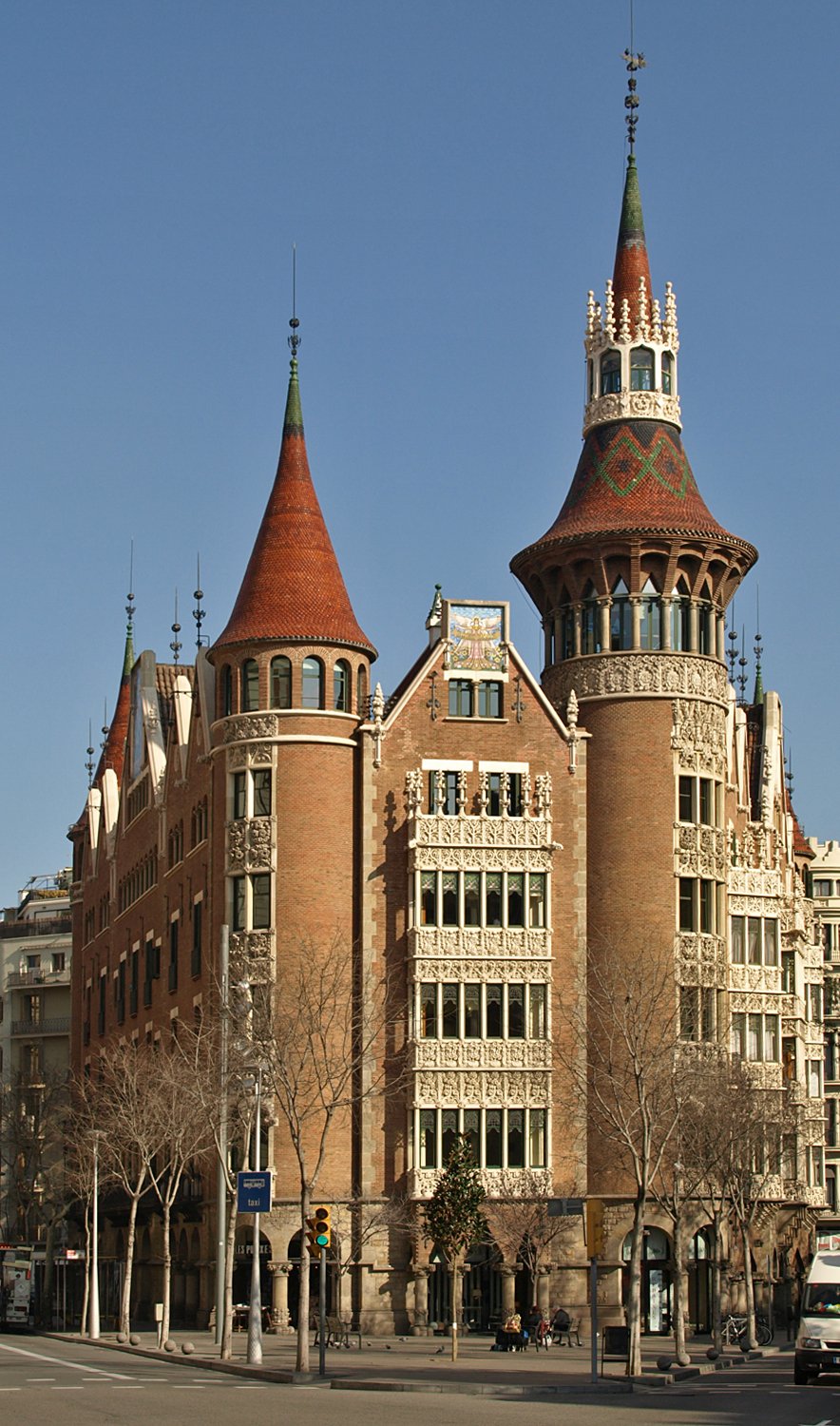

Does this structure look like it fell out of a fairy tale rather than a modern city plan? It was built on an atypically shaped, triangular lot that was a leftover of the urbanized Eixample. Because of this irregular shape, the architect Josep Puig i Cadafalch could not follow Cerdàs' urban plan. Instead, he designed a building inspired by the fashion of northern Europe, creating a block with six corners and six pointed towers. It earned the popular name Casa de les Punxes, or the House of Spikes.
In 1905, a textile industrialist commissioned the building to provide homes for his three sisters: Angela, Josefa, and Rosa. The result was a spectacular work of Catalan Modernisme that blends medieval feel with Central European vision. The architectural details reflect the ownership of the individual houses. You can find references to the owners in anagrams distributed as a frieze around the main tower, as well as in specific sculptural panels like the work by Enric Monserdà.
Can you see the celestial secrets? One section displays a ceramic panel from Monserdà featuring a sundial and a calendar with the four signs of the zodiac. Above the clock, a phrase from Virgil's Georgics reads: 'Numquam te crastina fallet hora'. Another ceramic panel represents Sant Jordi slaying the dragon with a message to the Patron Saint of Catalonia. Today, this historical monument of National Interest remains an emblematic part of the Barcelona skyline, housing offices in a privately owned workspace.
Sources: Wikipedia, OpenStreetMap, Wikidata, Wikimedia Commons
Written by Nicolo Ciampini
Discuss this with the author and others
No comments yet. Be the first to start the conversation.