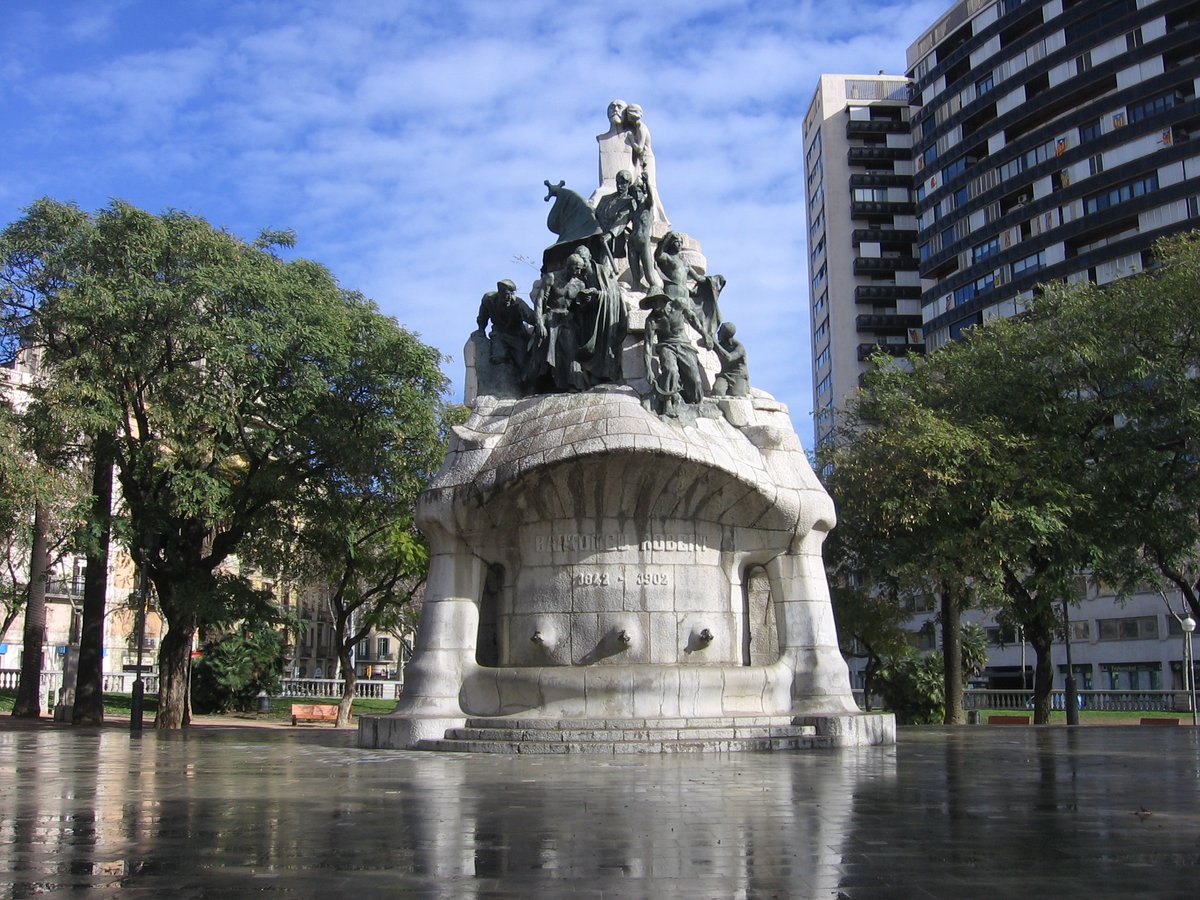

The Monument al Doctor Robert is a cataloged local cultural heritage site, located at the Plaça de Tetuan in Barcelona. It is dedicated to the memory of Bartomeu Robert i Yarzábal, a doctor and politician who made headlines in late 19th-century Spain. He was the mayor of Barcelona for a brief period from March to October 1899, but his popularity came from his opposition to taxes in commerce and industry proposed by the government of Francisco Silvela and Raimundo Fernández Villaverde, a position that led to protests known as 'El Tancament de Caixes'.
He had to resign but continued in politics, becoming President of the Lliga Regionalista in 1901. He died suddenly in 1902. The idea of a monument in his honor was proposed immediately after his death, and the construction began in 1904. It was inaugurated in 1910. The monument consists of a lightly piramidal stone structure crowned with a bronze figure of Doctor Robert and an allegory of Glory. The base is shaped like a fountain and is adorned with the name of the honoree and his birth and death years (1842-1902).
The frontal sculptural group features figures from various social strata such as farmers, laborers, politicians, intellectuals, clergy, and José Jacint Verdaguer with the Catalan flag. The monument also has sculptures of allegories of Music and Poetry, as well as references to medicine. The figures, especially those of a popular character, may be inspired by the work of sculptors such as Auguste Rodin or Constantin Meunier, but also by modernist sculptors such as Manuel Fuxà or Miquel Blay.
After the Spanish Civil War, the monument was removed and stored. It was restored and returned to its original location in 1985.
Sources: Wikipedia, OpenStreetMap, Wikidata, Wikimedia Commons
Written by Nicolo Ciampini
Discuss this with the author and others
No comments yet. Be the first to start the conversation.