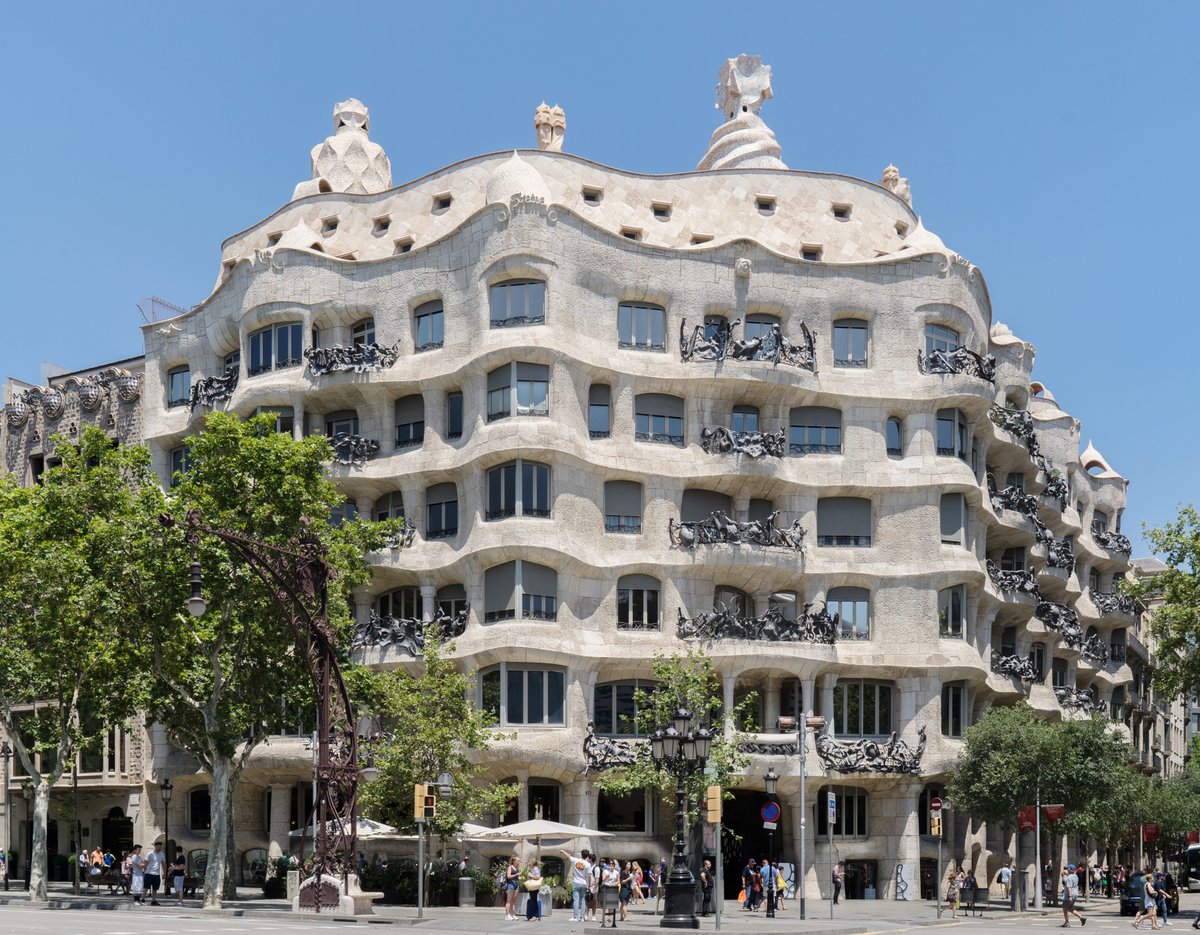

La Pedrera, popularly known as La Pedrera (Catalan: [lə pəˈðɾeɾə], Spanish: [la peˈðɾeɾa]; 'the stone quarry') in reference to its unconventional rough-hewn appearance, is a Modernist building in Barcelona, Catalonia, Spain. It was the last private residence designed by architect Antoni Gaudí and was built between 1906 and 1912.
The building was commissioned in 1906 by Pere Milà and his wife Roser Segimon. At the time, it was controversial because of its undulating stone facade, twisting wrought iron balconies, and design by Josep Maria Jujol. Several structural innovations include a self-supporting stone façade, and a free-plan floor, underground garage and the spectacular terrace on the roof.
In 1984, it was declared a World Heritage Site by UNESCO. Since 2013 it has been the headquarters of the Fundació Catalunya La Pedrera, which manages visits to the building, exhibitions and other cultural and educational activities at Casa Milà.
Pere Milà, a developer known for his flamboyant lifestyle, and Roser Segimón, a wealthy widow who had made her fortune with a coffee plantation in Guatemala, purchased the site in 1905. The demolition of the pre-existing building for Casa Milà started in 1906. The building, completed between 1906 and 1912, is often criticized for its unconventional name 'La Pedrera', which was a nickname given by the citizens. Though the building stirred up controversy, Antoni Gaudí hoped to make it a spiritual symbol with statues of Our Lady of the Rosary, St. Michael, and St. Gabriel on the roof.
Sources: Wikipedia, OpenStreetMap, Wikidata, Wikimedia Commons
Written by Nicolo Ciampini
Discuss this with the author and others
No comments yet. Be the first to start the conversation.