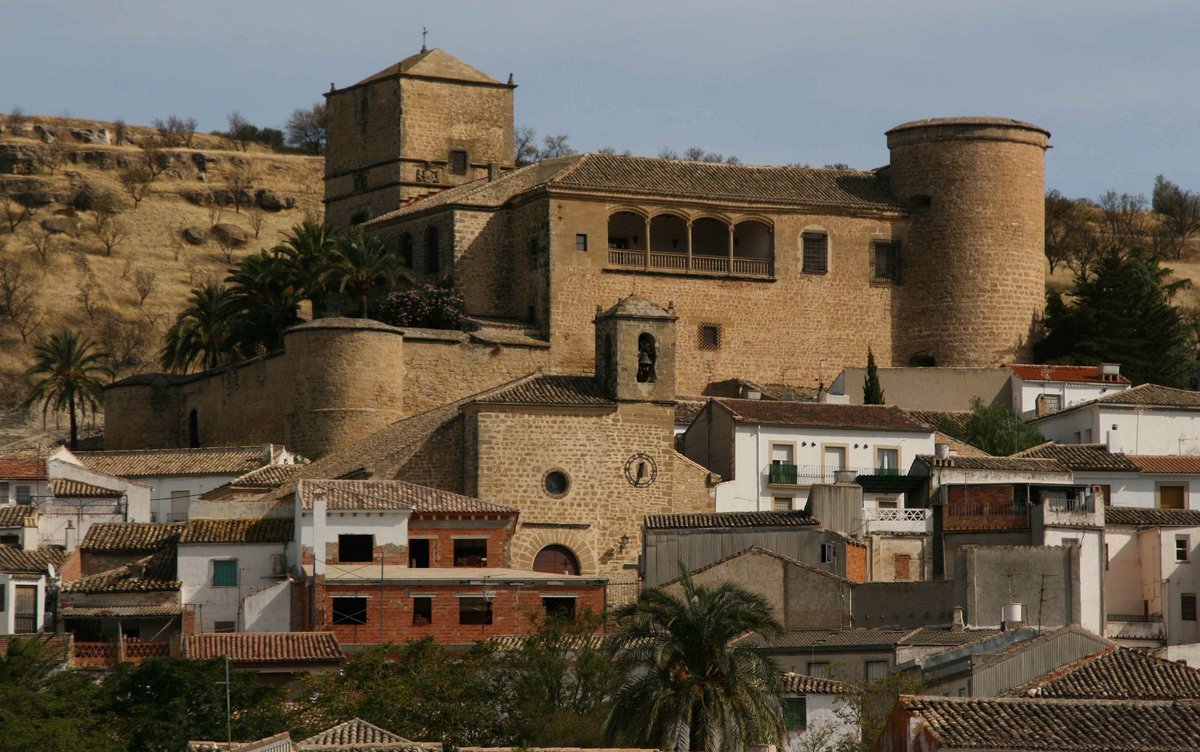

The Castillo de Canena, or palacio-residencia de Canena, is a building of Renaissance style built in the 16th century by the architect Andrés de Vandelvira. It belonged to Francisco de los Cobos and was mentioned by the Marqués de Santillana in one of his serranillas.
In 1538, Francisco de los Cobos, secretary to Carlos I and a prominent patron of the Renaissance in the Andalusian municipality of Úbeda and its region, purchased the villa of Canena. After his death, it was governed by his wife and descendants, the Marquises of Camarasa. In Canena, this great patron left one of his major construction projects, the transformation of a fortress that had lost its military purpose in the 16th century into a sumptuous palace-residence.
The building as seen today dates from the 17th century, although it stands on a fortress older than the 13th century. The palace is of quadrangular floor plan and possesses two large circular towers that protect the angles of the main facade and two others, of smaller size, on the opposite part, and the keep in the interior of the property. It features a magnificent interior courtyard with a second floor featuring a balustrade with columns and Ionic capitals.
The entrance opens with a semi-circular arch, flanked by Corinthian pilasters on plinths, with an entabliment of a frieze decorated with grotesques and a cornice above which rests a semi-circular arch housing the coats of arms of the founders. The interior courtyard features a double gallery and a cloister staircase. The lower gallery is of a molded semi-circular arch with a highlighted keystone and an intrados with rosettes.
The Castillo de Canena is declared a building of cultural interest, standing out as one of the most important in Andalusia and the most emblematic building of the municipality. It was declared a national monument in 1931. Currently, this building is privately owned and gives its name to the family company Aceite de oliva "Castillo de Canena", although visitors may view it by asking permission from the owners or by inquiring at the Town Hall.
Sources: Wikipedia, OpenStreetMap, Wikidata, Wikimedia Commons
Written by Nik Frost
Discuss this with the author and others
No comments yet. Be the first to start the conversation.