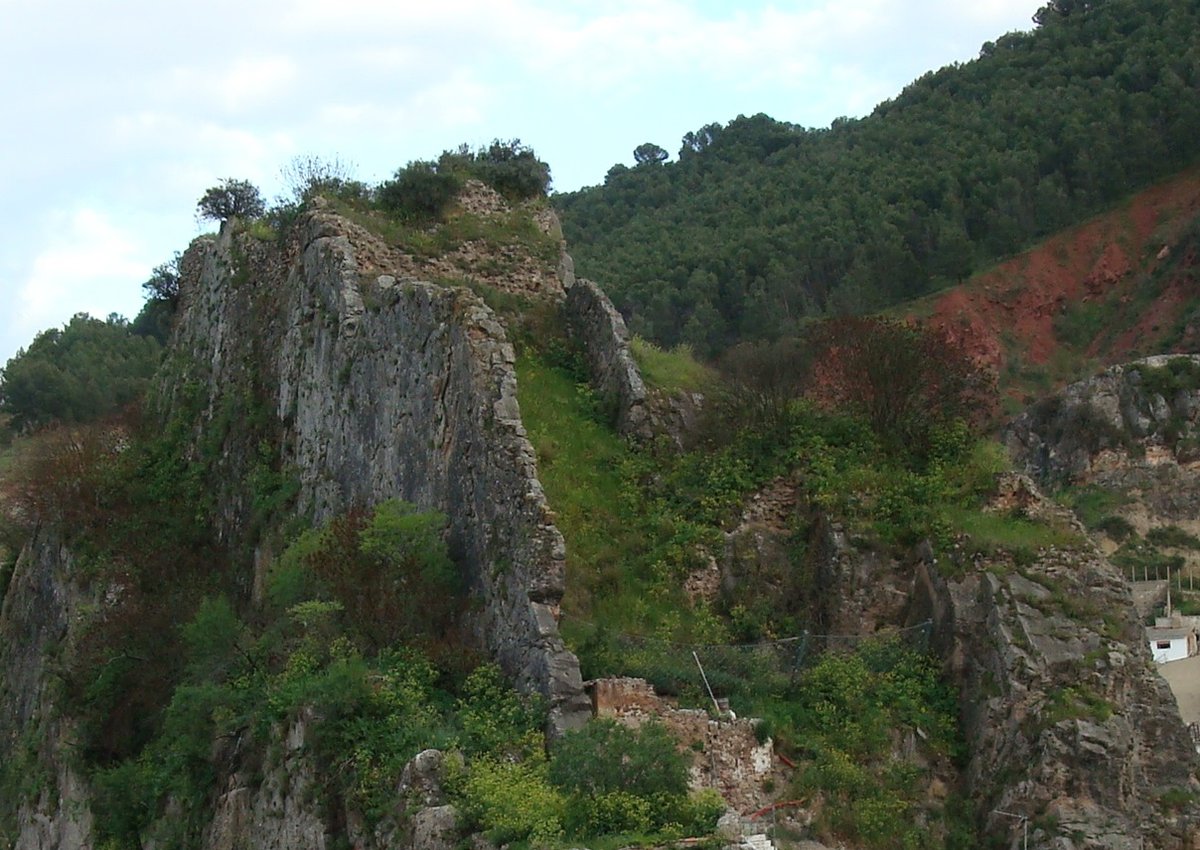

Stand on the crest of the Alhabar outcrop, and you are on a time capsule. This rugged landscape has been a fortress since the 13th century, the foundation for two villages: Cambil and Alhabar. The castle occupies the top of the outcrop, which has a steep slope and natural walls that enclose the major sides of a rectangular area. The castle, known as Castillo de Alhabar, was possibly built in the 13th century. However, it does not seem likely that it existed during the conquests of Fernando III.
The castle's rectangular shape and crude interior work, with small stones and abundant lime mortar, hint at its age. In the 12th century, Qanbil and Alhabar are first mentioned in relation to a water problem, indicating that two small villages (Cambil and Alhabar) existed at the time, each protected by a small castle. It does not seem likely that Castillo de Alhabar existed during the conquests of Fernando III. The castle appears in the 'Chronica de Alfonso XI' in the mid-14th century, when it was conquered by the Infante Don Pedro.
After this conquest, the castle became the subject of various attacks, particularly by the Condestable Don Miguel Lucas de Iranzo in 1462 and 1471, which failed. The castle was finally abandoned when it was captured by the Catholic Monarchs in 1485. Today, the castle lies abandoned and overgrown, the once refined fortress left to the elements.
Sources: Wikipedia, OpenStreetMap, Wikidata, Wikimedia Commons
Written by Nik Frost
Discuss this with the author and others
No comments yet. Be the first to start the conversation.