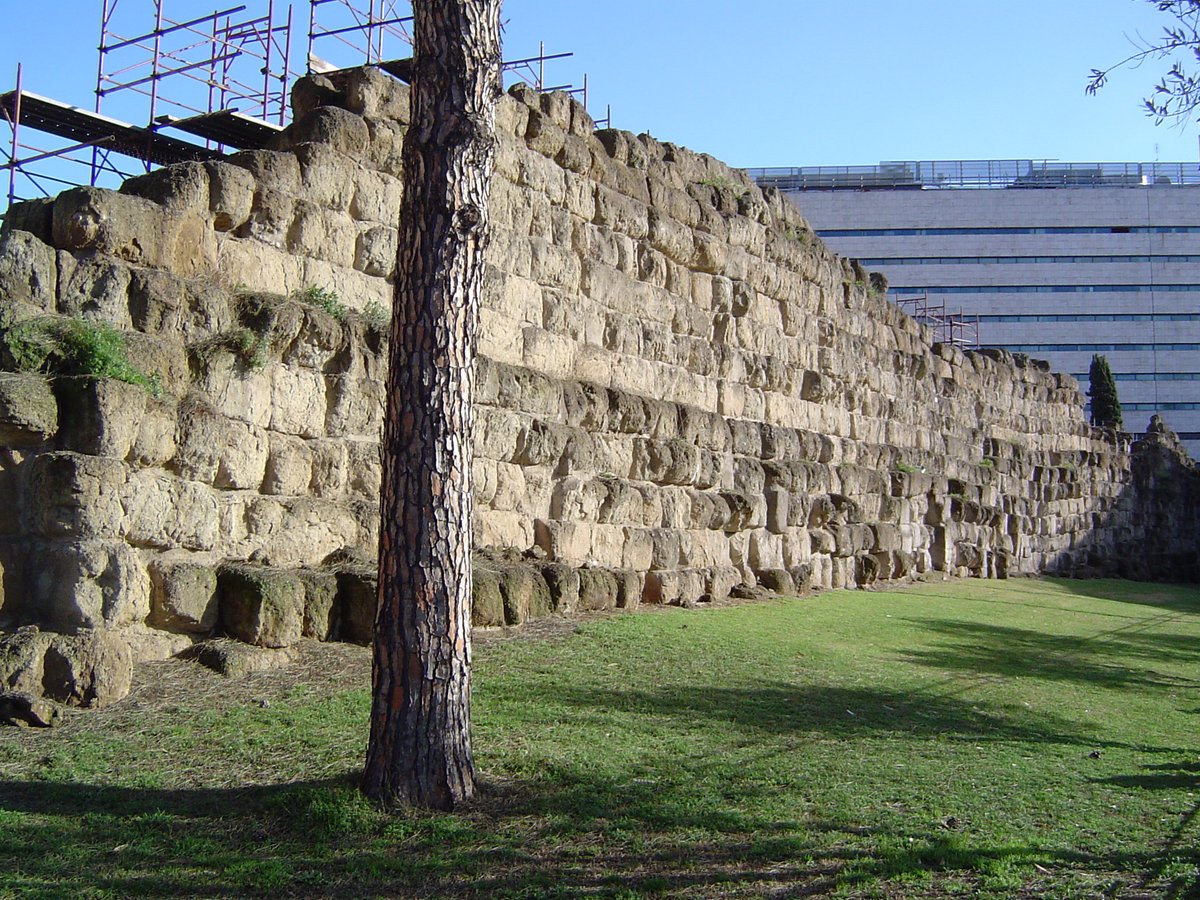

Standing near Porta Collina, one of the 16 main gates of the Servian Wall, envision Hannibal encamping his army and visualize the Roman catapults defending this ancient barrier against invaders. The Servian Wall was Rome's first line of defense, constructed in the 4th century BC for purposes of protection and security. It stood as a barrier against external threats, withstanding centuries of conflict and conquerors until its eventual replacement by the Aurelian Walls in the 3rd century AD.
Today, some sections of the Servian Wall remain visible, offering a look into the history that molded Rome. The Servian Wall was built from large blocks of Cappellaccio tuff, a volcanic rock, and it stood as high as 10 metres (33 feet) in places, enclosing a total area of 246 hectares (610 acres) and measuring 11 kilometres (6.8 miles) in length. Sections of the Servian Wall can still be found in various locations around Rome, such as outside Termini Station and near Aventine Hill.
Sources: Wikipedia, OpenStreetMap, Wikidata, Wikimedia Commons
Written by Nicolo Ciampini
Discuss this with the author and others
No comments yet. Be the first to start the conversation.