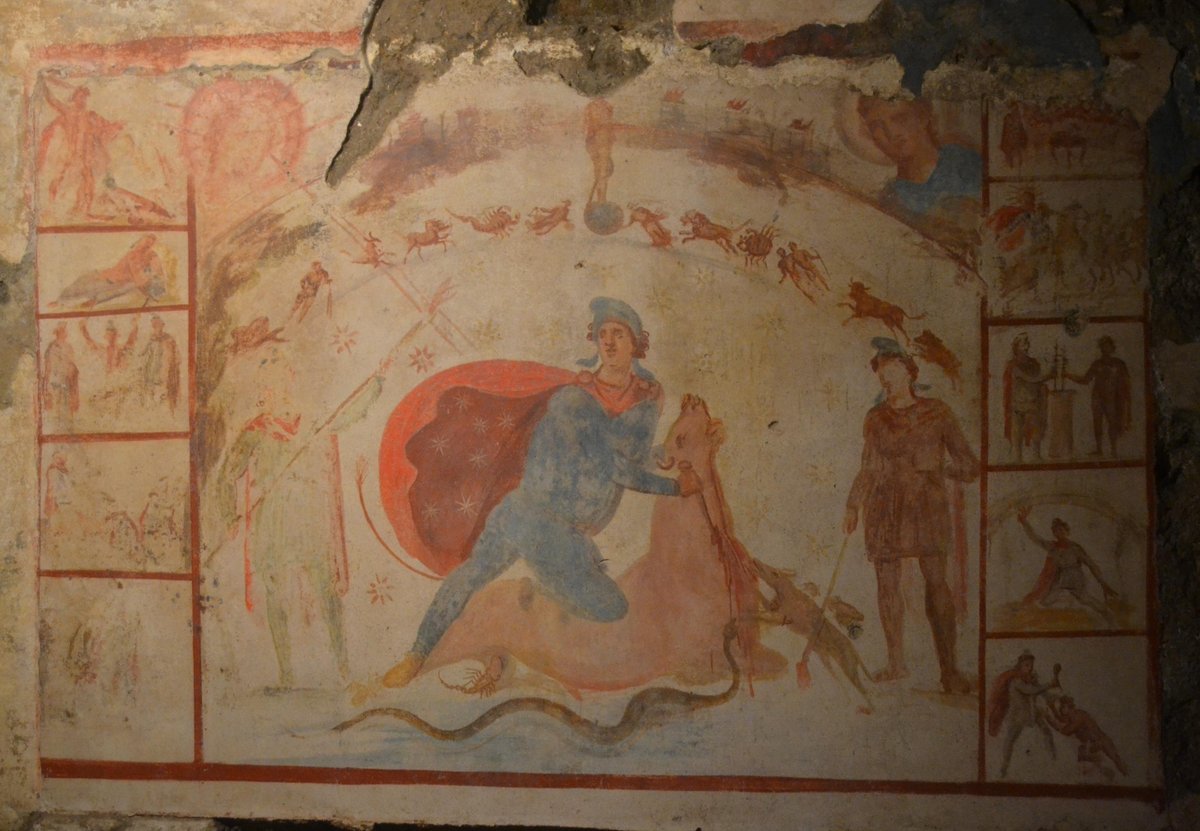

The Palazzo Barberini Mithraeum, discovered in 1936, is one of Rome's best-preserved Mithraea. In the 3rd century, the western part of the building was transformed into this subterranean temple. The room, 11.85 x 6.25 meters, features a barrel vault ceiling and two benches on either side. The painting on the back wall mirrors those in the Mithraea of Marino and Capua. The central scene depicts Mithra killing a bull, accompanied by a dog and a serpent drinking his blood, and a scorpion stinging his testicles.
Cautes and Cautopates, representing light and darkness, aid the scene. The zodiac signs and a figure with a lion’s head are displayed in the circle above. The sun and moon are depicted in the corners at the top. The side scenes narrate the tale of Mithra, encompassing his birth, the emergence of water from a rock, and his ride on a sun chariot. The Palazzo Barberini and Santa Prisca Mithraea are Rome's only painted Mithraea. Access to the Mithraeum is not included in a regular visit to Palazzo Barberini.
It is only accessible on extraordinary occasions, typically by reservation or in conjunction with special events organized by the National Gallery of Ancient Art.
Sources: Wikipedia, OpenStreetMap, Wikidata, Wikimedia Commons
Written by Nicolo Ciampini
Discuss this with the author and others
No comments yet. Be the first to start the conversation.