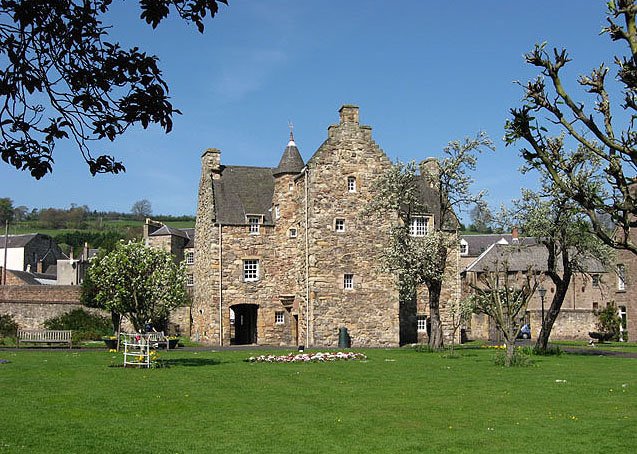

Mary, Queen of Scots, arrived in Jedburgh to preside over a justice ayre spanning from 9 October to 8 November 1566. While the presiding Lords Compositors rented a house from Lady Ferniehirst, Mary paid £40 to hire her own lodging in the town. During her stay, she took a hazardous journey to see James Hepburn, 4th Earl of Bothwell, who was injured at Hermitage Castle. She returned from this journey ill, and while in Jedburgh, she wrote a testament to confirm a will she had made while pregnant.
There is some doubt whether the queen stayed in this particular building, known as Queen Mary's House, which is a listed sixteenth-century structure. The building has been open to the public as a museum since 1930. During Mary's stay, the Privy Council issued a proclamation to keep good rule in the town, stating that no one should pursue private quarrels or arm themselves on pain of death for treason. The town also regulated the price of food and drink during this period.
Visitors today can still climb the stone spiral staircase of the three-storey stone-built building. An English border warden heard there had been a fire in Mary's lodging, which forced her to move. The house was painted by Arthur Perigal the younger in 1879 - a fanciful painting that places the building in a rural setting rather than the town setting where it has always stood. For the last thirty years, the museum has concentrated on telling the story of Mary's life and her eventual execution.
Sources: Wikipedia, OpenStreetMap, Wikidata, Wikimedia Commons
Written by Nicolo Ciampini
Discuss this with the author and others
No comments yet. Be the first to start the conversation.