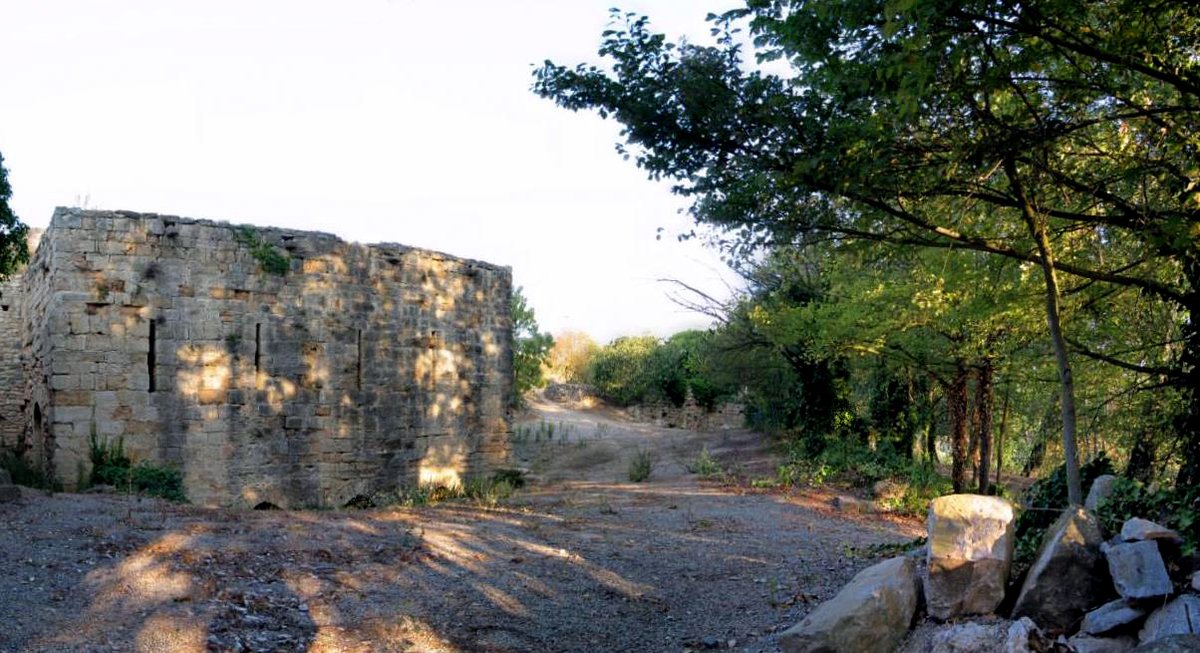

Molins de la Vila, located in Montblanc, Catalonia, Spain, is a group of medieval watermills dating back to the 12th century. Two of the original mills, Molí Gran or Molí de la Volta and Molí Xiquet, still stand today, offering a glimpse into the region's past and the importance of watermills to the economy and daily life of medieval villages.
The Molí Gran or Molí de la Volta, the larger of the two mills, covers an area of 89 square meters and includes four water-powered mills underneath a semi-circular arch. The walls and roof structure, as well as upper sections, are built with dressed stone. Four gun-shaped openings are located in the east wall. The water cistern, made of both masonry and excavated clay, is at a higher level and receives water from the Francolí river and discharges into the Anguera. Molí Xiquet, located by the Anguera river, has been destroyed by numerous floods and retains only a 61 square meter area with upper sections of two arches. Currently, the entire complex is part of the Museum Comarcal as a monographic section.
The Molins de la Vila area was documented in 1155 when Count of Barcelona Ramon Berenguer IV granted a charter of population to Pere Berenguer de Vilafranca. King Alfons I, with a new charter of population, established that the village should move to the other side of the Francolí river and be named Montblanc. The mills were the property of the commune from the 13th century until the Guerra dels Segadors. The municipality was sold to the Comunitat de Preveres. In 1846, the Comunitat de Preveres rented the mills to Baltasar Pedrol and Anton Casanovas, who in the contract mentioned that only two of the four were operational. The mills were destroyed in part at the end of the 18th century and were completely ruined by a flood in 1848.
Sources: Wikipedia, OpenStreetMap, Wikidata, Wikimedia Commons
Written by Nik Frost
Discuss this with the author and others
No comments yet. Be the first to start the conversation.