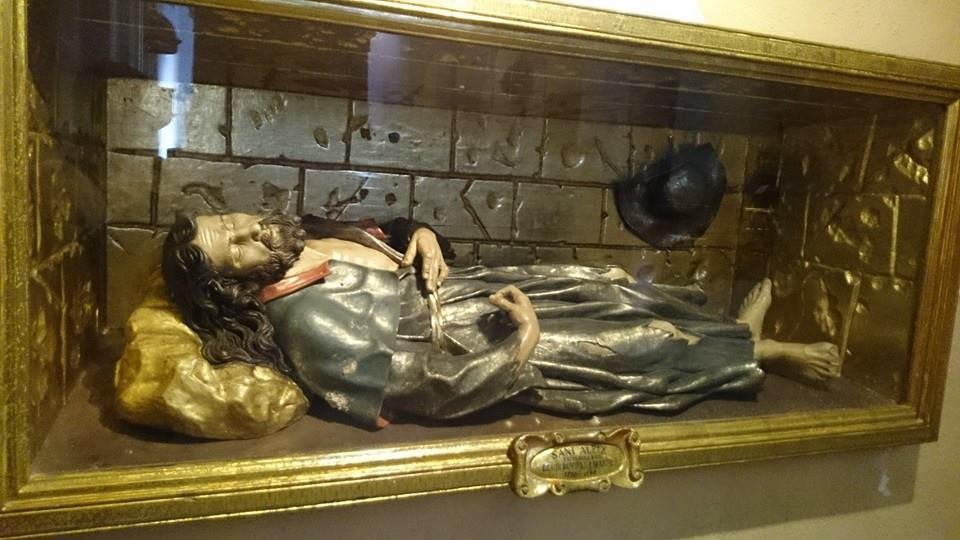

The small chapel of Sant Aleix jacent is located under a step in Sant Joan Baptista de Valls church, Tarragona, Spain. Carved out of polychrome wood in 1769, the statue was commissioned by Lluis Bonifaç i Sastre, who were devotees of Sant Aleix. Lluis Bonifaç i Massó, a master of the Baroque style, portrays the saint as a pilgrim who returned to his hometown and is depicted as wearing worn, tattered pilgrimage clothing and is barefoot. The chapel serves as a tomb for the Bonifaç and Ixart families, the statue stands as a fitting tribute to a pious pilgrim and a skillful artist.
The consecration of the chapel took place on April 17, 1769, the gilding of the sculpture was completed on June 24, 1771 and the retable was destroyed in 1936. The chapel is home to the statue of Sant Aleix, the plaque of Sant Aleix's temptations, the plaque of Sant Aleix saying goodbye to his wife, and the relief of the Virgin Mary. The statue of Sant Aleix is highlighted within a vitrine and above it, the relief of the Virgin Mary with her baby in her arms, symbolizing that she is accepting the soul of the saint and the Bonifaç family.
A golden plaque identifying the saint and the sculptor, Lluís Bonifac i Massó, is located beneath the statue. The chapel is decorated with mouldings and plafonds, and inside the chapel, there is a glass urn containing the jacent statue of Sant Aleix (1.20m). Another relief with the Virgin Mary accepting souls is present in the chapel. On the left, there is a plaque with the scene of Sant Aleix saying goodbye to his wife on their wedding day. On the right, there is a plaque depicting Sant Aleix tempted by the devil.
There are also images of Santa Sabina, Sant Ferran, and Santa Teresa. The Bonifaç and Ixart family coats of arms are on the front of the altar.
Sources: Wikipedia, OpenStreetMap, Wikidata, Wikimedia Commons
Written by Nicolo Ciampini
Discuss this with the author and others
No comments yet. Be the first to start the conversation.