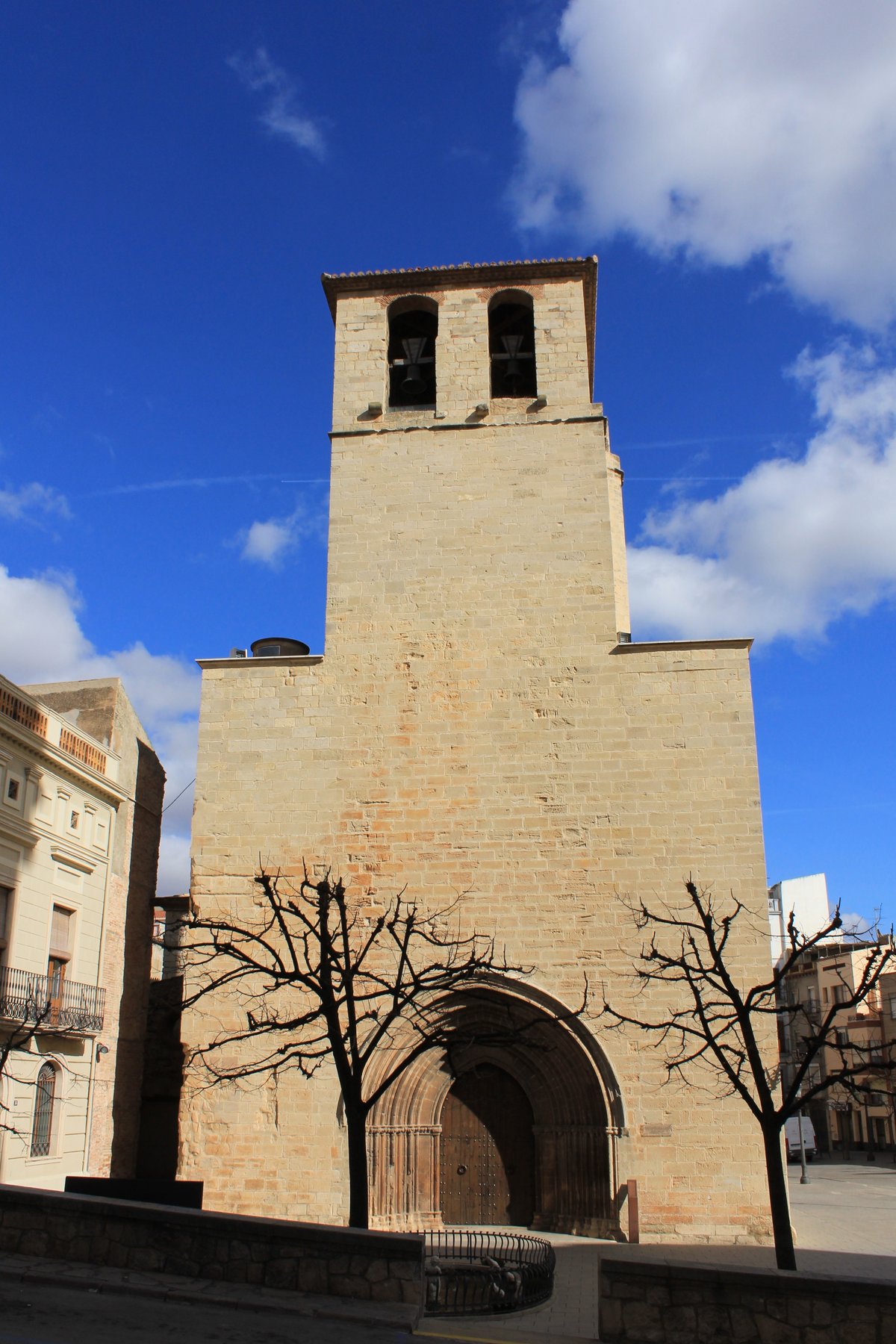

Sant Miquel de l'Espluga, in the Conca de Barberà region of Spain, was declared a cultural asset of national interest. This beautiful church, built in the 13th-14th centuries at the site of an earlier, romanesque church mentioned in 1182, boasts an intricate structure and stunning decorative work. Sant Miquel de l'Espluga has three trams and an apse with radial chapelles and a side chapel. The massive west facade, with a single entrance featuring complex feixes of moldures forming the arches and archivoltes, is a notable feature.
The belltower is a later addition. There is another entrance on the south facade, surrounded by contraforts. The presbytery, with rich decorative work that remarkably resembles that of Sant Miquel de Montblanc, is the 14th-century church's unique interior space that houses such decoration. The main altar has an image of Saint Michael from the 18th or 19th century. The pulpit, made of stone, has a floral design and is supported by a structure. In the 15th century, the Espluga was divided into two domains: Espluga Jussana and Espluga Sobirana.
There were two separate cemeteries for the two Esplugues, despite the church being the only parish. A larger church was constructed in the 19th century in front of the gothic church. The interior of the temple was heavily damaged in the third carlist war. Two restoration campaigns were carried out in the 1920s and 1950s. Sant Miquel de l'Espluga no longer has the character of parish, but remains open for worship. Tombes from the medieval period were found during urban sewer installation in the Plaça de l'Església.
The discoveries correspond to one of two cemeteries. 17 long-trench burials were identified during the intervention. The burrial type is typical of the late medieval and modern period. A copper chalice was found in one of the graves. The burials' location near the church walls suggests they might be from the 17th or 18th centuries, but no specific century could be determined.
Sources: Wikipedia, OpenStreetMap, Wikidata, Wikimedia Commons
Written by Nik Frost
Discuss this with the author and others
No comments yet. Be the first to start the conversation.