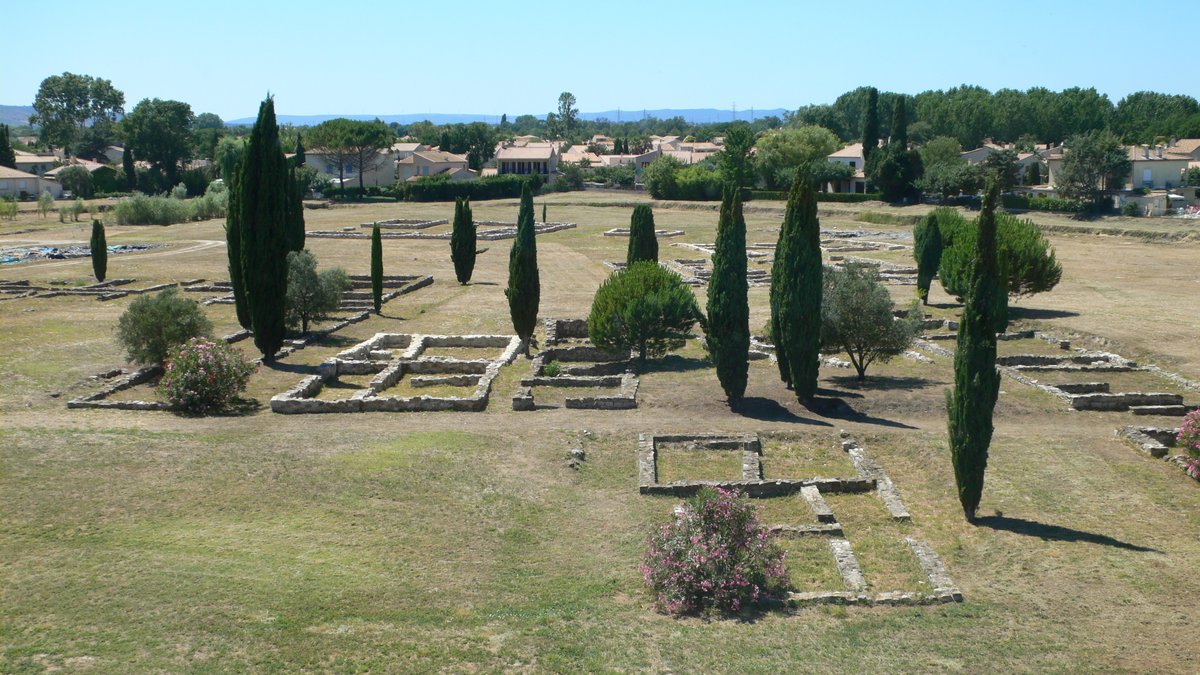

Lattara, a small town in southern France, is an ancient Etruscan port city with significant discoveries. Particularly notable are discoveries revealing Lattara's connections to the Etruscan origins of wine in Europe, including Etruscan amphorae from circa 525–475 BC containing residues of wine mixed with pine resin and herbs, and a limestone pressing platform dated around 425 BC with tartaric acid traces confirming local grape processing.
Accepting that Lattara was mentioned by many Roman authors, it was discovered in 1963 and is now home to the Musée Archéologique Henri Prades. Roman-era remains of a gray whale, now an extinct species in the North Atlantic, have also been found here.
These findings demonstrate how Etruscan imports likely spurred the transplantation of vines from Italy, establishing an indigenous industry that traces back to ancient Eurasian winemaking traditions. The exact role of Lattara in Mediterranean trade exchanges is uncertain, but evidence includes Iberian, Greek, and Roman influences in artifacts and architecture located at the site.
Sources: Wikipedia, OpenStreetMap, Wikidata, Wikimedia Commons
Written by Nicolo Ciampini
Discuss this with the author and others
No comments yet. Be the first to start the conversation.