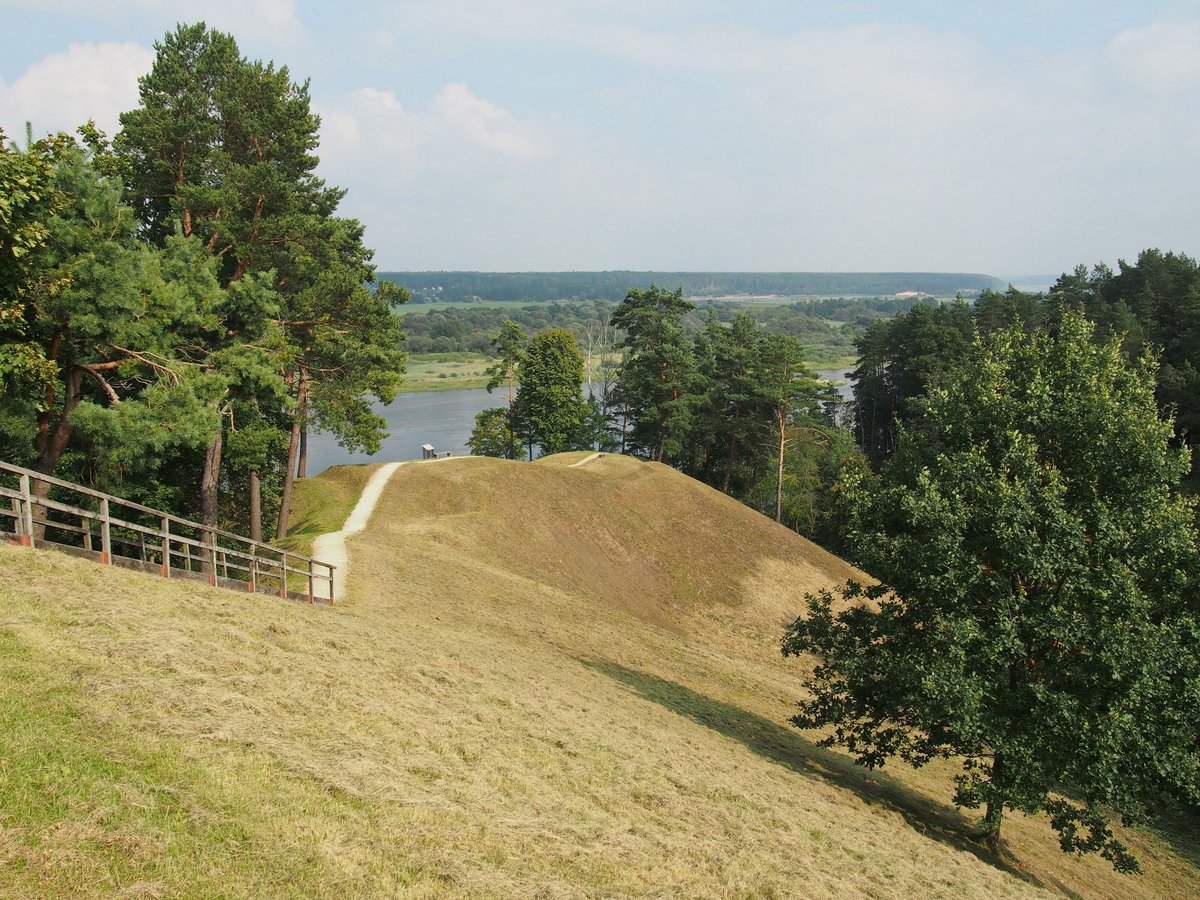
Hidden in the hills of Lithuania, the Burgaičių II piliakalnis contains three ancient sites: the labyrinthine Vorpilis, the triangular Pilaitė, and the long paved path Burgaičių piliakalnis III, also known as Bevardžius. These archaeological sites, part of the Nemuno kairiojo kranto Sudargo piliakalnio kompleksas, offer unique structures and histories. Vorpilis has square-shaped structures, 35 meters long and 30 meters wide, with a height of 9 to 27–40 meters.
Pilaitė, with its triangular form, is 15 meters long and 10 meters wide, with a natural stone wall of approximately 2.5 meters high, 14 meters wide, and 10 meters deep. Archaeological research suggests that it was inhabited in the Holy Roman Empire era and possibly during the Middle Ages. After archaeological excavations in 1970, 2005, 2008, and 2012, artifacts such as human bones, pottery, stone and metal objects, and iron deposits were found at Burgaičių piliakalniai.
Sources: Wikipedia, OpenStreetMap, Wikidata, Wikimedia Commons
Written by Nicolo Ciampini
Discuss this with the author and others
No comments yet. Be the first to start the conversation.