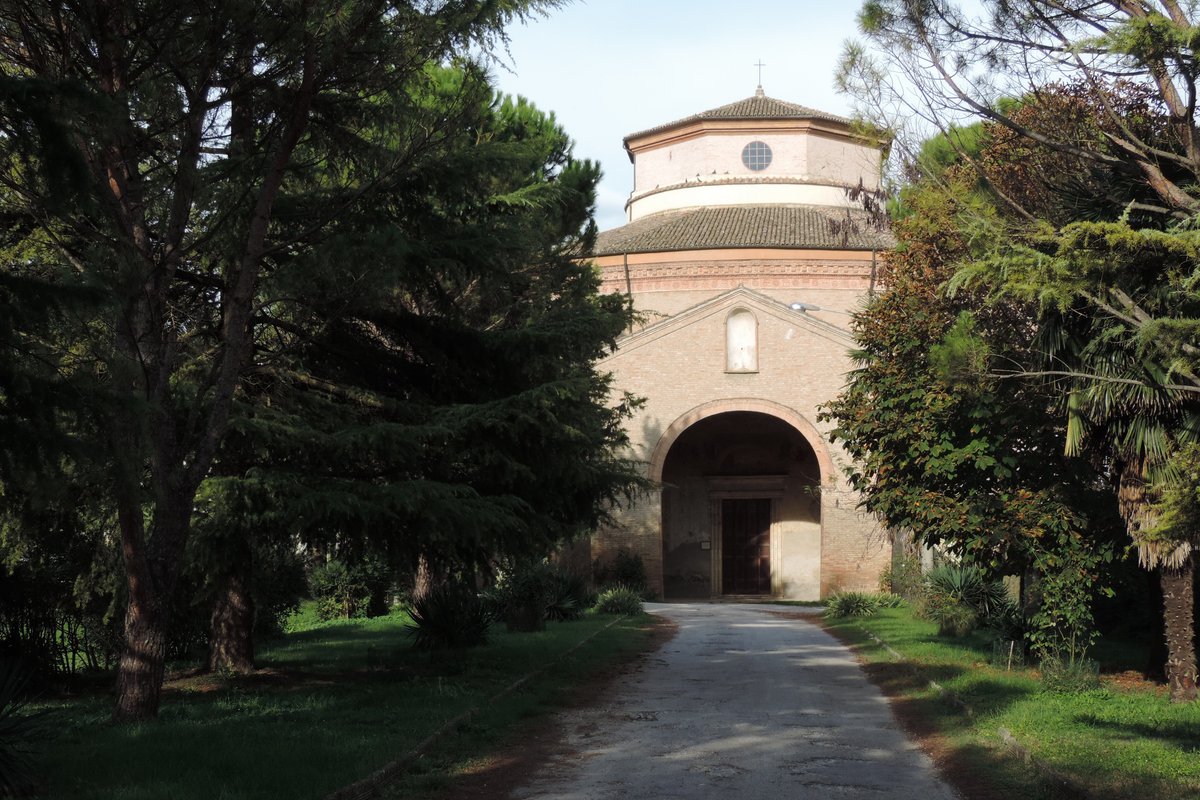

When the hermit Pietro Bianco arrived in Forlì in 1458, he eventually sought to build a sanctuary dedicated to the Madonna. The project was oriented toward creating a space of equilibrium and harmony, resulting in a central plan that Mariacristina Gori calls the most singular monument in the territory. The sanctuary features a main structure reaching a diameter of about 34 metres.
The building's history began as a small structure in the 1450s. While the current size is much larger, elements from the original 15th-century core remain, such as ogival windows and walled arches. These early features suggest a primitive structure that was later expanded, leaving behind the core of a building designed with a central plan and a focus on spiritual balance.
History has left its mark on the site through various trials. In 1483, an earthquake necessitated lowering and covering the ceiling with wooden beams, and floods from the Ronco river buried the original floor, requiring a new one to be built a metre higher. By the 1800s, the site faced potential demolition, but it was saved by the intervention of local inhabitants and officials. Between 1853 and 1857, restoration work was carried out to save the site from abandonment.
Today, the sanctuary retains its distinctive character. Visitors can see the entrance portal featuring an inscription and a Carrara marble copy of a painting, as well as a Renaissance frieze with medallions and busts of saints along the internal curved wall. While part of the bell tower spire fell in 1944 and was never rebuilt, the circular body of the church remains a significant architectural achievement of the Romagna region.
Sources: Wikipedia, OpenStreetMap, Wikidata, Wikimedia Commons
Written by Nicolo Ciampini
Discuss this with the author and others
No comments yet. Be the first to start the conversation.