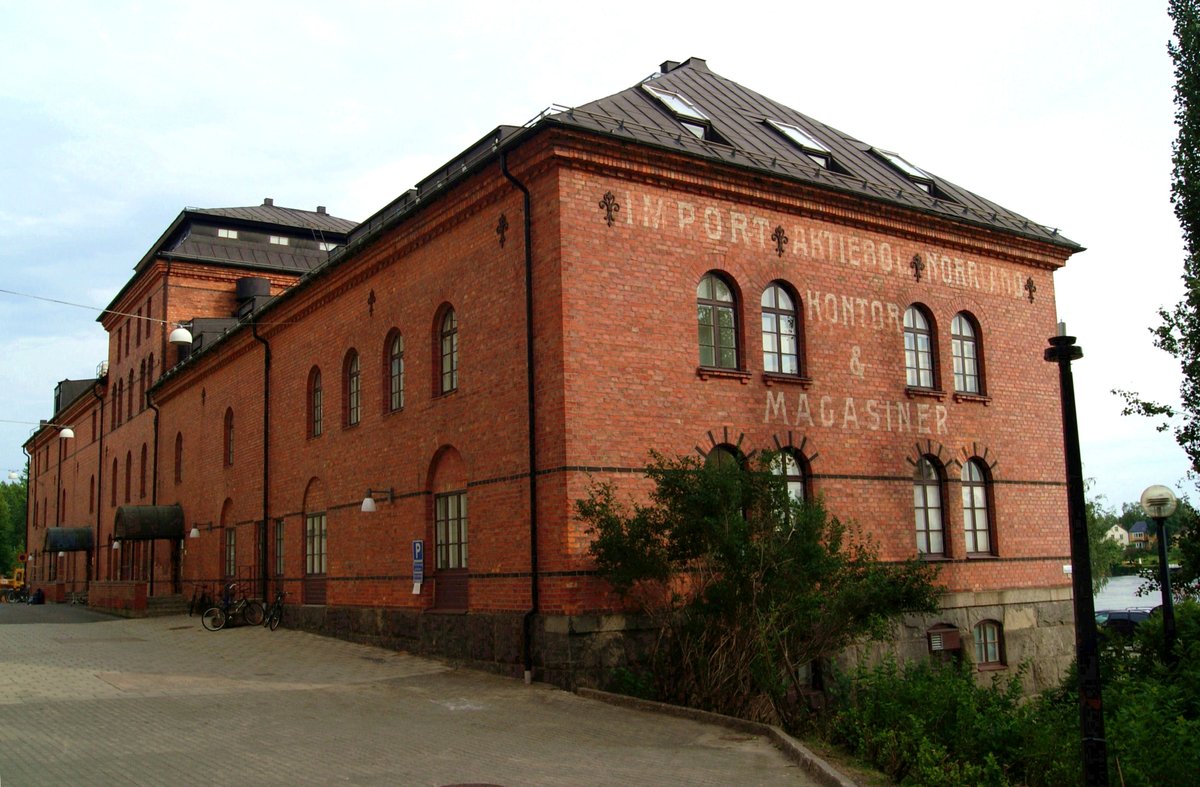

The massive red-brick facade of Tullkammaren bears a permanent inscription in white lime. It names the companies that once occupied its interior - the eastern part which housed the customs house, Umeå Import Aktiebolag, and David Renman AB. This 12,000 square metre building was born from the ashes of the 1888 city fire, which destroyed the local merchants' existing warehouses and homes.
Local merchants and the city formed a company to erect the structure in 1901. They hired architect Erik Olof Mångberg, who was known primarily for wood construction at the time. He gave the building a sturdy granite base and a light red-brick face. When the harbor moved to Holmsund in 1920, the building's primary maritime purpose ended, but its scale remained a defining feature of the northern riverbank.
Architectural details reveal a story of repair and compromise. After a fire in 1908 destroyed parts of the roof, the reconstruction ignored the original symmetry. Instead, builders focused on ensuring the warehouse harmonized with a nearby theater. This change meant the western risalit disappeared, being replaced by four dormers, while the middle risalit was rebuilt into a tower with an additional floor and a mansard roof.
Today, the building remains a protected heritage site. It has served as a home for a variety of institutions, including art schools, radio stations, and cultural offices. While the specific businesses listed on the walls are long gone, the brickwork remains a clear map of the town's industrial past.
Sources: Wikipedia, OpenStreetMap, Wikidata, Wikimedia Commons

Written by Nik Frost
Discuss this with the author and others
No comments yet. Be the first to start the conversation.