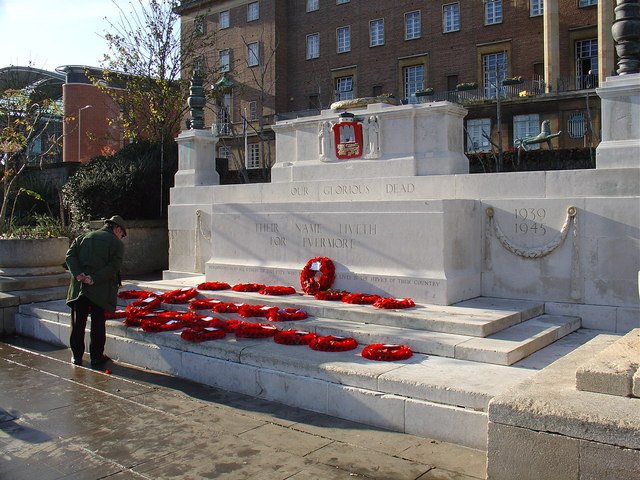

Early attempts to commemorate Norwich's war dead were fraught with controversy, including a scheme to build an agricultural college that was abandoned as being too ambitious and not appealing to all social classes. When Charles Bignold was elected Lord Mayor in 1926, he was determined to see a physical monument constructed before he left office. He established an appeal to raise funds for local hospitals and a memorial, eventually commissioning Sir Edwin Lutyens to design the monument.
Lutyens designed an empty tomb, or cenotaph, atop a low screen wall from which protrudes a Stone of Remembrance. The monument was completed swiftly once the location was agreed, costing £2,700 in 1927, though the design and proposed location continued to be a source of local controversy. Bignold defended the choice by noting that the Guildhall was a famous landmark and that the design was based on the expert opinion of the man who designed London's Cenotaph.
Because the memorial would not have space for the names of the city's 3,544 war dead, Lutyens was also commissioned to design a roll of honour. These oak panels, which fold out to reveal names painted on the inside, were installed in Norwich Castle in 1931.
Today, the memorial is a grade II* listed building in a memorial garden between the market and the City Hall. It was moved from its original location in 1938 and was rotated to face the City Hall in 2011, following a period of closure for structural repairs and restoration.
Sources: Wikipedia, OpenStreetMap, Wikidata, Wikimedia Commons

Written by Nicolo Ciampini
Discuss this with the author and others
No comments yet. Be the first to start the conversation.