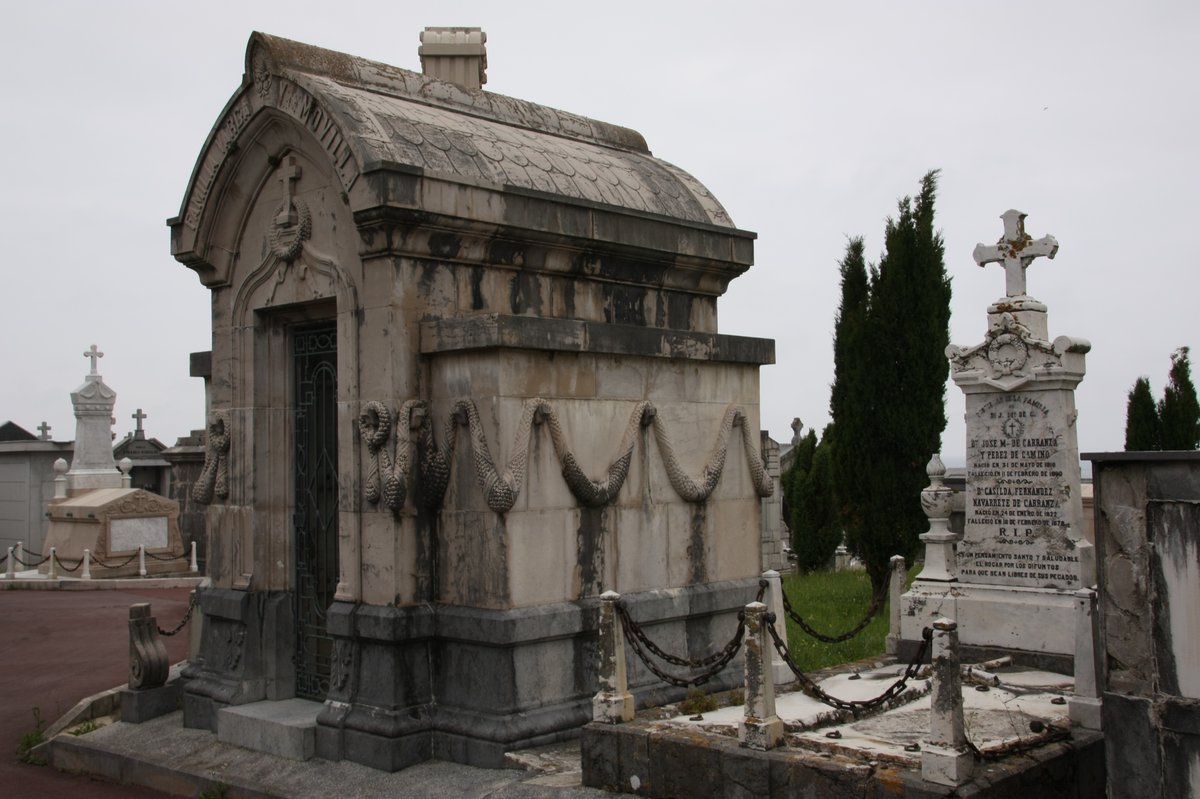

The Municipal Cemetery of Castro-Urdiales, colloquially known as La Ballena, stands as one of the most notable examples of Spanish funerary architecture. Designed by Joaquín Rucoba between 1885 and 1888, the cemetery was part of the urban expansion of the late nineteenth century. Its unique urban structure distributed the cemetery in blocks and streets, reminiscent of a city of the living. The scenic cemetery offers visitors an open-air museum experience, with its strategic location on a peninsula facing the Cantabrian Sea.
The heritage site of Castro-Urdiales, including its Santa María Church, its castle and lighthouse and the Santa Ana hermitage, can be viewed from the cemetery. The cemetery is unique, not only for its funerary architecture, but also for its historical significance. The name 'Ballena' (Eng. 'whale') refers to the importance of fishing and maritime activity in the city. La Ballena represents the economic boom of the 20th century, manifested in the sumptuous pantheons of the bourgeois class that emerged in the modern town of Castro-Urdiales.
In fact, La Ballena is one of the few Spanish cemeteries that has so many pantheons designed and projected by famous architects.
Sources: Wikipedia, OpenStreetMap, Wikidata, Wikimedia Commons
Written by Nicolo Ciampini
Discuss this with the author and others
No comments yet. Be the first to start the conversation.