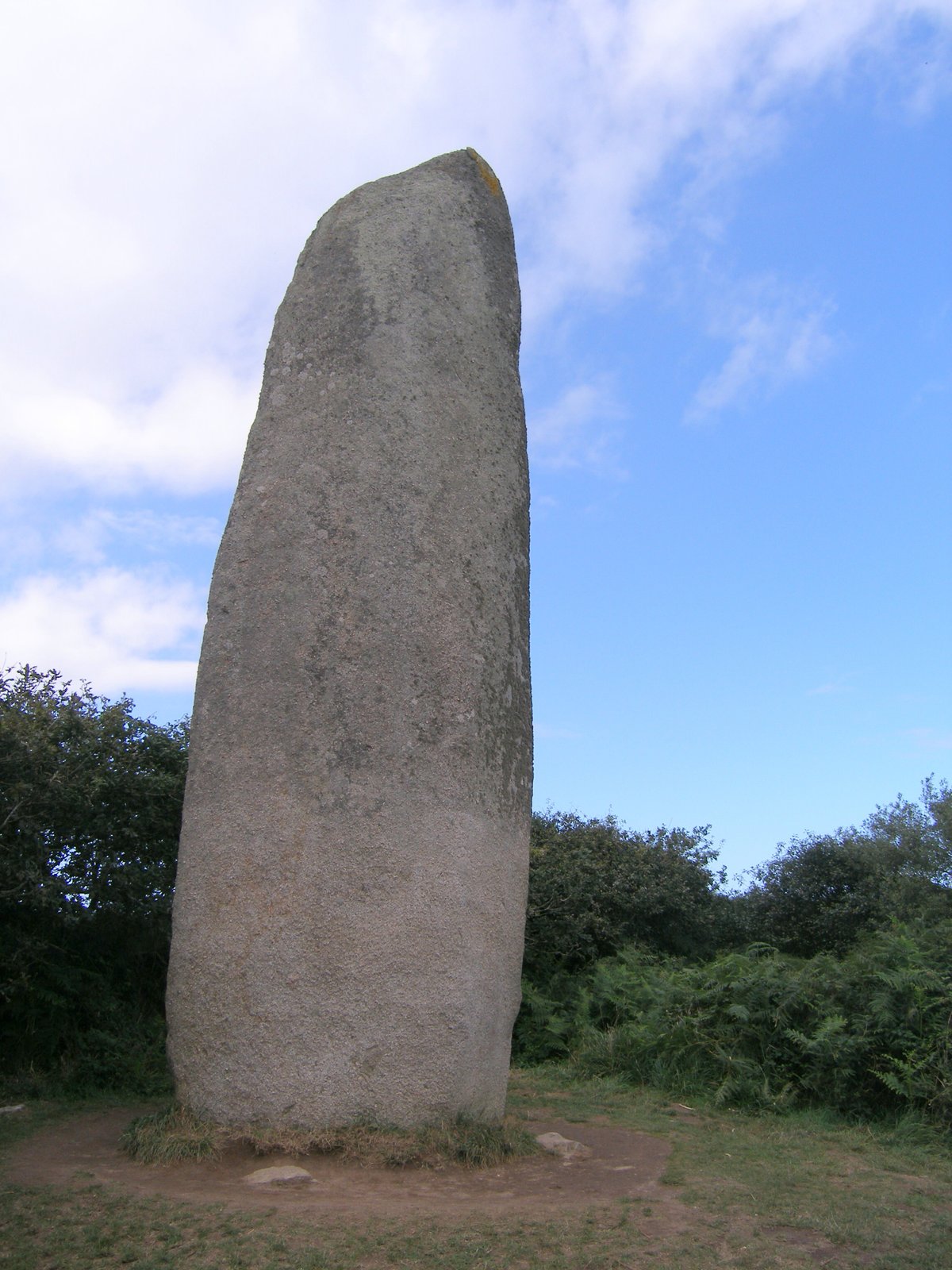

Against the French sky, the Kerloas Menhir, or Kervéatoux, stands proudly at 9.5 meters tall. centuries-old riddle to all who lay eyes on it. Much of its past remains a mystery, buried in time. What makes this monolith special? Its distinctly phallic shape and elaborate carvings, of course. Strange spheres, meticulously carved, adorn its western face, reaching roughly 30cm in diameter and a meter in height. Seven cupules, carefully placed between 2.5m and 4.5m, only add to the puzzle.
Two crosses appear in the daylight, but they do not provide answers, merely more riddles. Nearby, a circular arrangement of stones was discovered by Charles-Tanguy Le Roux at a depth of 0.6m and measures about 20 meters in diameter. Since Jacques Cambry noted its height as 10 meters in his travel records of 1794-1795, and Adolphus Trollope labelled it as 'the tallest and most magnificent menhir in all of Brittany' in 1839, this standing stone has left an indelible mark on those who have encountered it.
Classified as a historical monument since 1883, it serves as a formidable landmark for navigators, visible from up to 30 kilometers away. Could the tallest standing stone in France still hold a hidden secret?
Sources: Wikipedia, OpenStreetMap, Wikidata, Wikimedia Commons
Written by Nicolo Ciampini
Discuss this with the author and others
No comments yet. Be the first to start the conversation.