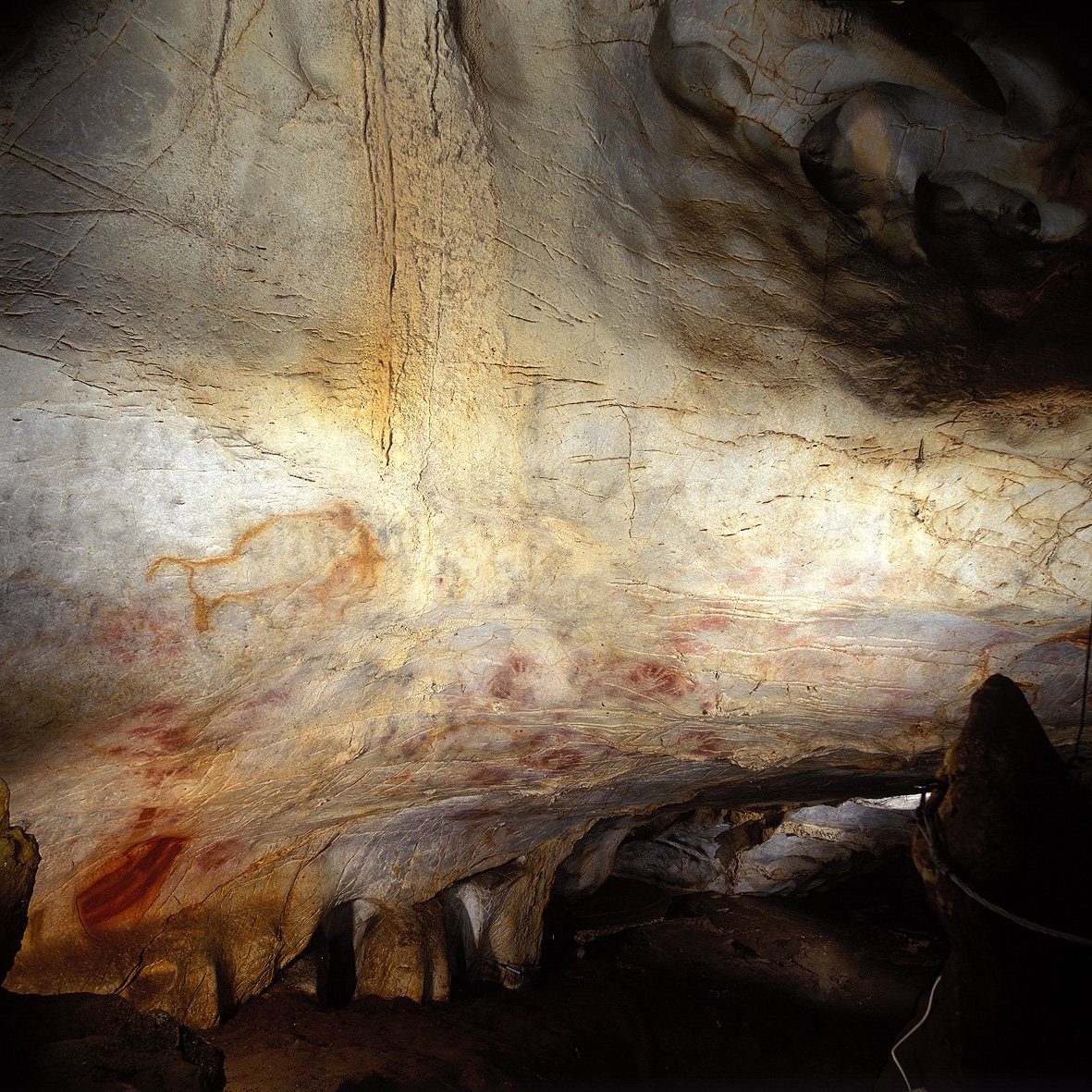

The Cave of El Castillo, located within the Caves of Monte Castillo in northern Spain, houses a rich archaeological site that provides a glimpse into the lives of our prehistoric ancestors. Discovered by Spanish archaeologist Hermilio Alcalde del Rio in 1903, it is considered one of the pioneering works in the study of Cantabria's cave paintings. The entrance to the cave has been artificially enlarged due to archaeological excavations. Upon entering, one is greeted by an extensive sequence of imagery painted in charcoal and red ochre on the walls and ceilings of multiple caverns.
The first monograph, published in 1911, catalogued approximately 200 motifs, including various animals and human figures. Modern studies dating back to 2012 suggest that the artwork in El Castillo dates back more than 40,000 years, which could indicate that cave painting originated in the Proto-Aurignacian period. According to a 2013 study, all verified hand stencils were of female hands, contradicting the previously held belief that this art form was primarily a male activity. The complete study of the cave, conducted from 2003 to 2023, identified around 2,698 motifs and archaeological evidence, including around 475 animals, 3 composite animals, 21 humans, 1 composite human, 1 imaginary creature, 40 projectiles, 834 elementary tracings, 90 complex tracings, 884 marks, 84 handprints, 118 archaeological evidence, and 17 lithophones.
Sources: Wikipedia, OpenStreetMap, Wikidata, Wikimedia Commons
Written by Nicolo Ciampini
Discuss this with the author and others
No comments yet. Be the first to start the conversation.