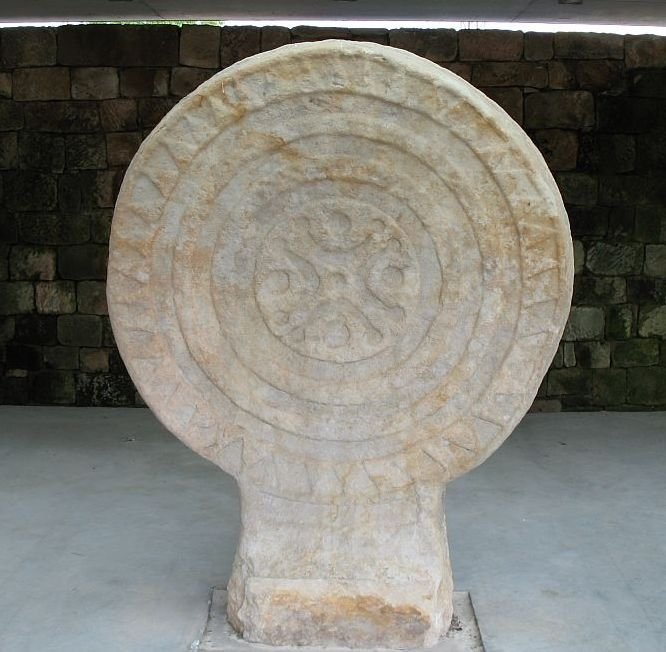

The colossal stone from Barros is a disk-shaped megalithic stele, dated from the 4th century BC. This gigantic relic is decorated with sun-worship motifs. With a diameter of 1.66 meters and a thickness of 0.40 meters, it is placed on a base of 1 meter in height and 0.80 meters in width. Despite being the most famous stele of Cantabria, it is not the largest; the second plinth of the Virgen de la Rueda is part of another large stele, with a diameter of 1.90 meters.
Other pre-Roman, Roman, and medieval steles can be found in the same locality. Carved in natural sandstone, the stone has a stone quality index of 65%, with fifteen internal fissures. The exterior surface is in good condition of conservation. Its decorative motifs, related to the worship of the Sun, are a circumference of isosceles triangles and a series of concentric circles carved in low relief; this decoration appears on both sides.
There are four grooves that run across the entire length of the stele. In 1946, it was taken to the Museum of Prehistory and Archaeology of Cantabria (Santander) by order of the provincial diputation, causing an uproar in the local population, who requested its return. The stele returned to Barros the next year, and is now located in the Barros Stone Park, opened in 2001 next to the N-611 highway, where it can be visited for free, along with the Second Stela of Barros, which was removed from the adjacent hermitage.
Sources: Wikipedia, OpenStreetMap, Wikidata, Wikimedia Commons
Written by Nicolo Ciampini
Discuss this with the author and others
No comments yet. Be the first to start the conversation.