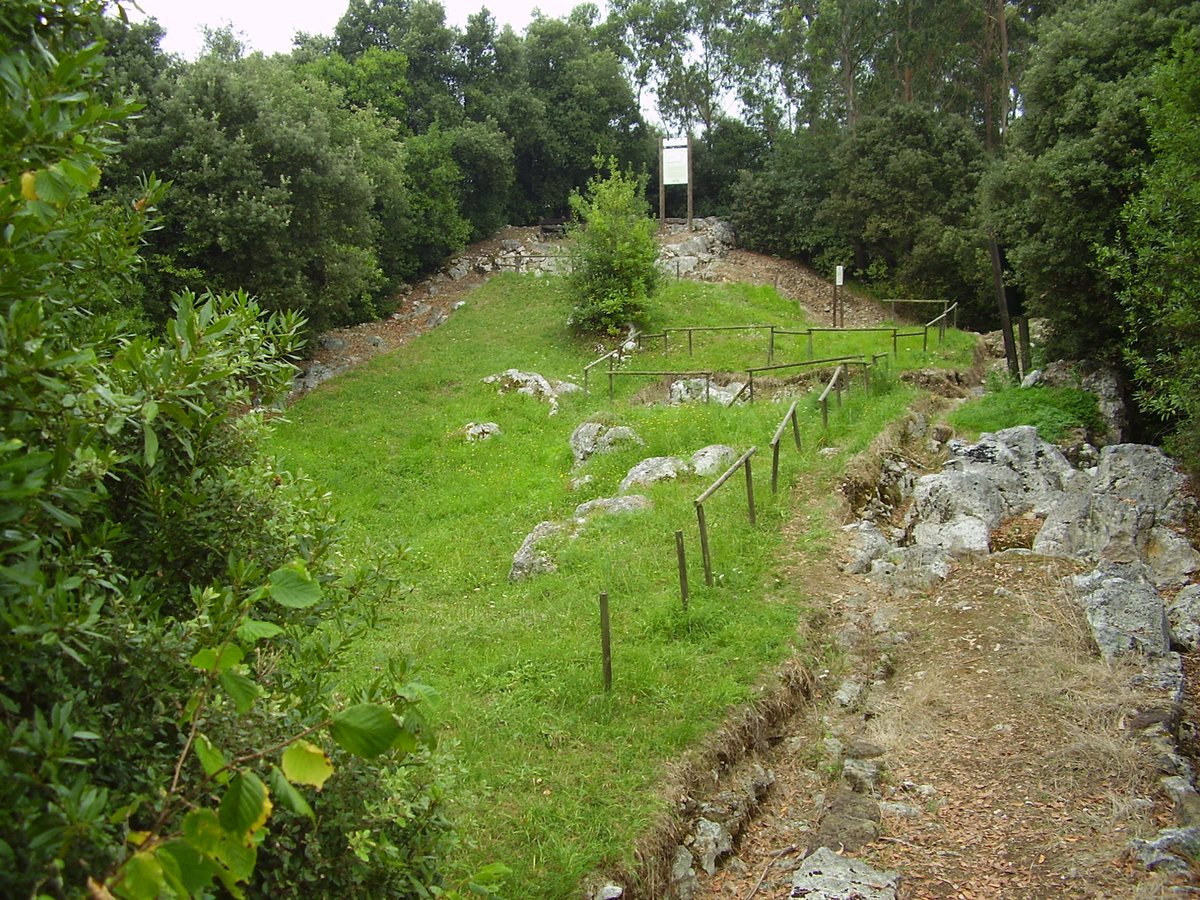

Castillo del Collao, located in Escobedo, Camargo, Cantabria, Spain, stands on the Collao hill to which it originally owes its name. Dated between the 8th and 12th centuries, it is one of about 30 similar castles found in Cantabria and one of the best preserved in the region. Built from stone and rubble with a lime mortar filler, it has walls 2.5 meters wide and a total protected area of about 512 square meters on top. While the castle is dated between the 8th and 12th centuries, it was rehabilitated between 2000 and 2001.
Today, the castle stands on public land and offers a great viewpoint, providing views of Santander Bay, the Pas Valley, and part of the Camargo Valley. Abundant ceramic pieces, including pots and jars, have been found, as well as iron arrowheads and a figurine of a man made of clay and a bronze plaque covered in gold with a monster heads motif, and other artifacts. Carbon dating tests have determined the age of the site between 760 and 1020 AD, with a 110-year range of uncertainty for each date.
Sources: Wikipedia, OpenStreetMap, Wikidata, Wikimedia Commons
Written by Nik Frost
Discuss this with the author and others
No comments yet. Be the first to start the conversation.