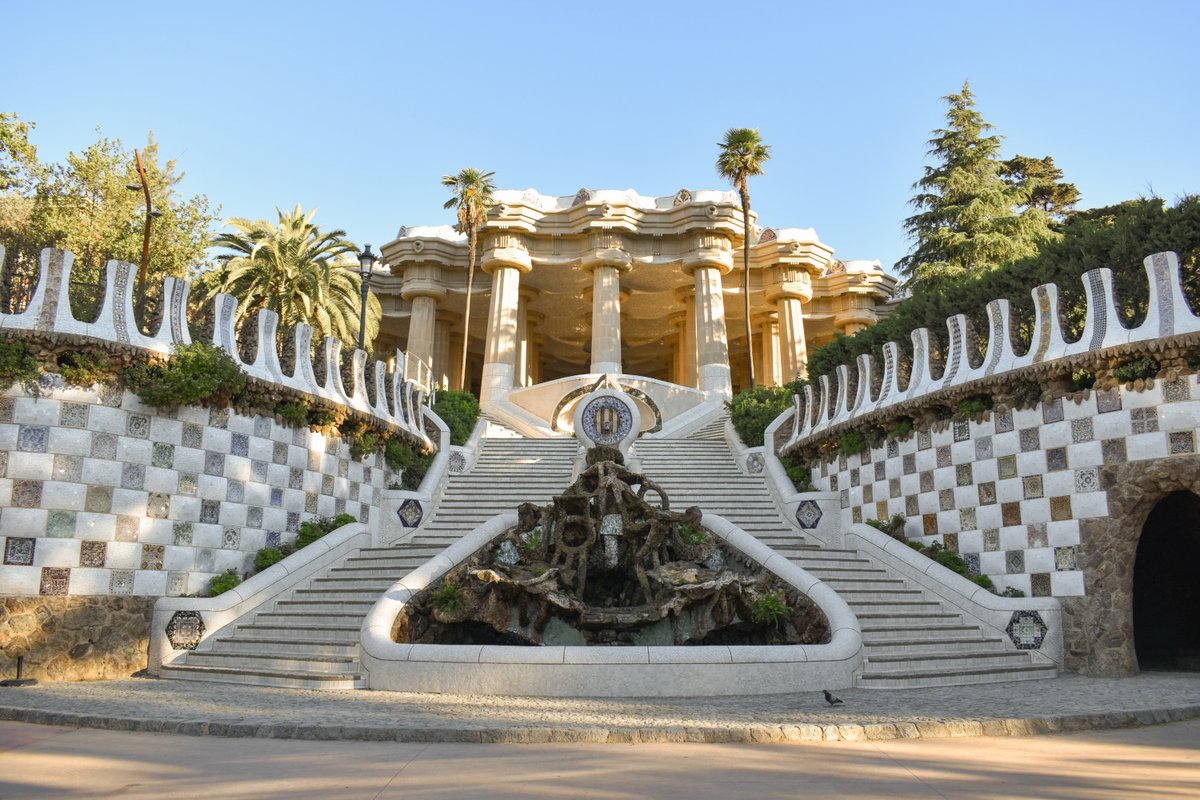

Originally, Catalan industrialist Eusebi Güell commissioned architect Antoni Gaudí to design a private residential development of luxury homes with modern amenities. Inspired by the English garden city movement, Güell sought to market the rocky hill of Muntanya Pelada for its clean air and views. The plan included sixty triangular plots for luxury homes, but the sparsely developed area was found to be too far from the city centre. Only two homes were built, and neither were designed by Gaudí.
Between 1900 and 1914, Gaudí transformed the site into a park reflecting his naturalist period, using innovative structural solutions based on geometric analysis. He designed elevated pathways using local stone, with columns and vaulted supports that mimic tree trunks and natural forms. He also created a terrace bordered by a long, curving bench shaped like a sea serpent, designed by Josep Maria Jujol. This terrace features mosaic vaults inspired by grotesque motifs from Roman architecture, particularly the Domus Aurea.
The park eventually became a municipal garden and was designated a UNESCO World Heritage Site in 1984. Visitors can walk the pathways to the highest point, where steps lead to El Turó de les Tres Creus, a calvary of three stone crosses. Since 2013, entry to the Monumental Zone requires a ticket, though Barcelona residents may enter for free. The park now supports a diverse range of wildlife, including non-native parrots and the hummingbird hawk moth.
Sources: Wikipedia, OpenStreetMap, Wikidata, Wikimedia Commons
Written by Nicolo Ciampini
Discuss this with the author and others
No comments yet. Be the first to start the conversation.