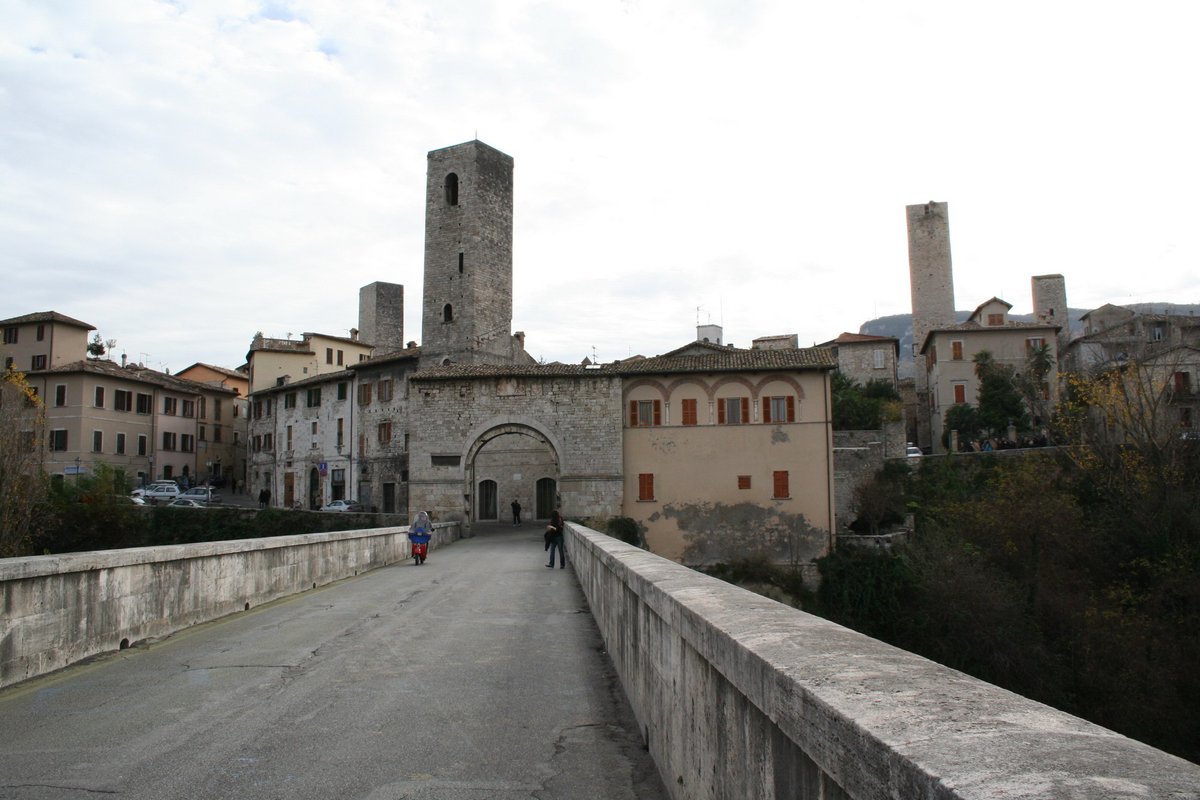

Porta Solestà, also known as Porta Cappuccina, is one of the gates of the city of Ascoli Piceno. While it was named Cappuccina from the 16th century because the commissioner Angelini allowed the Capuchin friars to build a small church nearby in 1544, the structure was actually built in 1230. It was erected at the beginning of the Ponte Romano, from which a secondary branch of the Via Salaria departed.
The origins of the name Solestà may derive from 'Sol', suggesting a temple dedicated to that deity, or from 'Sullae statio', in memory of a column placed there by Silla. The gate was built by Fildesmilio da Mogliano, the podestà of Ascoli, likely using materials from a pre-existing Roman gate. The architecture is simple and clean, consisting of a large, massive arch made of smooth-faced square blocks of travertine.
Latin inscriptions on the walls provide historical context. One, in Gothic characters, dates the construction to 1230 and mentions Fildesmilio ordering the gate's creation. Another inscription from 1450 commemorates a peace and confederation with the city of Fermo, featuring the emblems of both cities within a single shield. A third stone from the first half of the 13th century shows three emblems surrounded by oak leaves, where the central emblem is believed to be that of Fildesmilio da Mogliano.
Sources: Wikipedia, OpenStreetMap, Wikidata, Wikimedia Commons
Written by Nicolo Ciampini
Discuss this with the author and others
No comments yet. Be the first to start the conversation.