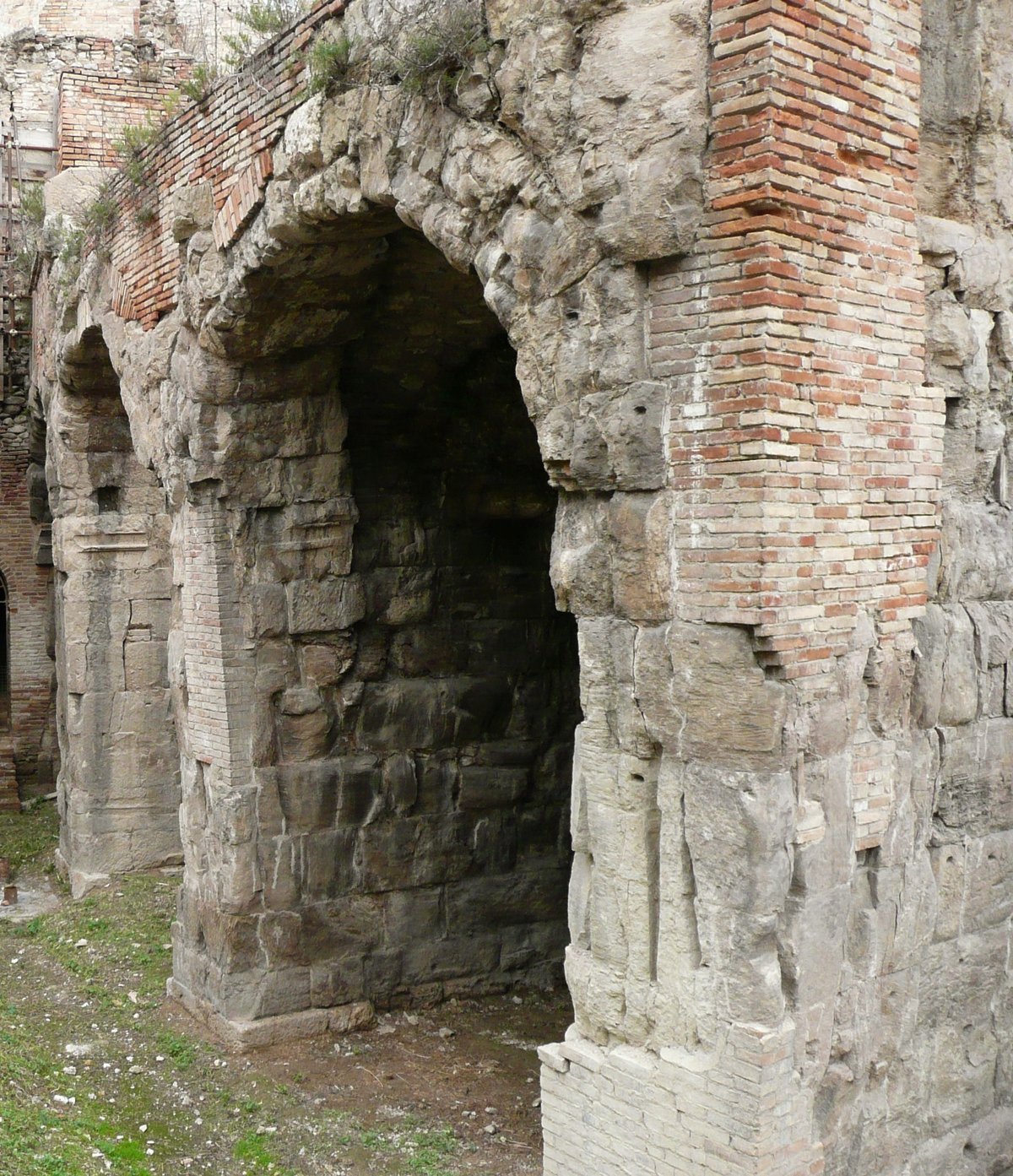

In the historic center of Teramo, between via Teatro Antico and via Luigi Paris, lies the ancient Roman theatre of Interamnia. Constructed during the Augustan age around 30 BC, the theatre featured a stage decorated with alternating rectangular and semicircular niches. The monument was erected in the western sector of the city at the entrance near the via Caecilia, which connected Interamnia Praetuttiorum to Roma.
The theatre suffered the same fate as numerous other monumental works. It was used as a quarry for stone to build nearby structures, particularly the Duomo of Teramo, built in the area northwest adjacent to the archaeological site. Some carved stones removed from the Roman constructions can still be observed today in the northeast external wall and in some internal parts of the Duomo.
For a long time, the theatre's stage remained hidden beneath the urban area above, including the Adamoli and Salvoni palaces built at the end of the 19th century. In the 20th century, the historian and archaeologist Francesco Savini discovered that the theatre existed in its entirety beneath these buildings. Although the first world war abruptly interrupted the work, only the eastern part of the stage was brought to light by 2021. A large part of the orchestra and the cavea remained covered by overlying buildings until that time.
Sources: Wikipedia, OpenStreetMap, Wikidata, Wikimedia Commons
Written by Nicolo Ciampini
Discuss this with the author and others
No comments yet. Be the first to start the conversation.