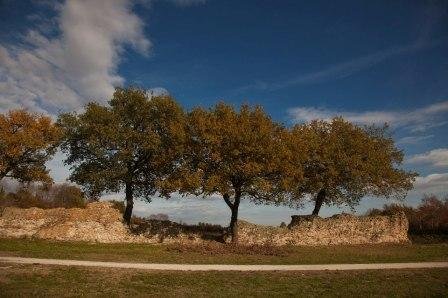

Urbs Salvia was a Roman city in the Marches, Italy, founded as a colonia during the 2nd century BC. The city was located on the via Salaria Gallica and in the Roman province of Picenum. The monuments were largely built under Augustus and Tiberius. The Archaeological Park of Urbs Salvia is exceptional for the ease with which the overall building plan can be deciphered. This park houses an impressive reservoir, built to provide the entire city with water.
The reservoir, located outside the medieval city walls, on the highest point of the site, was formed by an underground vaulted conduit. The ancient aqueduct that supplied the reservoir was about 1.5 km long. It had a gentle and constant slope so that it could carry water from a spring situated at the opposite side of the present-day Urbisaglia into this structure. The reservoir itself consisted of two barrel-vaulted tunnels, each about 51 meters long, 2.9 meters wide, and 4.1 meters high.
These tunnels, made of bricks, were built to hold a total of 2000 cubic meters of water. The water outlet, still visible in the reservoir, allowed water to be distributed to the city.
Sources: Wikipedia, OpenStreetMap, Wikidata, Wikimedia Commons
Written by Nicolo Ciampini
Discuss this with the author and others
No comments yet. Be the first to start the conversation.