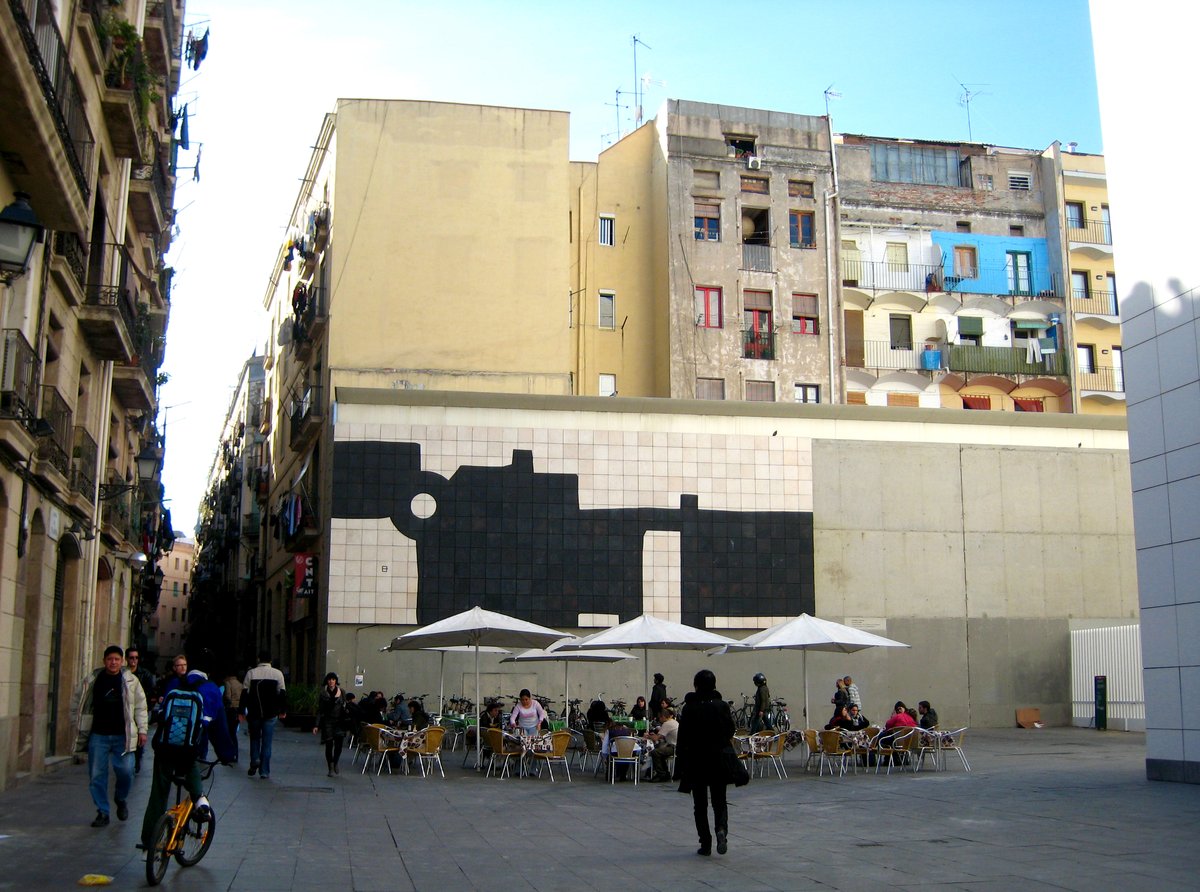

Eduardo Chillida identified a structural disconnect in the architecture of the MACBA. He perceived the concrete barrier between the museum and the Raval neighborhood as a failure of integration. To bridge this divide, he decided to introduce a ceramic mural positioned three metres above the ground.
This project culminated in 1998 in Barcelona as Mural G-333. It marked the debut of large-scale ceramic work for Chillida. He partnered with the German ceramicist Hans Spinner in Grassa to manufacture the components. The production involved refractory concrete plates that underwent two separate firings at 1,300 degrees and 1,120 degrees after the application of copper oxide. These specific conditions produced a deep black hue and a surface quality that occupies the space between a sculpture and an engraving.
Chillida did not approach these materials through the lens of traditional pottery. Instead, he viewed them as a medium for architectural exploration. The mural utilizes dark graphics and black chromatic boundaries to investigate the interplay between volume and void. This work remains a public fixture of his collection for all to observe today.
Sources: Wikipedia, OpenStreetMap, Wikidata, Wikimedia Commons
Written by Nik Frost
Discuss this with the author and others
No comments yet. Be the first to start the conversation.