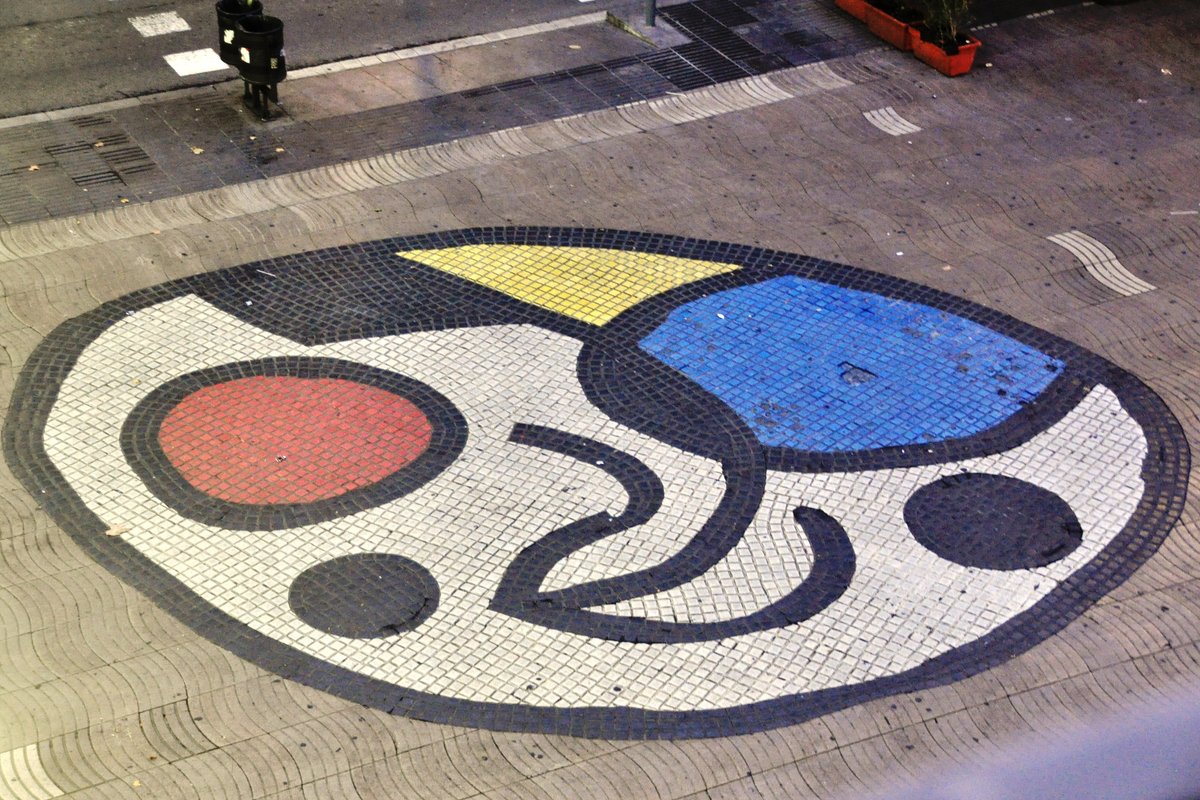

The Joan Miró pavement mosaic is a work of 1976 found at Pla de la Boqueria on the Rambla of Barcelona, a natural path for those traveling between the sea and the city. The work was inaugurated on December 23, 1976, and is included in the Art Públic de Barcelona catalog. While Joan Miró was the creator of the work, the mosaic was executed by Joan Gardy-Artigas with the collaboration of the Escofet workshops, who specialized in terrazzo pieces.
Miró received the commission in 1968 to create a ceramic mural to welcome visitors arriving at the Barcelona Airport. He committed to designing three works for different modes of arrival: land, sea, and air. This pavement mosaic, covering more than 400 square meters, was designed to greet visitors arriving by sea. Miró based the work on a paper sketch currently held at the Fundació Joan Miró de Barcelona. During the installation, Miró observed the public's reaction to the irregular placement of the pieces, which he insisted the workers use to give the work vitality.
The mosaic has seen various interventions, including one in 2007 where the Institut del Paisatge Urbà spent nearly 32,000 euros to recover the Pla de l'Os. During this intervention, the most eroded and degraded colored tiles were replaced with identical ones made of hydraulic pavement with a mix of white cement and crushed colored glass. These tiles were produced by Escofet just as they had done in the late 1970s for Miró. The mosaic also served as the point where a van stopped after carrying out an attempted attack on the Rambla of Barcelona on August 17, 2017.
Sources: Wikipedia, OpenStreetMap, Wikidata, Wikimedia Commons
Written by Nik Frost
Discuss this with the author and others
No comments yet. Be the first to start the conversation.