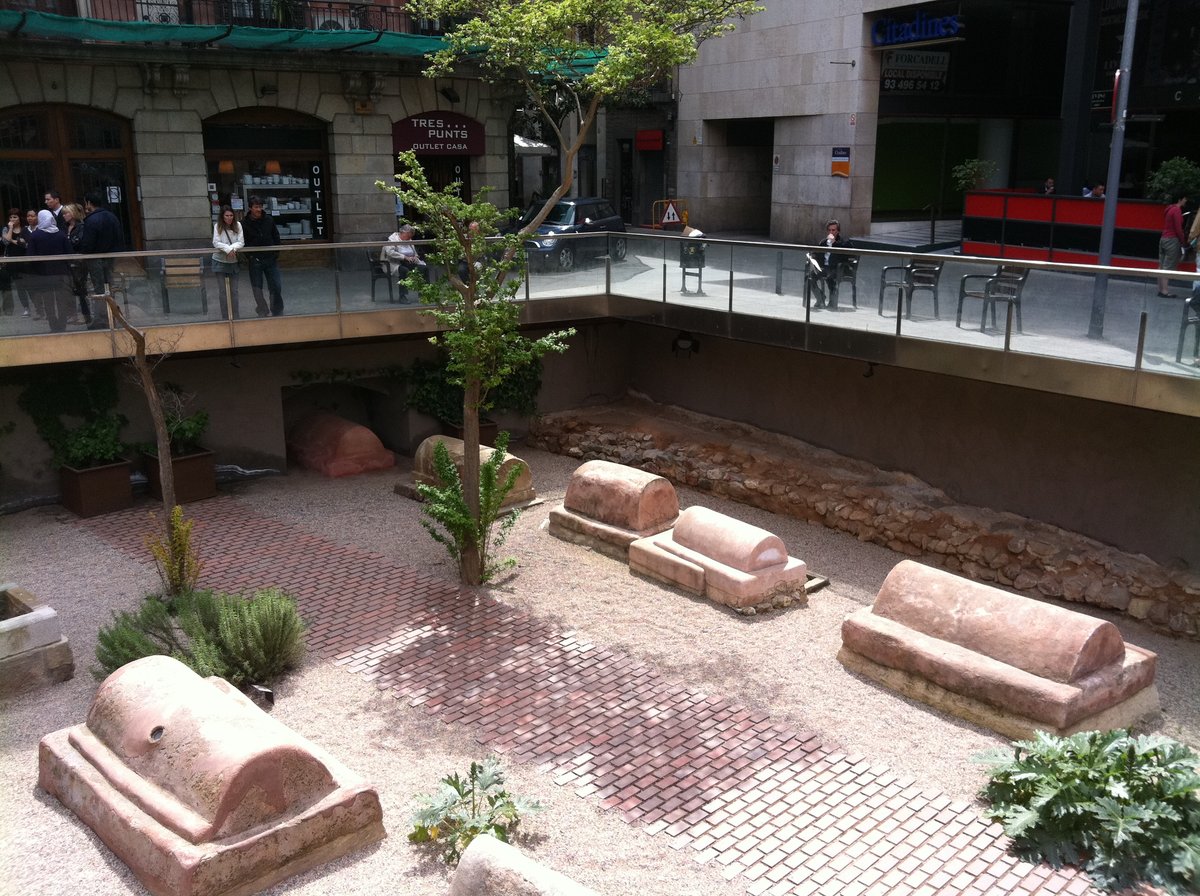

Beneath the vibrant Plaça de Vila de Madrid is a 1st to 3rd century AD Roman cemetery, the Via Sepulcral Romana. This necropolis housed the middle and lower classes, including slaves and freedmen. A five-meter wide road, which left the city through the south-west gate and led to the Corts or Sarrià areas, is one of its notable characteristics. Managed by the Museum of the History of Barcelona, the site was rediscovered in 1956 and further excavations took place between 2000 and 2003.
Three additional monolithic cupae, brought from the excavations of the Roman wall in the 1950s to replace damaged original masonry cupae in their original positions, can be seen in the burial path. The tombs, arranged in rows but not in any regular order, are flanked on the outside by a wall. 85 burials of different types have been identified, which is significant as the vast majority of Roman burials known to us have only reused stone elements from other buildings or isolated tombs.
Sources: Wikipedia, OpenStreetMap, Wikidata, Wikimedia Commons

Written by Nicolo Ciampini
Discuss this with the author and others
No comments yet. Be the first to start the conversation.