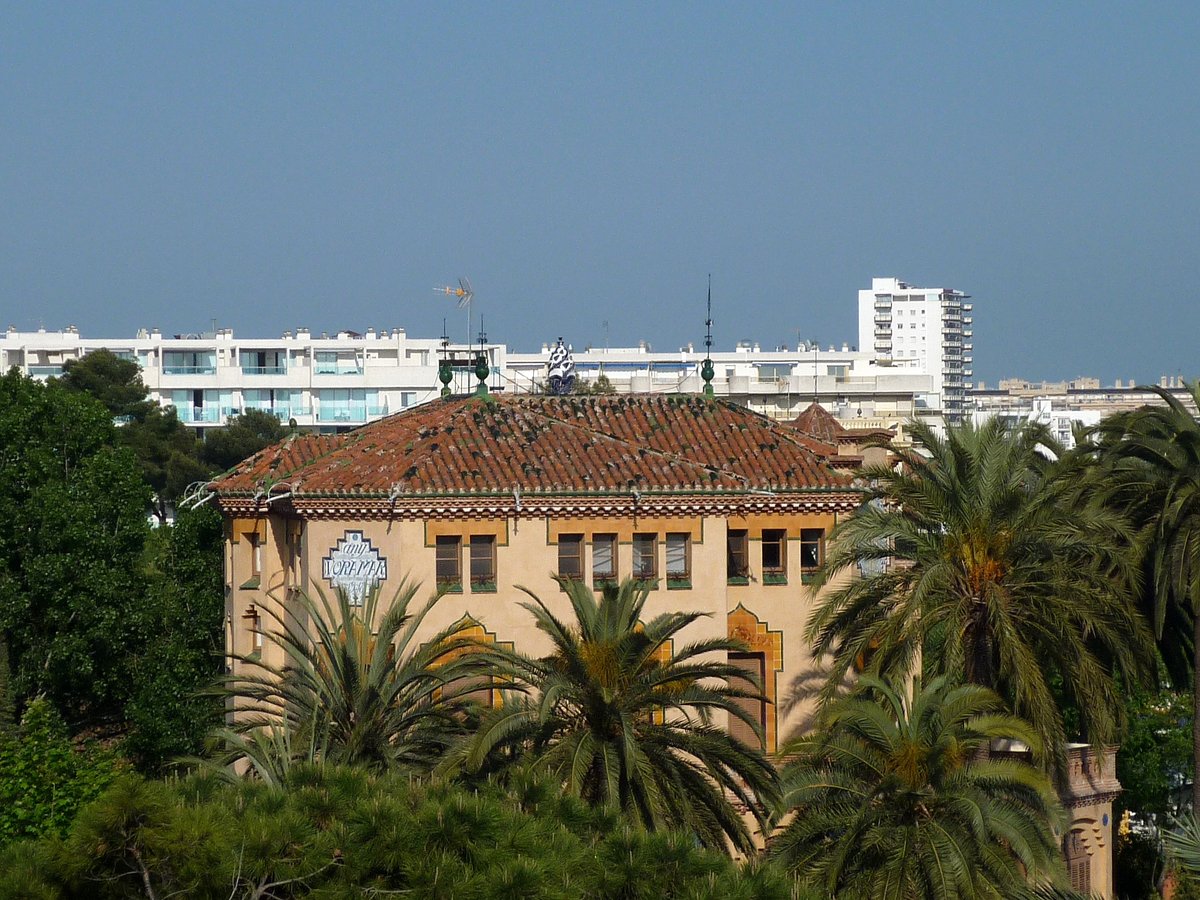

Casa Bonet, located in Salou, a seaside town in Tarragonès, Catalonia, is a remarkable testament to Catalan architecture and local history. Mapped as heritage, the house was constructed in 1918 by architect Domènec Sugranyes i Gras, one of the pioneers of the Catalan Modernista movement. Casa Bonet stands out in the Inventari del Patrimoni Arquitectònic de Catalunya, reflecting its historic and architectural significance.
Originally a farmstead, Casa Bonet was transformed into a palace before the beach, thanks to its owner, the entrepreneur Ciríac Bonet. The entire building and its surroundings are of high quality and great aesthetic appeal. The solutions used for the construction of doors and windows are notable, adorned with colorful handles. The entrance gate to the house is artistic ironwork, very beautiful.
The house has a ground floor, a noble floor, another floor above, and a place for garages. A sundial ceramic clock adorns the principle angle. The interior was embellished with murals by Agustí Ferrer that evoke the departure of Jaume I, from the beach of Salou, to the conquest of Mallorca. The covering of the well’s pool on the property, which had a covering of blue and white mosaic pieces, has disappeared.
Sources: Wikipedia, OpenStreetMap, Wikidata, Wikimedia Commons
Written by Nik Frost
Discuss this with the author and others
No comments yet. Be the first to start the conversation.