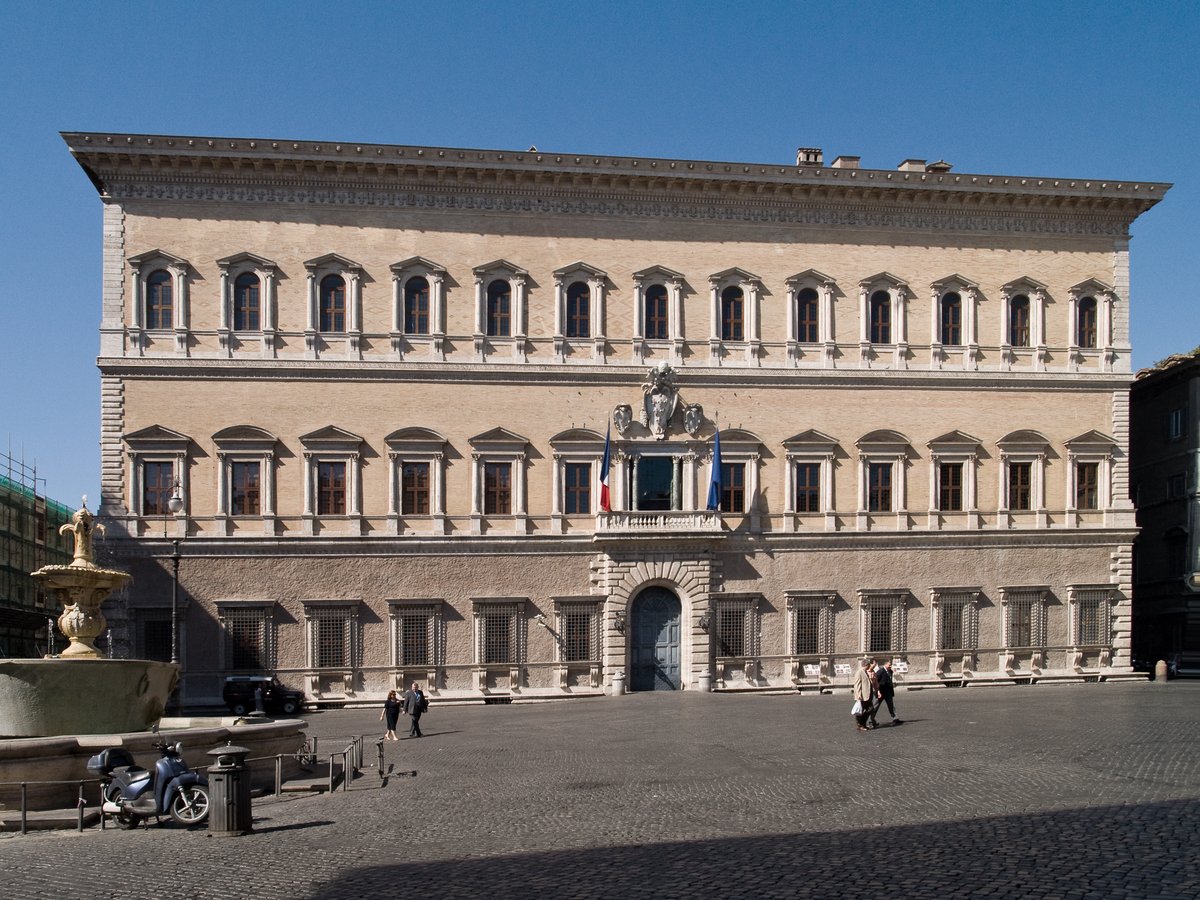

After Odoardo's death, Pope Alexander VII allowed Queen Christina of Sweden to lodge in the palace for several months, but she proved a tenant from hell. After her departure for Paris, the papal authorities discovered that her unruly servants not only had stolen the silver, tapestries, and paintings, but also had smashed up doors for firewood and removed sections of copper roofing.
Pope Paul III expanded this site significantly in 1534. He hired Michelangelo, who completed the redesigned third story with its deep cornice and revised the courtyard as well. You can still spot the signature cornice on the facade, casting deep shadows. When Paul appeared on the balcony, the entire facade became a setting for his person. The courtyard, initially open arcades, is ringed by an academic exercise in ascending orders - Doric, Ionic and Corinthian.
Annibale Carracci spent years on the Farnese Gallery creating The Loves of the Gods between 1597 and 1608. This marked the beginning of two divergent trends in painting during the 17th century - the Roman High Baroque and Classicism. The rooms featuring the Hercules cycle and maps remain, though most sculptures moved to Naples long ago.
Today, the building serves as the French Embassy in Italy. While it is no longer a private residence, it remains one of the most important High Renaissance palaces in Rome, showcasing the immense power of the Farnese family through its massive block and imposing facade.
Sources: Wikipedia, OpenStreetMap, Wikidata, Wikimedia Commons



Written by Nicolo Ciampini
Discuss this with the author and others
No comments yet. Be the first to start the conversation.