


Ponte Sant'Angelo, originally the Aelian (Helios) Bridge or Pons Aelius, is a Roman bridge in Rome, Italy, built in 134 AD by the Roman Emperor Hadrian (Publius Aelius Hadrianus) across the Tiber River, from the city center to his newly constructed mausoleum, now the towering Castel Sant'Angelo. The bridge is faced with travertine and spans the Tiber with five arches, three of which are Roman; it could be approached via a ramp from the river side. Today, the bridge is exclusively pedestrian and offers a picturesque view of Castel Sant'Angelo. It connects the Ponte district (named after the bridge itself) and Borgo, to which the bridge administratively belongs.
Starting from the early Middle Ages, the original name was forgotten: after the destruction of Nero's bridge, pilgrims were forced to use this bridge to reach St. Peter's Basilica, so it was also known as the "Bridge of Saint Peter" (pons Sancti Petri).
Legend has it that in 590 AD, the newly elected Pope Gregory the Great, leading a penitential procession he himself convened to avert an epidemic, had a vision while crossing the Aelian Bridge: he saw the Archangel Michael sheathing his sword atop Hadrian's Mausoleum before disappearing, which he took as a divine sign that the plague epidemic was defeated. Since then, the bridge has borne the name Sant'Angelo after the castle, whose entrance it symbolically represents. Dante writes in his "Divine Comedy" that during the Jubilee of 1300, due to the large number of pilgrims coming to and from Saint Peter's, two separate lanes were arranged on the bridge. During the Jubilee of 1450, because of the large number of pilgrims, the bridge's balustrades collapsed, and nearly 200 people drowned in the river.
In response, some houses at the beginning of the bridge, as well as the Roman triumphal arch, were demolished to widen the path for pilgrims.
Dante writes in his "Divine Comedy" that during the Jubilee of 1300, due to the large number of pilgrims coming to and from Saint Peter's, two separate lanes were arranged on the bridge. During the Jubilee of 1450, because of the large number of pilgrims, the bridge's balustrades collapsed, and many drowned in the river. In response, some houses at the beginning of the bridge, as well as the Roman triumphal arch, were demolished to widen the path for pilgrims. In 1535, Pope Clement VII allocated the income from the toll on the bridge for the erection of statues of the apostles Saint Peter (holding a book, with an inscription on the pedestal Rione XIV) by Lorenzetto and Saint Paul (holding a broken sword and a book, with an inscription on the pedestal Borgo) by Paolo Romano, to which were later added four evangelists and patriarchs, as well as other statues representing Adam, Noah, Abraham, and Moses.
For many, many years, the Bridge of Saint Angel was both a place of execution of death sentences and a place for displaying the bodies of those executed as a warning to the population. It is said that in 1500, during the first exhibition, nine people were hanged at each entrance to the bridge, a total of eighteen bodies.
In 1533, Pope Clement VII ordered the demolition of two small chapels and their replacement with two famous statues: these are the statues of Saint Peter by Lorenzetto and Saint Paul by Paolo Taccone.
After the incident, it was decided to demolish several houses at the beginning of the bridge to facilitate the movement of pilgrims and prevent further accidents. In memory of the victims, Nicholas V built two chapels on the bridge dedicated to Saint Mary Magdalene and the Holy Innocents. For many, many years, the Bridge of Saint Angel was both a place of execution of death sentences and a place for displaying the bodies of those executed as a warning to the population. It is said that in 1500, during the first exhibition, nine people were hanged at each entrance to the bridge, a total of eighteen bodies.
In 1533, Pope Clement VII ordered the demolition of two small chapels and their replacement with two famous statues: these are the statues of Saint Peter by Lorenzetto and Saint Paul by Paolo Taccone.
Just three years later, on the occasion of the visit of Charles V of Spain, Paul III commissioned Raphael da Montelupo to create eight stucco statues depicting the four evangelists and the patriarchs Adam, Noah, Abraham, and Moses, which, however, were soon destroyed.
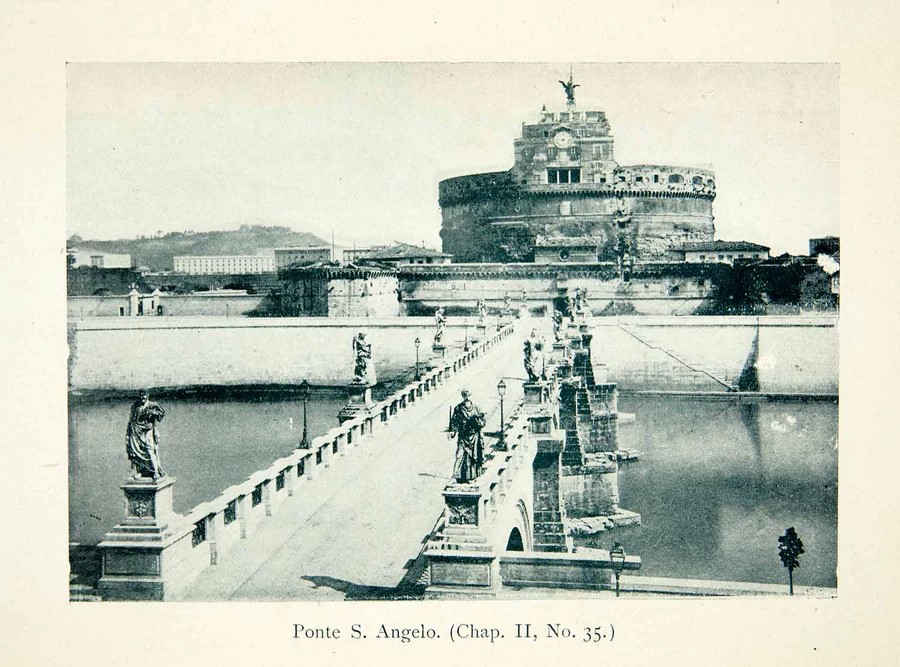
For centuries after the 16th century, the bridge was used to display the bodies of those executed in the nearby Piazza di Ponte, on the left side of the bridge. The new parapet, on the other hand, was commissioned in 1669 by Gian Lorenzo Bernini by order of Pope Clement IX. In addition to the overall reconstruction project of the bridge, Bernini was tasked with designing ten new statues of angels holding the instruments of the Passion of Christ, which were to be placed alongside the statues of Peter and Paul. Bernini personally, with the help of his son Paolo, completed only two original Angels: the Angel with the inscription "INRI" and the Angel with the Crown of Thorns, but they were kept by Clement IX for his own pleasure. They are now located in the church of Sant'Andrea delle Fratte, also in Rome.
On the parapets of the Castel Sant'Angelo bridge, one can still admire two imposing sculptures of Saints Peter and Paul, created by Paolo Taccone and Lorenzetto, as well as ten marvelous statues of angels, designed by Bernini and made by his pupils. The Guardians of the Bridge of Angels, the two saints, are depicted with their most famous symbols: Saint Peter holds the Keys to Heaven, commonly known as the Keys of Paradise, an ancient Christian symbol of the Universal Church; while Saint Paul holds a sword, a clear reference to the Epistle to the Ephesians, in which the saint himself uses it as a symbol of the fight against evil. Both statues also serve as a reminder to all who are about to cross the bridge: at their bases are engraved Latin inscriptions: "Hinc humilibus venia" and "Hinc retributio superbis," which can be translated as "From here forgiveness to the humble" and "From here retribution to the proud."

The first angel, by Antonio Raggi, carries the column to which Christ was bound for scourging. The inscription engraved at the base, taken from the Book of Sirach, reads "Tronus meus in columna," or "My throne is in the column." The second angel, by Lazzaro Morelli, holds the whip with which Jesus was scourged. The inscription reads: "In flagella paratus sum," or "I am ready for scourging." The third angel, by Paolo Naldini, completed by Bernini himself, depicts the crown of thorns placed on Christ's head at the end of the scourging. The inscription at the base reads: "In aerumna mea dum configitur spina," or "In my sorrow, a thorn was fixed." The fourth angel, by Cosimo Fancelli, holds the Veil of Veronica, with which she wiped the sweat and blood from Christ's face. The inscription reads "Respice faciem Christi tui," or "Look upon the face of your Christ." The fifth angel, also by Paolo Naldini, holds the tunic of Jesus, which the soldiers who pursued him cast lots for. The inscription at the base, taken from the Gospel of Matthew, reads: "Super vestem meam miserunt sortem," or "They cast lots for my garment."
The sixth angel, by Girolamo Lucenti, holds the nails with which Christ was crucified. The engraving at the base, taken from the Book of Zechariah, reads: "Aspiciant ad me quem confixerunt," or "They look upon me whom they have pierced." The seventh angel, by Ercole Ferrata, carries the cross that Jesus was forced to carry through the city of Jerusalem and on which he was ultimately crucified. The engraving at the base, quoting the Book of Isaiah, reads "Cuius principatus super humerum eius," meaning "His dominion is upon his shoulder." The eighth angel, a copy by Giulio Cartari from the original made by Bernini himself, shows the inscription INRI (Iesus Nazarenus Rex Iudaeorum, Jesus of Nazareth, King of the Jews), which was placed at the top of the cross. The engraving at the base, taken from the text of the hymn Vexilla Regis, reads "Regnavit a ligno deus," or "God reigned from the wood." The ninth angel, by Antonio Giorgetti, depicts the sponge soaked with vinegar on a stick, which, according to the Gospels of Matthew and Mark, was offered to Christ to drink before his death. The engraving at the base, quoting Psalm 68, reads: "Potaverunt me aceto," or "They gave me vinegar to drink." The tenth and final angel, by Domenico Guidi, holds the flint with which Roman soldiers pierced the side of Jesus. The engraving at the base, taken from the Song of Songs, reads "Vulnerasti cor meum," or "You have wounded my heart."
At the end of the 19th century, due to the construction works on the Lungotevere, two Roman ramps connecting the bridge to the two banks were demolished, and in their place, two arches resembling Roman ones were built. For the Great Jubilee of 2000, the Lungotevere on the right bank between the bridge and the castle became a pedestrian zone.
On October 21, 2019, Austrian activist Alexander Tschugguel threw five Pachamama statues, which he had stolen from the exhibition in Santa Maria in Traspontina as part of the Amazon Synod, off the bridge into the Tiber.
Sources:
https://en.wikipedia.org/wiki/Ponte_Sant%27Angelo


Written by Jermaine
Discuss this with the author and others
No comments yet. Be the first to start the conversation.