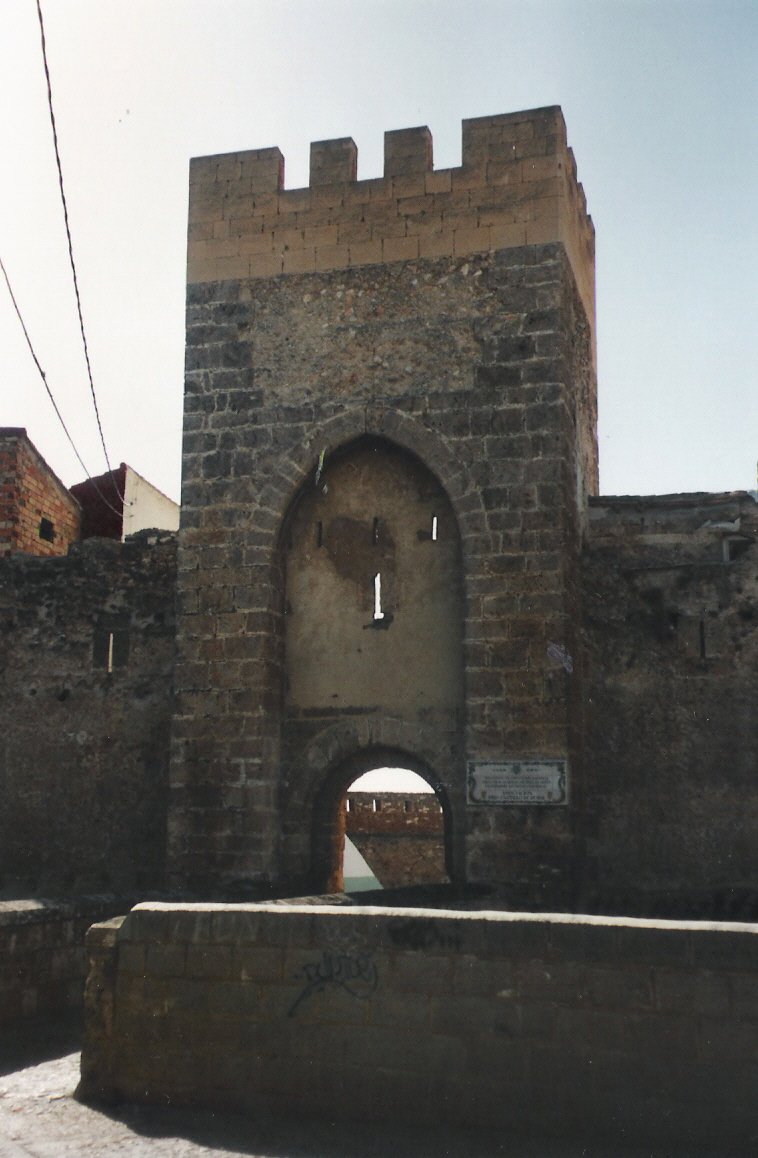

The Castillo de Buñol, located near the center of Buñol on two rocky mounds that formerly housed an Islamic settlement, was built during the 11th and 12th centuries. It initially served as a military space, with walls made with a mortar mix of lime and limestone rock. The castle's northern fortress had an irregular pentagonal plan with a central square for the military. The current open space within the castle's perimeter is occupied by houses attached to it, leaving a central space that once housed buildings serving the military garrison (kitchen, dormitories, sentry, stables.).
The southern fort was constructed with walls of ashlar mortar and housed the residential structures of the castle. The Tower Mayor, located in the center of the castle, is built with ashlar except for its north face, which is a mix of mortar and ashlar. It serves as entry to the southern or residential enclosure. The southern enclosure can be divided into two zones: the higher zone, where the Tower Mayor, the Gothic Palace, and the Renaissance Palace are located, and the lower zone, currently occupied by housing.
The Gothic Palace, known as the Oscurico, has a rectangular plant and five diaphragmatic arches. The church of El Salvador, with a single nave, is covered with a barrel vault, with brick archways, with lunettes between them. It was founded in the 14th century and underwent Baroque-style reform in the 17th century, although its civil occupation at the end of the 19th century almost completely destroyed its decorative program. The Renaissance Palace or Palace of the Merchants, built in the 16th century as an expansion of the residential complex of the Gothic Palace to which it was connected by a small bridge at the level of the noble floors of the two palaces, currently houses the tourist office and a small archaeological museum.
Castillo de Buñol was conquered from the Arabs in 1238 by King D. Jaime I. It was then donated to the Order of San Juan de Jerusalén in 1241 by Don Rodrigo de Lizana. The castle passed through multiple hands before being purchased by the Mercader family in the 15th century. The castle was used as a barracks during the Carlist Wars and was occupied by the less fortunate civilian population of the area in the late 19th century.
Sources: Wikipedia, OpenStreetMap, Wikidata, Wikimedia Commons
Written by Nik Frost
Discuss this with the author and others
No comments yet. Be the first to start the conversation.