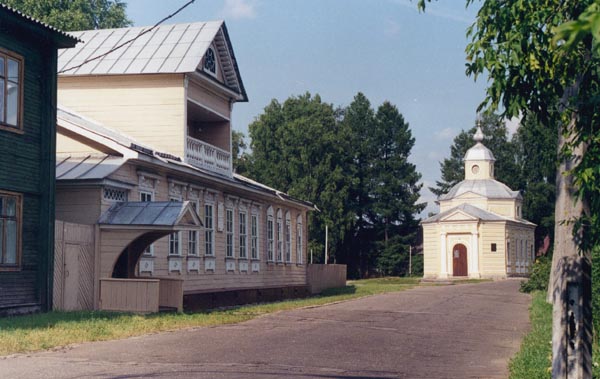
Place of birth of Nikolai Andreyevich Rimsky-Korsakov
12 Rimsky-Korsakov St., Tikhvin, Leningrad Region, Russia, 187552
Great Composers: Nikolai Andreyevich Rimsky-Korsakov Jermaine
 For Browsing
Born on March 6 (18), 1844, in Tikhvin, Novgorod Province, into the noble family of the Rimsky-Korsakovs, known for their traditions of naval service. The family home was located on the bank of the Tikhvinka River, opposite the Bogorodichny Assumption Monastery. The composer’s father, Andrey Petrovich Rimsky-Korsakov (1778–1862), served for some time as the vice-governor of Novgorod and later as the civil governor of Volyn; his mother, Sofya Vasilievna (1802–1888), was the daughter of a serf peasant and a wealthy landowner Vasily Fyodorovich Skaryatin (brother of Ya. F. Skaryatin). In his memories of his mother, the composer noted: “By the standards of the time, she received a good education. She was fluent in French, could play the piano, and in her youth mastered everything expected of a young lady in a wealthy family of the Alexandrian era.†A strong influence on the future composer was his elder brother, Voin Andreevich, a naval officer and future rear admiral. At six years old, Rimsky-Korsakov began home schooling, including piano lessons, but compared to books, music made less impression on him: among music, he preferred church music and Russian folk songs. At 11, he began composing his first musical works. In 1856, his father sent the travel-dreaming Nikolai to the Naval Cadet Corps. In 1858, the future composer developed a genuine passion for music. “I was a 16-year-old boy, passionately loving music and playing it,†he recalled later. Feeling the need for more serious musical education, from autumn 1859 Nikolai began taking lessons from pianist F. A. Kanille. In 1862, his father died, and the Rimsky-Korsakov family moved to Saint Petersburg. That same year, thanks to Fyodor Kanille, Nikolai met composer Mily Balakirev and became a member of his circle, which had a decisive impact on the formation of his personality and aesthetic views. At that time, Balakirev’s circle, later called “The Mighty Handful,†included besides its leader Balakirev and Rimsky-Korsakov himself, C. A. Cui and M. P. Mussorgsky. Balakirev guided the work of his younger colleagues, not only suggesting correct compositional solutions for their works but also helping with orchestration. Under the influence and guidance of Mily Alekseyevich, Rimsky-Korsakov began his first major work — the First Symphony. According to the composer himself, sketches of the symphony’s beginning existed during his studies with Kanille, but serious work on the composition unfolded only in 1861–1862 — and “by May 1862, the first movement, scherzo, and finale of the symphony were composed and somewhat orchestrated by me.†That same spring, Nikolai graduated with honors from the Naval Corps and was accepted as a midshipman for naval service. From 1862 to 1865, he served on the clipper Almaz, which took part in an expedition to the coasts of North America, allowing him to visit several countries — England, Norway, Poland, France, Italy, Spain, the USA, Brazil. Service on the clipper left no time for music, so the only composition from this period was the second movement of the First Symphony, Andante, written at the end of 1862, after which Rimsky-Korsakov temporarily set aside composing. The impressions of naval life later found expression in the “sea landscapes†that the composer managed to capture in his works through orchestral colors. Upon returning from the journey, Rimsky-Korsakov rejoined the society of Balakirev’s circle members. A milestone work for the composer was the musical picture “Sadko†(1867, later its music was partially used in the opera of the same name), the earliest of Rimsky-Korsakov’s programmatic compositions. In “Sadko,†Rimsky-Korsakov, later called a “storyteller,†first encountered the world of fairy tales; here he first used the symmetrical scale he invented, the so-called “Rimsky-Korsakov scale,†which he continued to apply to characterize the fantastic world in his musical works. Also, for the first time, the composer attempted to depict the sea element through orchestral colors (later he did this repeatedly in such works as the suite “Scheherazade,†the prelude-cantata “From Homer,†and the operas “Sadko†and “The Tale of Tsar Saltanâ€). Turning to the operatic genre, which later became dominant in his work, in 1872 the composer completed the opera based on Lev Mei’s drama “The Maid of Pskov.†In the summer of the same year, on June 30, he married pianist Nadezhda Purgold; one of the sponsors at their wedding was Modest Petrovich Mussorgsky. The 1870s saw the expansion of Rimsky-Korsakov’s musical activities: in 1871 he became a professor at the Saint Petersburg Conservatory, where he taught practical composition, instrumentation, and orchestration; from 1873 to 1884 he was inspector of the “musicians’ choirs of the Naval Department†(with a rank change from naval lieutenants to collegiate assessors); from 1874 to 1881 he was director of the Free Music School. Starting in 1874, the composer took up conducting — first symphonic concerts, then opera performances. From 1882, Rimsky-Korsakov headed the Belyayev circle; from 1883 to 1894 he was also assistant manager of the Court Singing Chapel with the rank of state councilor. From 1886 to 1900, he was the permanent conductor of the “Russian Symphony Concerts.†For example, on October 31 (November 12), 1887, the “Spanish Capriccio†was performed for the first time under Rimsky-Korsakov’s baton, and in 1888, in the Petersburg Hall of the Nobility Assembly, the composer conducted the performance of the “Sunday Overture,†which he dedicated to the memory of Borodin and Mussorgsky. In 1906, he was elected a member of the Royal Swedish Academy of Music. In the early 1890s, there was a certain decline in the composer’s creative activity: during this period he studied philosophy, wrote articles, and revised and edited some of his earlier works. Then his creativity gained exceptional intensity: one after another, operas appeared from his pen — “Christmas Eve†(1895), “Sadko†(1896), “Mozart and Salieri†(1897), the prologue to the opera “The Maid of Pskov,†and “The Tsar’s Bride†(based on Lev Mei’s drama, 1898). During the revolutionary events of 1905–1907, Rimsky-Korsakov actively supported the demands of striking students and openly condemned the actions of the administration of the Saint Petersburg Conservatory: he resigned and returned to the conservatory only after it was granted partial autonomous rights and leadership changed. In 1907, he was a member of the Committee for organizing “Historical Russian Concerts†in Paris. He died on June 8 (21), 1908, at the age of 64 from a myocardial infarction in Lyubensk, at his country estate, which now houses the composer’s Memorial Museum Complex, combining two reconstructed estates — the house in Lyubensk and the neighboring Vechas estate, where the composer lived until 1907. He is buried in Saint Petersburg at the Novodevichy Cemetery. In the 1930s, his remains were transferred to the Necropolis of Artists of the Alexander Nevsky Lavra.
Jermaine Loading stories…
12 Rimsky-Korsakov St., Tikhvin, Leningrad Region, Russia, 187552
Great Composers: Nikolai Andreyevich Rimsky-Korsakov Jermaine 
Lieutenant Schmidt Embankment, 17, Saint Petersburg, Russia, 199034
Great Composers: Nikolai Andreyevich Rimsky-Korsakov Jermaine 
Nevsky Prospect, 33, St. Petersburg, Russia, 191186
Great Composers: Nikolai Andreyevich Rimsky-Korsakov Jermaine 
Teatralnaya Square, 2, Saint Petersburg, Russia, 190000
Great Composers: Nikolai Andreyevich Rimsky-Korsakov Jermaine 
37HX+F3 Vyborgsky District, Saint Petersburg, Russia
Great Composers: Nikolai Andreyevich Rimsky-Korsakov Jermaine 
PXM4+FC Holiday Home "Luga", Leningrad Region, Russia
Great Composers: Nikolai Andreyevich Rimsky-Korsakov Jermaine 
Bolshaya Konyushennaya St., 11, Saint Petersburg, Russia, 191186
Great Composers: Nikolai Andreyevich Rimsky-Korsakov Jermaine 
Zagorodny Prospekt, 28, Saint Petersburg, Russia, 191002
Great Composers: Nikolai Andreyevich Rimsky-Korsakov Jermaine 
9HRJ+QP Lyubensk, Pskov Oblast, Russia
Great Composers: Nikolai Andreyevich Rimsky-Korsakov Jermaine 
CJ23+84 Lyubensk, Pskov Oblast, Russia
Great Composers: Nikolai Andreyevich Rimsky-Korsakov Jermaine 
pl. Alexander Nevsky, 1zh, Saint Petersburg, Russia, 191167
Great Composers: Nikolai Andreyevich Rimsky-Korsakov Jermaine