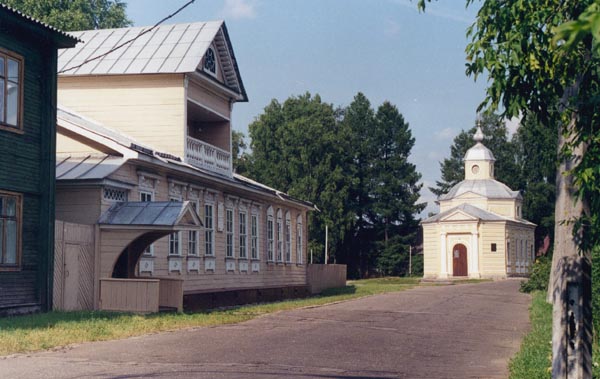

Tikhvin is the birthplace of the great Russian composer Nikolai Andreyevich Rimsky-Korsakov. He was born here, and here he took his first steps in music. Nikolai Andreyevich spent only 12 years in Tikhvin. But these were his early childhood years, when a person, often without realizing it, absorbs everything he sees, hears, and touches, when tastes, views, and character are formed. Much of what he saw and heard in Tikhvin later found reflection in his work — an interest in folk rituals and customs, in folk musical creativity, certain features of historical and fairy-tale works, maritime and starry themes, unparalleled soundscapes — all rooted in his Tikhvin childhood.

The Rimsky-Korsakov surname first appeared in Tikhvin in 1706. The Vice-Governor of the Ingermanland Province, Yakov Nikitich Rimsky-Korsakov, sent his brother Vasily Nikitich to Tikhvin as commandant, who stayed there from 1706 to 1710. The composer’s grandfather, Petr Voinovich Rimsky-Korsakov, was the district leader of Tikhvin nobility from 1798 to 1801, and provincial leader from 1801 to 1804. At the beginning of the 19th century, he built the house where the composer was born in 1844. In the mid-19th century, Tikhvin was a small district town, its unique character shaped by two monasteries: the Great Assumption Monastery for men and the Vvedensky Monastery for women, both founded by the order of Ivan the Terrible in the mid-16th century.
Rimsky-Korsakov entered the history of Russian music as an opera composer. He created 15 operas, 3 symphonies, about 80 romances, and many other works.
In 2003, the 1250th anniversary of Old Ladoga was celebrated. Among Rimsky-Korsakov’s works, we find the cantata "The Song of the Wise Oleg." "Sadko" is about the Novgorod gusli player. "The Pskov Maiden" tells about a Pskov free woman... Practically the entire Northwest is reflected in the composer’s work. Tikhvin motifs can be heard in such works as "The Snow Maiden," "The Pskov Maiden," "The Tsar’s Bride," the overture "Bright Holiday," and others.
In the Rimsky-Korsakov house in Tikhvin (now a memorial museum) the score of "Bright Holiday" is kept. On March 25, 1858, Rimsky-Korsakov, then 14 years old, wrote a letter to his parents from the Naval Corps, congratulating them on Bright Easter: "...Oh, how pleasant and joyful this holiday is, I don’t know why, but I love it more than all others... How did you celebrate it? There was no longer any desire or enthusiasm to dye eggs or celebrate Easter." He often attended monastery services with his parents. This worldview, absorbed in childhood, undoubtedly strongly influenced the composer’s artistic world. He did not like grandiose declarations related to the inner world of the artist — "the listener should be interested in the music, not the life of the composer," he asserted. Therefore, every statement by the composer himself that allows us to peek into his creative laboratory is especially precious to us.
The Rimsky-Korsakov house was located opposite the monastery, where there was a bell tower. Twenty-two bells rang morning and evening... Rimsky-Korsakov constantly heard these chimes in childhood, and later they sounded in his music. The overture combines memories of an ancient prophecy, the Gospel narrative, and the general picture of the Easter service with its "pagan merriment"... In his "Chronicle," Rimsky-Korsakov recalled — "...Isn’t the Russian Orthodox bell ringing a kind of church instrumental dance music? Don’t the shaking heads of priests and deacons in white robes and sticharions, singing at allegro vivo tempo (red Easter), etc., transport the imagination to pagan times..." The composer’s father was religious and highly valued his friendly relations with Berednikov, a Tikhvin resident, academician, archimandrite of the Great Men’s Monastery, and spiritual writer Illarion Kirillov. Berednikov studied monastery archives, examined monastery libraries, and worked on the "spiritual testament of Ivan the Terrible’s fourth wife Anna Koltovskaya."
It is possible that the legends and tales connected with the stay of Tsarina Darya in the Vvedensky Monastery and the mysteries of Tsaritsyno Lake, which young Nika heard in the Tikhvin house, inspired the composer to the plot of "The Tsar’s Bride." Tikhvin is the homeland of the great Russian composer Nikolai Andreyevich Rimsky-Korsakov. He was born here, and here he took his first steps in music. Nikolai Andreyevich spent only 12 years in Tikhvin. But these were his early childhood years, when a person, often without realizing it, absorbs everything he sees, hears, and touches, when tastes, views, and character are formed...
Much of what he saw and heard in Tikhvin later found reflection in his work — an interest in folk rituals and customs, in folk musical creativity, certain features of historical and fairy-tale works, maritime and starry themes, unparalleled soundscapes — all rooted in his Tikhvin childhood. The history of the Vvedensky Monastery is unique. Nika was baptized here; after the death of Catherine I in 1728, the Supreme Privy Council exiled Princess Volkonskaya (daughter of Count Bestuzhev-Ryumin) here; here lived the first wife of Pushkin’s great-grandfather, E. A. Hannibal; the fourth wife of Ivan the Terrible, Anna Koltovskaya, spent 50 years in this monastery (Tikhvin nun Darya — Tsarina Darya). In 1574, the tsar exiled Anna to the Tikhvin Vvedensky Monastery and confiscated lands from her relatives. Church historian Count Tolstoy wrote in the 1888 journal "Soulful Reading": "The memory of the tsarina — nun Darya has been vividly preserved to our time, not only among the sisters of the Vvedensky convent but also among the inhabitants of nearby villages. The tsarina Darya is still remembered in Tikhvin. Pilgrims coming to the monastery call it 'Tsaritsa’s Monastery.' He also reports that four versts from Tikhvin 'the place is still known where they (the former tsarina and her nieces) hid from the Swedes; it still belongs to the Vvedensky Monastery and is remarkable for a small lake called "Tsaritsyno," on its shore a small chapel and traces of the foundation of a small hut and smoldering remains of walls are visible.'"
Little Nika went with his uncle Petr Petrovich to Tsaritsyno Lake for berries and mushrooms. When he studied at the Naval Corps, given an assignment, he wrote an essay in Russian class titled "Sunrise." "...I am writing an essay for Russian language; recently I described Tsaritsyno Lake, covered with wild forest and surrounded by marsh."
Rimsky-Korsakov was the greatest musical landscapist; his immense love of nature and rare ability to observe it manifested even in childhood, in the letters he wrote to his parents at age twelve from the Corps: "Mom, will you soon be closing your garden with fir trees and covering the apple trees with straw?" "I think that in Tikhvin buds are appearing on currants, violets have bloomed, and soon tulips and daffodils will bloom. I don’t know if I will hear the nightingale that sings behind the hospital..."
Berendey symbolizes folk wisdom. He is wise and just; he knows what Beauty means and what it can do. "...I noticed a chill in people’s hearts... Their service to Beauty has disappeared...".
When creating "The Snow Maiden," Rimsky-Korsakov, according to his own words, "listened to the voices of folk creativity and nature and took what was sung and suggested by them as the basis of his work."
Rimsky-Korsakov’s favorite uncle in childhood was Petr Petrovich Rimsky-Korsakov, a lover of Russian songs and church worship. Walks around the outskirts of Tikhvin, trips to Bochevo, Pechnevo to his father’s acquaintances, where he heard folk songs, remained forever in the future composer’s memory. The "History of the Old and New Testament" with the autograph of the composer’s uncle is kept in the Tikhvin house: "Petr Petrovich Rimsky-Korsakov gives this to his nephew Nika when he turned 4 years old." He often sang Russian songs to him: the playful "Sharlatarla from Partarla"; "My head does not bow to sleep"; "How on the grass, on the ant" and others. In his "Chronicle," Rimsky-Korsakov recalls: "...I loved these songs, but I heard them relatively rarely among the people, since we lived in the city, where nevertheless I had the chance to see the annual farewell to Maslenitsa with a procession and effigy."
In the Tikhvin house, the composer’s father read aloud works by Pushkin, Lermontov, and Gogol. Some poems were recorded in the album of Sofia Vasilievna, the composer’s mother.
Every artist who devotes his life to art dreams that his name will not be forgotten by descendants. The people of Tikhvin carefully preserve the memory of their fellow countryman: the house where Rimsky-Korsakov was born is now a State House-Museum. The museum holds and exhibits rare relics: Nika’s childhood belongings, a ribbon with marks of his height, and many others. In 1971, a monument to N. A. Rimsky-Korsakov was unveiled. In 1987, a concert hall was opened in the former Regimental Church, an 18th-century architectural monument, as part of the House-Museum. Every March, Music Days are held in Tikhvin in memory of the great composer, with concerts featuring students from the Saint Petersburg State Conservatory named after N. A. Rimsky-Korsakov. The House-Museum hosts solemn gatherings with the participation of the composer’s descendants. One of the city’s streets and the Tikhvin School of Arts bear Rimsky-Korsakov’s name. Annual music competitions of regional and Russian significance are held, attracting guests not only from Russia but also from various countries.
The Rimsky-Korsakov House-Museum was opened in Tikhvin, the composer’s homeland, on July 23, 1944, by government decree on the centenary of Rimsky-Korsakov’s birth. The composer’s son Vladimir Nikolaevich, grandson Georgy Mikhailovich, and granddaughter Tatyana Vladimirovna participated in the organization and decoration of the museum. The Rimsky-Korsakov house, where the composer was born in 1844, has been preserved to this day. It is a monument of history and culture of the first half of the 19th century. The house’s layout is typical for provincial noble estate buildings of its time: an enfilade of rooms along the main facade. The house is a wooden one-story building with a mezzanine. It was built in 1801 by the composer’s grandfather; the house retains stucco cornices, doors, stoves, and floors. In 1971, a monument to the composer was installed near the Rimsky-Korsakov house. From 1980 to 1984, restoration was carried out and the interior of the memorial rooms was recreated. In 1987, a concert hall was opened in the building of the Regimental Church, and landscaping work was done on the garden and square near the Rimsky-Korsakov monument.
The museum’s main collection contains more than 10,000 exhibits. The most valuable are the personal belongings of the Rimsky-Korsakov family, items of noble life, furniture, pianos, and scores with the composer’s autographs. The house holds family relics: a baptismal shirt, a wool undershirt, children’s kid gloves, a ribbon with marks of Nika Rimsky-Korsakov’s height. In the second parlor is the authentic Rimsky-Korsakov piano by the "Becker" firm, which served the composer for more than 30 years. Tchaikovsky, Mussorgsky, Borodin, Glazunov, Lyadov, Stravinsky, Taneyev, and Scriabin played on this piano. Fyodor Ivanovich Chaliapin sang by this piano.
Sources:


Written by Jermaine
Discuss this with the author and others
No comments yet. Be the first to start the conversation.